Register for LOOP

Get your copy of LOOP by registering for FREE! Go

Find a school/club

Book Flying Lesson

Click Here Go

Buy an aircraft

Click Here Go

Sell an aircraft

Click Here Go
Explore

LOOP Learn to fly


So you want to learn to fly?
by Dave Calderwood
Editor-in-Chief, LOOP

So you want to learn to fly. What do you do? Simple - go flying! Look up a flying school on our
find a flying school page and book a trial lesson. All flying schools offer these. Alternatively you can buy one of our LOOP learn to fly packs, equipped with everything you need to know for your next steps in flying.

The flight will be with a qualified flying instructor who will brief you on what to expect, how the controls work

 and what to do if there is an emergency. He/she will handle the take-off and landing but you will take the controls at some point.

Flying straight and level, turning, climbing and descending are fairly easy if you have reasonably good coordination. The hard parts are landings, procedures and learning the theoretical knowledge.  If you enjoyed the trial lesson and like the school, talk to the instructor or school manager about the full PPL course.

There are a few things to consider when choosing a flying school.  Choosing a school A big school at a busy airfield will probably have more facilities and resources but the downside could be time spent waiting to take off. Busy airfields have more procedures and stricter radiotelephony (R/T) but at least you'll quickly become accustomed to dealing with Air Traffic Control (ATC). 

A smaller, less busy airfield will have simpler R/T procedures and you'll get airborne more quickly. Circuit flying is also less hectic and smaller airfields often have a more sociable atmosphere.   Whatever your choice of flying school, try to select one that not only suits you  but which is conveniently located. You don't want to have to drive an hour each way for a one-hour lesson. There may be opportunities to go flying at short notice when the weather is better than forecast or when another pilot has had to cancel.  

Many schools offer a complete PPL package. These offers are worth looking into but before paying upfront, satisfy yourself that you're happy to fly with the school. It may take six months - sometimes more - to complete a PPL course. If you have any doubts, don't pay a large sum up front. Take a few lessons first.  When you sign up for a PPL course, take along photo ID and a utility bill with your name and address. The police now require flying schools to identify potential pilots. 

PPL syllabus
For a JAR PPL(A) you must complete a minimum of 45 flying hours, of which up to five hours can be completed on an approved flight simulator (known as an FNPT - Flight & Navigation Procedures Trainer). Do not be surprised if you need more than 45 hours - most people do. It's a good idea to budget for around 55 hours.   The course contains a minimum of 25 flying hours dual instruction and ten hours supervised solo flight time. The solo flying includes one cross-country flight of at least 150 nm during which you must make two landings at two different aerodromes away from your home airfield. 

The minimum of 25 hours dual instruction (with the instructor sitting next to you) will take place mostly in the local training area and will be broken down into set exercises: flying straight and level, climbing and descending, circuits including take-offs and landings, stall recovery, recovery from unusual attitudes, steep turns, navigation and so on. There are sticking points, as you might expect. The first major hurdle is to be able to land the aircraft. For all pilots, even the most experienced, landings are a cross between science and art, something to be practised. Rarely are two landings the same.  

First solo
Once you are competent at landing the aircraft, the next big stage is the first solo.  There is no set number of flying hours for this. It will come when your instructor has worked with you through all the elements of flying a complete circuit.   He and the Chief Flying Instructor (CFI) need to be sure you could also cope with an engine failure resulting in a forced landing. They also have to be sure you can perform a go-around if required, and that you can operate the radio.   Bit by bit, your flying instructor will brief you to do more challenging flying, including leaving the circuit on carefully planned cross-country flights. A good instructor will be stretching you but also thoroughly checking your pre-flight planning. 

The books
At the same time, you'll also be working your way through the theoretical knowledge. You'll need the relevant textbooks, available singly or in packages from pilot shops. Make sure the books are current; details do change.  There are seven written exams to study for and pass for the JAR PPL(A): 
1 Aviation Law & Operational Procedures
2 Human Performance & Limitations
3 Navigation & radio Aids
4 Meteorology
5 Aircraft (General) & Principles of Flight
6 Flight Performance & Planning
7 JAR Communications 

Before you can fly solo you must have passed Aviation Law (and have also passed the medical). Most flying schools will run their own 'ground school', with instructors going through the textbooks with you, and there are also Computer-Based Training DVDs available.  All these items will be recorded on your student record, along with hours flown and regular progress reports by your instructor.   The aim of the PPL training course is to pass the Skill Test. This is a very thorough, demanding flight with an examiner.

Before your flying school enters you for the test, you will have completed the full syllabus, both flying and ground school.   There is a checklist of everything required on the day in a very useful document issued by the CAA, Notes for the Guidance of Applicants Taking the PPL Skill Test, available on their website (
click here note 522kb file). 

Pass the
Skill Test and, well done, you're a pilot!  What'll it cost? Prices vary a bit according to area but many schools offer a 45-hour PPL course for between £5000-7000. Usually that includes club membership, landing fees at the base airfield and ground school. 

Some packages include the textbooks and other equipment required but if not, expect to pay another £200-250.   Finally, each of the seven theoretical knowledge exams cost £41 and there is a £157 fee for the Skill Test. The licence itself costs £149 on first issue, and then £59 for renewal after five years. (Prices correct August 2005). 


More material on this site: 
The Skills Test: What you have to do to pass 'The Flying Test'. 
Safety is paramount  Everything that can be done IS done to make flying as safe as possible. 

More info on the web:
CAA  
Database of Approved Medical Examiners  
Skill Test Guidance Notes  (522kb file)  


News calendar
<November 2006>
SunMonTueWedThuFriSat
1234
567891011
12131415161718
19202122232425
2627282930
Partners
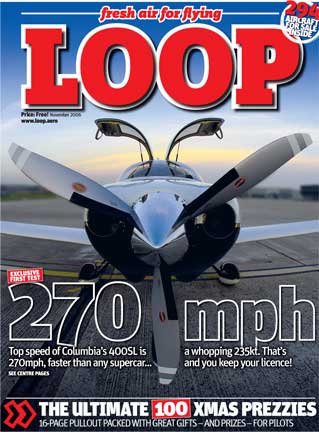
Tested
Columbia 400SL
The exclusive first test of the amazing Columbia 400SL. With a top speed of 270mph, it's fast!
Features
One for the ladies
LOOP visits the female-friendly Stapleford Flying Centre.
Find a school/club

Want to learn how to fly?
Click on the map above to find your nearest flight training school.

News
BUSINESS Aviation is going through the roof! The annual meeting of the US National Business Aviation Association (NBAA), ... more
A SPECIAL version of the Diamond DA40 developed for the US market will be available in Europe next year. Diamond Aircraft ... more
BRIT Paul Bonhomme was unable to repeat his win in the UK round of the 2006 Red Bull Air Race at the penultimate round, ... more
© LOOP Publishing (UK) Ltd 2006