Register for LOOP

Get your copy of LOOP by registering for FREE! Go

Find a school/club

Book Flying Lesson

Click Here Go

Buy an aircraft

Click Here Go

Sell an aircraft

Click Here Go
Explore

LOOP Features

nil

Columbia 400SL

FIRST EUROPEAN FLIGHT TEST
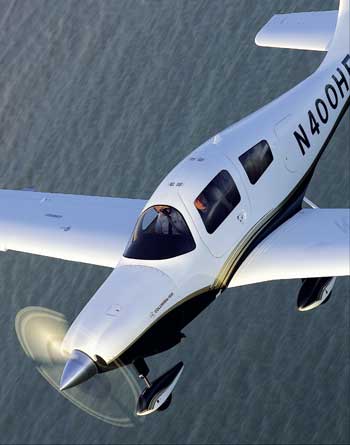
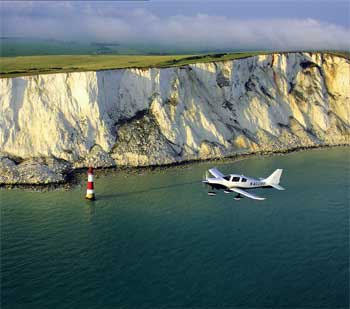
COLUMBIA 400 SL


THE Columbia just looks fast. Standing on the apron outside Air Touring's hangar at Biggin Hill, the latest SL version of the turbocharged 310hp Columbia 400 oozed speed and sex appeal in the same way a Ferrari sportscar or a Ducati motorbike does. So far as I know, designer Lance Neibauer doesn't have a gram of Italian in him, but boy, can he draw like one.

With aeroplanes, of course, just as with any potent machinery, it's not just about the looks but also making it work. These days, for FAA and EASA certification, that's tough. The regs make the factories produce aeroplanes that are predominantly safe, that can cope with pretty much any situation a pilot can throw at them. Of course, the factories want the same thing but without compromising key ideals.

For Columbia, the ideals are speed, comfort and all-weather usability. OK, most weather - the Columbia 400 isn't cleared for flight into known icing conditions but then most of us just don't want to do that.
Let's deal with these three ideals in turn.

First, speed. This is at the heart of Columbia aircraft. The Oregon-based company works tirelessly to reduce drag wherever it can on the airframe. As a measure of thsi, Lance Neibauer discounts a move to retractable undercarriage - they'd be hardly any speed benefit from tucking the wheels away in flight.
Then Columbia shoehorns in a hugely potent Teledyne Continental turbocharged, 6-cylinder, aircooled, 550 cubic inch (which is where the TSIO-550 nomenclature comes from, in cc terms that's 9 litres) engine.

Turbocharging in aeroplanes comes into its own as you climb - the power-reducing effect of thinner air at altitude is overcome by the forced induction. It's the reason Columbia can claim 235kt True Air Speed at 25,000ft, but another benefit is being able to handle hot and high conditions when engine performance would otherwise be marginal.

That wasn't a worry on our test flight. Showers and low cloud plagued the first half of the day but with TAFs indicating the weather was clearing to the south, we took off from Biggin, found our way through the cloud and flew above the weather to a sunny Shoreham.

Second ideal - comfort. In a half-million dollar aeroplane that should be a given and it is. This is a luxurious aeroplane. Large, sumptuous, supportive leather seats, a roomy cabin, door seals deployed after start-up that reduce wind noise to zero and allow no draughts... Adding to the sense of well-being is a digital Automatic Climate Control system - air-con to you and me - that requires no input other than the temperature you want. Once set, the system just does it. No switching off for takeoff or other high power situations.

The final element in Columbia's quest is the Garmin G1000 installation. To call this an instrument panel is an injustice. The G1000 is integral to everything the Columbia stands for. It's almost as though the aeroplane was built and designed just for this glass cockpit system.

The G1000 replaces the Avidyne Entegra system - it's still available but virtually all new customers are opting for the Garmin. Columbia redesigned the whole panel for the G1000 taking the opportunity to integrate it into the aircraft's systems and simplifying the pilot's view. It looks tremendous, less complicated and with everything falling to hand exactly where you want it.

Flying the Columbia to its full potential revolves around the G1000 and especially its built-in autopilot. Of course, you can hand-fly the aircraft as much as you want, but for going places, especially if flying IFR, the pilot makes most inputs via the autopilot. That's why pilots new to the Columbia have a five-day training course - most of that time is getting to know the aircraft's systems and the G1000.
Anyway, onto our flight with LOOP's instrument-rated Captain Nick Heard in the left seat.

FLIGHT TEST - Nick Heard


THE Columbia 400 is a top-of-the-range GA aircraft, with long range, advanced avionics and superb comfort. You can go 1300 miles and cruise at 235kt (not necessarily together), with the autopilot doing the work, operating from runways of 400m or so. In the UK, the 400 is currently only on the FAA register (US), with EASA (Europe) certification planned for early 2007.

The 400 has great looks, with graceful curves all round, three-blade prop, and a 'notched' leading edge. The outer third of each wing has a completely different wing shape for spin resistance.


A range of modern technical features is standard on the 400. It has a dual electrical system with a cross-tie should one system fail (and no vacuum system at all), composite structure, heated leading edges for inadvertent penetration of icing conditions, built-in oxygen, digital engine monitoring, and Garmin G1000 'glass cockpit'. An option is wing-mounted 'pop-up' speed brakes which were fitted to the test aircraft.

The interior is extremely stylish, with leather seats, uncluttered cockpit (with the two glass screens and a set of standby instruments), throttle/rpm/mixture controls, an easily accessible circuit breaker panel by the pilot's left leg, an overhead electrical panel, and 'retro' style wooden side-stick control columns and fuel selector. Large forward opening doors make entry easy, with the front seats folding forward for rear-seat access. There is plenty of headroom even with a headset on.

Pre-start checks are straightforward and the engine starts easily hot or cold. After start, there are a number of checks for the autopilot and electrical cross-tie system. The nosewheel is a free castering type which takes a little getting used to initially while taxying, and pre-takeoff checks involve fairly standard engine checks.

Takeoff itself is quick! Opening the throttle slowly to make it easy to keep straight, the 400 accelerates rapidly. The Columbia rockets down the tarmac to 75kt when the sidestick is smoothly eased back to unstick at 85kt. The 400 is then accelerated to 110kt climb speed, scampering up initially at 1500fpm at max takeoff weight of 3600lb (1633kg). Incidentally (and unusually for a GA aircraft), max landing weight is 3420lb, some 180lb below max takeoff weight. Theoretically, you need to burn off some 30 US gallons before landing after a max weight takeoff.

With electric elevator and aileron trim on the sidestick (but no rudder trim), the 400 is pleasant to fly. On levelling off at 5000ft the aircraft accelerates quickly to 170kt Indicated Air Speed (IAS).

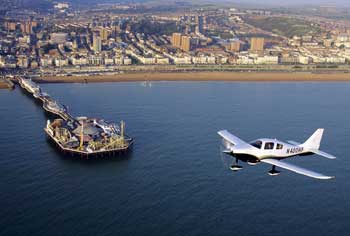
I found the ailerons a little heavy at higher speeds and the rudder very sensitive, but it's all very stable and comfortable. I did get a right wing drop at the stall, but it was easily countered. Steep turns up to 60º angle of bank were easy to fly. In fact, the 400 was really quite manoeuvrable - flying in formation was fine, with crisp response enabling comfortable station keeping with the camera aircraft during our air-to-air photography session.

The Columbia is a cruising aircraft so the digital engine monitoring system enables you to set up precisely the best parameters, using the mixture control to obtain the right exhaust gas temperatures and cylinder head temperatures. Typical book figures for the cruise at 10,000ft (25in Manifold Air Pressure, 2400rpm, giving 61% power) gives 178kt True Air Speed (TAS) with a fuel flow of 16 US gallons per hour (gph), or 17gph at 22,000 ft with 206kt TAS. 

Given the speed the Columbia 400 flies at, and the possibility of shock-cooling the engine, descent requires some planning - and this is where the speed brakes become useful.

Manifold pressure can be eased back very gently over several minutes, but with the speed brakes extended a gentle descent can be initiated while keeping the speed under control. The Columbia 400 is a slippery ship and would accelerate very snappily when going downhill! Like all speed brakes, they are most effective (and noticeable by their buffet) at high speeds, but not so effective that they would cause problems if left out inadvertently on a go-around.


With the super avionics fit, I was hoping to fly a GPS Approach at Shoreham (which is a participating airfield in  the current CAA GPS trials), but being an N-reg aircraft this was not possible.
So we joined the circuit instead, where again the slippery characteristics of the 400 require some thought. It's easy to rattle into the circuit at 170kt under not a great deal of control if you are not careful! However, the speed brakes are a great help again in decelerating.
The first stage of flaps are taken downwind at 110kt, with the final approach being flown at 85kt with full flap.

 
The aircraft is very stable on the approach, with touchdowns easily achieved with a little rearward
movement of the sidestick to flare. The wheel brakes are effective in stopping the 400 quickly.   
    
Having flown a handling flight and an air-to-air photography trip, we set up to return to Biggin Hill from Shoreham. This was where I wanted to fly the 400 how it was designed to - using the avionics to their full potential. We engaged the autopilot shortly after takeoff and carried on climbing to 4000ft towards Seaford VOR. We programmed the rest of the route home via Acorn, including the ILS onto RW 21 at Biggin.

After vectoring from Thames Radar, we were given a closing heading onto the localiser and the autopilot approach mode was armed. The 400 smoothly turned onto the localiser course on ILS intercept, followed shortly by glideslope intercept. The 400 followed the ILS smoothly down to minimums, with the final landing completed manually after disconnecting the autopilot with the sidestick button. Just the way for an instrument-rated business pilot to fly!

The Columbia 400 is a top aircraft, but it's fast, slippery, and full of some advanced avionics, making it potentially quite a handful for a low-hours pilot.

However, Air Touring does have a Columbia 400 customer with only 130 hours, so it's not impossible! It's clearly not going to be in many pilots' price range so I guess we won't see too many around. But if you can find that generous owner who wants to give you a trip in a Columbia 400, then drop everything and go - you really will enjoy it!      

CONCLUSION
SO is the latest Columbia 400 the world's best production single-engine piston aircraft?
It's main rival is the fully-loaded Cirrus SR22 GTS, soon to be available with a turbocharged engine. Other competitors include Mooney's new turbocharged Acclaim, which will replace the Bravo, the iconic Beechcraft Bonanza G36 and possibly Piper's Saratoga TC. The Cirrus and Piper are fitted with the Avidyne Entegra glass cockpit, while Mooney and Becchcraft have opted for the Garmin G1000.

All of these aircraft are desirable. Each has their pros and very few, if any, cons. For most buyers, it'll come down to a choice between the Columbia and the Cirrus. I'll be absolutely honest - we can't put one above the other. Both are superb aeroplanes, with the Columbia having a touch more exclusivity. The TWO best single-engine piston aeroplanes in the world then.

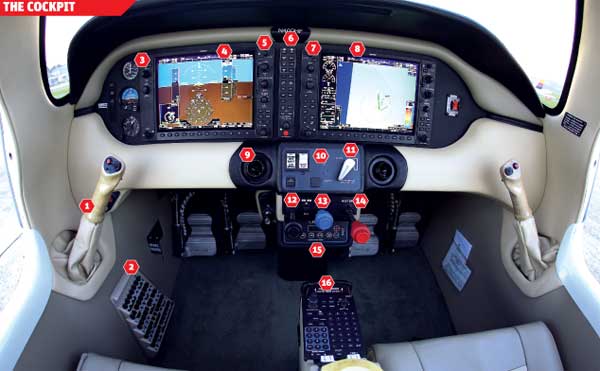
1. Sidestick, with electric trim control and PTT button on top.
2. Bank of circuit breakers.
3. Stack of analogue instruments – Air Speed Indicator, Attitude Indicator and Altimeter.
4. Primary Flight Display of Garmin G1000 glass cockpit.
5. Control buttons and knobs for PFD.
6. Navcomm and function selectors.
7. Control buttons and knobs for Multi-Function Display.
8. Multi-Function Display (MFD) of G1000 – used for navigation, engine instruments and as a ‘spare’ PFD is required.
9. Air vent.
10. ADD.
11. Flap lever.
12. Vernier throttle.
13. Propeller pitch.
14. Mixture.
15. Automatic Climate Control.
16. ‘Ready-Pad’ for entering data into G1000 navcomms.

Comparison chart Columbia V Rivals


Price*
Cruise speedCruise fuel burnRangeUseful load
Columbia 400
$478k
182kt64 lt/hr880nm499kg
Beechcraft Bonanza G36$700k
163kt59lt/hr775nm505kg
Cirrus SR22 GT$449K
176kt56lt/hr805nm522kg
Diamond DA40-TDI€406k
138kt33lt/hr852nm525kg
Mooney Acclaim**$495k
150kt55lt/hr1050nm460kg
*Base price **Estimates

COLUMBIA 400 SL
PERFORMANCE
Vne 230kt
Cruise speed & 65% 182kt
Stall speed (full flap) 59kt
Rate of climb 1500ft/min
Takeoff roll (to 50ft) 579mt
Landing roll (fr 50ft) 792mt
Fuel burn 64lt/hr
Range 880nm

SPECIFICATIONS
Power 6-cyl, 9-litres, turbocharged Teledyne Continental, producing 310hp @ 2700rpm
Prop 1.98mt diameter Hartzell 3-blade constant-speed
Length 7.75mt
Height 2.74mt
Wingspan 10.92mt
Wing area 13.12sq mt
Seats 4
Mtow 1633kg
Empty weight 1134kg
Useful load 499kg
Fuel capacity 371 litres (usable)

PRICE
400 SL $575,000

MANUFACTURER
Columbia Aircraft Manufacturing Corp
2550 Nelson Road Bend
Oregon 97701
USA
W: www.flycolumbia.com

UK DISTRIBUTOR
Air Touring Group
Buildings 204/205
Biggin Hill Airpoirt
Kent TN16 3BN
T: 01959 579 730
W: www.airtouring.com

News calendar
<January 2008>
SunMonTueWedThuFriSat
12345
6789101112
13141516171819
20212223242526
2728293031
Partners
Aerobatics
Aeros with Alan – Opening your Personal Flight Envelope
Learning aerobatics is a great motivational tool for improving your flying.
Features
Learn to fly
So you want to learn to fly? What do you do? Take a look at our guide to get you airborne.
Find a school/club

Want to learn how to fly?
Click on the map above to find your nearest flight training school.

News
Massive order for Phenom takes Embraer into new leagueEMBRAER announced a mammoth order for up to 150 of its Phenom execut ... more
PIPER is working flat out to get its prototype VLJ in the air for next summer, with innovative new wings and an all-new ma ... more
THE Middle East has become the battleground for... who can fly the biggest banner!Dubai's Aerogulf Helicopter Services ann ... more
All material © LOOP Publishing (UK) Ltd 2005-2007