Register for LOOP

Get your copy of LOOP by registering for FREE! Go

Find a school/club

Book Flying Lesson

Click Here Go

Buy an aircraft

Click Here Go

Sell an aircraft

Click Here Go
Explore


MAY 2008
LOOP
OUT NOW


LOOP Features

Robinson R44
Robinson R44

Schweizer 300CBi v Robinson R44

NEW HORIZONS

Are the days numbered for the R22 as a training helicopter? Schweizer's two-seat 300CBi and Robinson R44 are set to take over at schools worldwide.

ONCE again I take an exciting call from LOOP's editor.
"Dennis, I'd like you to visit to a helicopter training school at Bournemouth.  The school has offered us a Robinson Raven 11 alongside its brand spanking new Schweizer 300CBI."

I crank up the old Jag and head off in the dark for an 08.30 hrs rendezvous with Bournemouth Helicopters and the LOOP special features team. A warm welcome awaited me and soon I was enjoying a coffee with the school's Operations and Marketing manager, Richard Griffin.  What a great friendly team. 

Bournemouth Helicopters is owned and run by Gary Ellson and what an intriguing history that man has.  Working for the Coastguard, he took every opportunity to join the helicopter rescue flights and like the rest of us, acquired an instant love of all things rotary.  He gained his helicopter licence in the 1990s and started a new helicopter business and followed this with an instructor rating.  Gary is also a trustee of the adjacent Bournemouth Aviation Museum, which has a fine collection of aviation memorabilia and a dozen classic aircraft, including a really fine Sea Fury. 

In 2002, a fixed wing school, Solent School of Flying was added to the helicopter facility and now operate two Cherokees and a Robin HR200. Gary tells me more than a few fixed wing pilots have converted to helicopters.
Bournemouth Helicopters offers two main types of aircraft. The primary training machine is the Schweizer 300CBi. Also on offer is the Robinson R44 Raven and a Raven II, the latter having a fuel-injected Lycoming engine.

Regular readers will already know of my fondness for the Schweizer marque in the training role, but I understand Frank Robinson is planning to see the popular R22's training role taken over by the larger Raven – a move I heartily endorse.

I can see many schools around the world making the switch, but here in the UK, thanks to tax, we have a dollar price for Avgas some 400% higher than the USA.

Bearing in mind the Raven's fuel consumption of around 14 to 16 gallons an hour, a UK operator is lumbered with a cost of something approaching £80 an hour for fuel alone.

Gary Ellson tells me his school policy is to offer the Schweizer 300 as a first choice, but where a client is looking at the four-seat capability of the Raven in the longer term, it makes sense to train on the type from the outset.

Helicopter schools will tell you that 50 hours or more are normally required to qualify for the private licence on the R22, whereas the CAA's 45-hour minimum requirement is quite achievable on the larger machine. This puts the Raven's higher PPL cost into perspective.


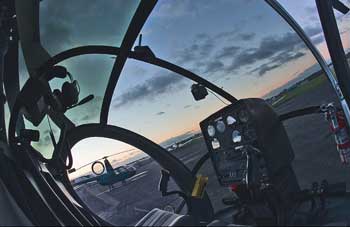
Schweizer 300CBi cockpit
SCHWEIZER 300CBi
Let's start with the Schweizer 300CBi.
Instructor Chris Dent took the PIC (Pilot-In-Command) seat as I wanted to observe from the co-pilot/instructor side.

I climbed aboard the Schweizer with a grin! Even with my 13,700 hours I still find myself smiling as I strap up for another interesting sortie.

But I forgot to mention the weather.  Lowish cloud, 15 knots gusting 20kt with a steady drizzle... not very conducive for our air test. 
But the outlook was for an improvement and as Chris invited me to lift from the school apron to a high hover, the raindrops quickly cleared from the windscreen.

ATC clearance was friendly but firm: "Cross runway 26 after the landing 737."  
I fast air taxied to the HTA north of the active runway and settled into a reasonably stable hover in the 20kt breeze.  Hover power in ground effect (HIGE) was 21hg. This jumped to 24hg HOGE at 60 feet. All as expected. 

I asked Chris to show me a hover engine failure exercise and with the stiff breeze and a mid-fuel state, the Schweizer settled amiably on the soft grass.   We repeated the exercise from a high hover. Mostly as before, albeit with a higher sink rate which required a firm pull on the collective lever to achieve a cushioned touchdown.

"Can we try a tail rotor failure from the hover?" I suggested. "You fly the cyclic and collective and I'll take command of the pedals."

So with Chris' feet planted firmly on the cabin floor, I became the yaw pedal man and to get the exercise going, I squeezed in a good boot of right foot to simulate the rapid right yaw that happens when the tail rotor fails.  Once again, the 300 behaved impeccably as Chris rolled off the throttle to stop the rotation and settle softly on the grass in a simple engine-off landing.

These emergency exercises are one of the reasons I like the Schweizer 300 in the training role. The type's handling is gentle and allows the instructor to demonstrate both engine and tail rotor failures with absolute safety.

My display 'party piece' is of course The Pirouette, which Chris asked me to demonstrate. As we completed three or four rotations which left a few skid marks on the grass, departure clearance was obtained for our local flying. 

Leaving the circuit, we had to level at 1000ft to remain VMC. I asked Chris to set the maximum MAP of 24.5hg and hold her straight and level so I could check the Schweizer’s cruise speed. The placard VNE at 1000ft and plus 15 degrees is 108mph, which promptly appeared on the ASI with barely a tremor from the Main Rotor disc. The Schweizer CBi certainly has plenty of power.

Next we looked at the infamous Vortex Ring exercise. I suppose the high rate of descent that follows the airframe buffet is the nearest the helicopter gets to a fixed wing stall. American pilots call it 'Settling with power.'

The technique here is to set up the famous three conditions: a 500 feet per minute rate of descent, low speed and power applied. Yet again, the delightful Schweizer 300 is so benign. She lets the pilot know of the impending problem with more than enough warning. Plenty of airframe buffet, a random yaw that can prove alarming to a first-timer and a rapidly increasing rate of descent.

However with our limited height we elected to recover at the incipient stage, which the Schweizer does so well. The smallest hint of forward cyclic and all is instantly well again. We followed this with a couple of full-stop engine-off landings in the circuit and I'm happy to report that both Chris and I managed to put the old girl down for a zero speed touchdown on the spot. But the wind was blowing at 15kt!  
The Lycoming 360 cubic inch engine produces more than enough power so even in the gusty wind conditions, the approach to our confined area became a doddle.

To keep down operating costs, the CBi is sold with a 1750lb maximum gross weight, which at a typical empty weight gives a bare 585lb payload.  A 33 US gallon fuel load of 200lb leaves just 385lb for the crew, hence she is certified as a two-seater. Buyers needing the original three seats and a 900lb payload can still find the 300C model in the used helicopter market, but of course she is a left hand drive model.

To complete our air test sortie, Chris and I decided to investigate the low rpm handling. We allowed the engine speed to drop to 2250rpm from the proper 2750. It says a great deal for the type that even as the main rotor loses lift and was badly over-pitched, yaw pedal control remained sufficient to maintain direction.

Bournemouth Helicopters’ CBi is nicely kitted out with solid door stays, an efficient 'upstack' cabin heater/demister and a full instrument panel to cover the CAA's five-hour instrument requirement for the PPL(H). Avionics consist of a voice-actuated intercom, a Skyforce 111C GPS and a GTX327 TPDR with an A30 encoder.  


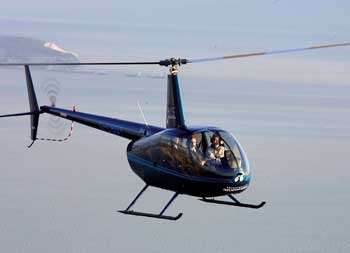
Robinson R44 Raven
ROBINSON R44 RAVEN
NEXT on our schedule was the Robinson 44 Raven, G-CBOT, but as the weather deteriorated, we were not able to run through our intended air test sequence, so some of the following exercises are from a flight I did earlier.

My Robinson 44 type experience is far from extensive, but I have flown the non-hydraulic control model and like most pilots found the collective lever loads to be heavy and in my view not really acceptable. That is a pity on such an otherwise fine machine. My only other criticism was the re-invention of the carburettor and its attendant icing problems.

So how happy I was to see the new Raven 11. Hydraulic controls and fuel-injection! Now Mr Robinson, please provide us with some luggage capacity and you have the perfect ship. 

In terms of numbers manufactured by the Robinson Torrance factory, the R22 and R44 models are the most successful helicopters ever produced – total production is now approaching 7000. So you might say, why change anything?

For the R44 flight John Sibley was my pilot. John was a graduate of the Biggin Hill school and was totally at home in the gusty conditions as once again we hovered on the school apron. We then air-taxied to the HTA for our flight test.

The Raven is a solid feel helicopter but definitely not, as I sometimes hear, a 'stretch' of the R22. She's a totally different animal, albeit sharing the simple design and operating philosophy.

The R44’s ride is particularly smooth and for those of us not used to the Robinson’s 'teetering' cyclic, all I can say is that with a few hours on type, one quickly adapts to the handling technique… even if the old bold pilot in me is shouting for something conventional. 

With a three-passenger crew and three-quarters fuel, I checked the HIGE power requirement at 22hg, which like the Schweizer increased to 24hg in the HOGE, out-of-wind hover. 

Throttle co-relation was exceptional so in spite of my inexperience with the cross-needle presentation for rotor and engine speed, it wasn't necessary to do any throttle twisting. With the light hydraulic-assisted controls and its excellent stability, the Raven feels and handles very much like a Bell Jetranger, which is praise indeed.

I asked John to set maximum power for another high speed run. A manifold pressure of 24.5hg gave an indicated 115 knots cruise, which once again equates to most Jetrangers. We pulled a steep turn with plenty of aft cyclic loading. The big machine responded well although with my limited type experience and in the gusty conditions, I decided I wouldn't investigate the control handling further.

Hydraulics are usually necessary on the larger helicopters but hydraulics can fail, so what was our Raven like in the circuit with the hydraulics off in manual control? Well, she's heavy but certainly no worse than the Bell Jetranger. Like the Bell, for landing it is best to use a 'run-on' technique. So no problems there.
Autorotation on the R22 is at best touchy, even for a well-trained pilot, but the Raven is... well, once again as good as the Bell. The comparisons go on, but that is simply because the R44 is, like the Jetranger, a great helicopter. 

The Jetranger autorotation technique works equally well on the Raven using a gentle and progressive flare, pulling in the collective lever as she sinks in the latter stage of the flare. The usual firm forward cyclic brings the skids level and with the Raven's heavy, high inertia blades, there is ample time to cushion the touchdown with a zero or very little residual run-on speed.

A downside for the type is the UK price of fuel, as I’ve already touched on.  The Raven employs the well-tried fuel-injected Lycoming 540 engine. The standard 245hp can be used for five minutes, but for continuous power this is de-rated to 205hp, which allows sea level performance to be maintained to over 5000ft. The combined main and auxiliary fuel tank capacity is 48 US gallons, but she uses around 16 US gallons per hour for training, 14 US gph in the cruise. As noted earlier, this means a whopping £80 of Avgas for an hour's flying. So it has to be there is a turbine on the stocks at the Torrance factory. Please.
So how do I rate the Raven 11 as a training helicopter? Forgetting for a moment the higher operating cost, she's comfortably ‘fit for purpose’.

So, in summary, Robinson's R44 Raven 11 has no competitor. Four passenger seats, 115kt cruise and superb support from the parent factory. All for a purchase price some 50% of the nearest turbine type. I can't wait for the R66 [rumoured 5/6 seat turbine from Robinson–ed].

SCHWEIZER FACTORY
SCHWEIZER Aircraft was started as long ago as 1930 by three brothers inspired by Charles Lindbergh’s pioneering solo flight across the Atlantic in 1927. At first the brothers Schweizer made gliders – 2160 of them at the last count – then went on to produce crop-sprayers and other specialist aircraft.
Schweizer started working helicopters in 1947 with a contract from Bell to build fuselages for the classic 47. Later, in 1981, they were contracted by Sikorsky to produce UH-60 Black Hawk gunner windows – the production line still exists.

It was 1983 before Schweizer reached an agreement with Hughes Helicopter to manufacture the Hughes 269/300C helicopters. Then, in 1995, a developed version, the Schweizer 300CB, received FAA certification and the modern story starts.
Through all this time, the company was privately owned by the family, right up until Sikorsky bought it in 2004.

ROBINSON FACTORY
ROBINSON Helicopters was founded in 1973 by Frank Robinson, a talented aeronautical engineer who started his working career with Cessna. After years of failing to interest his employers – which included Hughes Helicopters – in the notion of a personal, low-cost two-seat helicopter, Frank decided to go it alone.

The R22 was designed in Frank’s home and built in a tin hangar at nearby Torrance Airport, just south of Los Angeles. Frank flew the R22 on its first test flight in 1975 and after nearly four years of testing and analysis, the FAA issued its Type Certificate in 1979.

The R22 has since gone to become the world’s top-selling helicopter. It was followed in 1992 by the four-seat R44. The Raven 1 model with adjustable pedals and hydraulic assisted controls arrived in 2000, and the fuel-injected Raven 11 two years later.

BOURNEMOUTH FLOWS
IN recent years, Bournemouth Airport has developed into one of the UK's major airline destinations with a steady stream of commercial flights. I counted half a dozen Ryanair movements alongside the bright orange 737s of Easy Jet. Joining them was an almost continuous flow of FRA's fierce looking Falcon 60s in their all-black paint scheme.

Yet the relaxed Air Traffic Controllers moved easily from the commercial jets to the GA movements… something I was pleased to see. At other airfields I won't name, I often find myself brushed off the moment anything commercial appears on the horizon.

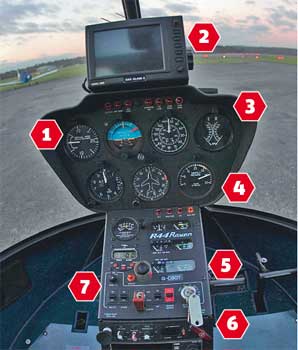
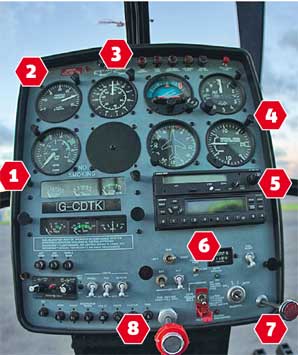
IN THE COCKPIT...


1. Vertical speed indicator
2. Aftermarket GPS unit
3. Robinson's unique Engine/Rotor rpm gauge showing needles to bring together
4. Manifold pressure gauge
5. Engine and fuel gauge
6. Mixture control
7. Light switches


1. Engine/Rotor rpm gauge
2. Manifold pressure
3. Air speed indicator
4. Altimeter and Vertical speed indicator
5. Radio and transponder
6. Various switches including auto rotor clutch engage/disengage
7. Fuel shut-off
8. Mixture control

SPECS

SCHWEIZER 300CBi

PERFORMANCE
Max speed (Vne) 94kt
Cruise speed 80kt
Hover ceiling IGE 7000ft
Hover ceiling OGE 4800ft
Fuel burn 40 litres per hour
Range 208nm
Ceiling na

POWER
Engine 180hp Lycoming HIO-360-G1A

DIMENSIONS
Main rotor diameter 8.18mt
Tail rotor diameter 1.3mt
Overall length 9.4mt
Cabin height 2.18mt
Width (cabin) 1.3mt
Seats 2
Mtow 794kg
Empty weight 494kg
Useful load 300kg
Fuel capacity 132 litres

PRICE
£172,000 + VAT

MANUFACTURER
Schweizer Aircraft Corp
Elmira/Corning Regional Airport
1250 Schweizer Road
Horseheads, NY 14845
USA
W: www.sacusa.com

UK DISTRIBUTORS
Caseright
Turweston Airfield
Brackley, Northants NN13 5YD
T:  01280 841111
W: www.caseright.co.uk

CSE Aircraft Sales
Oxford Airport
Kidlington, Oxon OX5 1RA
T: 01865 844255
W:  www.cseaircraftsales.com
ROBINSON R44 Raven 11

PERFORMANCE
Max speed (Vne) 130kt
Cruise speed 117kt
Hover ceiling IGE 8950ft
Hover ceiling OGE 4500ft
Fuel burn 53 litres per hour
Range 348nm
Ceiling 14,000ft

POWER
Engine 205hp Lycoming IO-540

DIMENSIONS
Main rotor diameter 15.6mt
Tail rotor diameter 2.3mt
Overall length 18.1mt
Height (cabin) 28.3mt
Width (across skids) 2.18mt
Seats 4
Mtow 1134kg
Empty weight 683kg
Useful load 451kg
Fuel capacity 116 litres (main) + 69 litres (aux)

PRICE
Base price in US $364,000

MANUFACTURER
Robinson Helicopter Company
2901 Airport Drive
Torrance, California
90505 USA
W: www.robinsonheli.com
 
UK DISTRIBUTORS
Heli Air
Wellesbourne Airfield
nr Warwick, CV35 9EU
T: 01789 470476
W: www.heliair.co.uk

Sloane Helicopters
Sywell Aerodrome
Northampton NN6 0BN
T: 01604 790595
W: www.sloanehelicopters.co.uk

*********************
WORDS Dennis Kenyon PHOTOGRAPHY David Spurdens

News calendar
<May 2008>
SunMonTueWedThuFriSat
123
45678910
11121314151617
18192021222324
25262728293031
Partners
Aerobatics
Aeros with Alan – Opening your Personal Flight Envelope
Learning aerobatics is a great motivational tool for improving your flying.
Features
Learn to fly
So you want to learn to fly? What do you do? Take a look at our guide to get you airborne.
Find a school/club

Want to learn how to fly?
Click on the map above to find your nearest flight training school.

News
THE fierce competition between Brit Paul Bonhomme and American Mike Mangold came to a head in San Diego at the weekend as ... more
THE Microlight Fair due to be held at Popham Airfield over the Bank Holiday Weekend, 3-5 May, has been cancelled.Organiser ... more
THE Light Aircraft Association (LAA) and British Microlight Aircraft Association (BMAA) are to begin work on merging the t ... more
All material © LOOP Publishing (UK) Ltd 2005-2007