Register for LOOP

Get your copy of LOOP by registering for FREE! Go

Find a school/club

Book Flying Lesson

Click Here Go

Buy an aircraft

Click Here Go

Sell an aircraft

Click Here Go
Explore


MAY 2008
LOOP
OUT NOW


LOOP Features

nil

Edge 540

EXCLUSIVE! What makes the Edge 540 such a winning aeroplane in the Red Bull Air Races? Winner Paul Bonhomme gave LOOP an inside... edge!

EDGE 540... it's the dominant aeroplane in the Red Bull Air Race Series. In the hands of Steve Jones on his first competitive outing in an Edge 540, Jones won the Budapest round of the Series - his previous places this season have been two 7ths, an 8th and a 10th. Paul Bonhomme, Jones's team-mate in the Matadors, took two seconds in a row after taking delivery of his Edge.

Series leader, Kirby Chambliss, is the factory pilot for Edge and has won the US National Unlimited Championship a record five times. He was also the best American at the 2005 World Unlimited Championships with a 7th... in an Edge 540. The Russians, French and Spanish pilots ahead of him flew Sukhoi 26s and CAP 232s.

Finally, but certainly not least, last season's runaway Series winner, Mike Mangold, flies an Edge. Mike tells a good story about his introduction to the aircraft:

"I flew Kirby's one day, it was the first one made, a prototype. I thought Kirby was a pretty good pilot at the time and when I got down and out of the airplane, I said, 'I've lost all respect for you.' He looked puzzled and said, 'why?' I said, 'It's the airplane - it's so fantastic, so easy to fly - now I know why you do so well!'

"I just had to get one after that. It is quite an amazing airplane when it comes to precision aerobatics and also the Red Bull Air Race."

Of course, Mike was only joking about Kirby. Kirby is an astonishing pilot - all the Red Bull racers are. They're flying low at very high speed, pulling maximum G turns, aiming for the air gates which look tiny when you're trying to line up a few hundred yards away.

Even so, it's nothing short of amazing that Jones and Bonhomme were able to shoot to the top of the results after just a few hours in the aircraft.

Paul: "They [the Americans] were surprised how quickly we got the hang of the Edge with my second places and Steve's win in his first go in the Edge. I'm not, it's such a great aeroplane. We're so competitive that it didn't take much to gee us up to learn how to fly it for this race."

CROSSHEAD HERE
So what is so special about the Edge 540? Mostly, it comes down to the wing design and the aircraft's relatively low weight. Add in a lightened, tuned Lycoming 540 cubic inch engine producing around 340bhp - that's the official figure for Kirby's aircraft but these guys have tuners trying to extract every last horsepower - and you have a highly potent package.

(Just for comparison, a Formula One car weighs 600kg including driver and has around 750bhp. The Edge is about the same weight with just under half the power - but doesn't have to fight immense rolling resistance and downforce that increases with speed).

Walk around the Edge and you can see every inch of it has been developed with competition in mind. First, its size - with a wingspan of just over 24-foot wingspan and overall length of  20ft 7in, this is a small aeroplane designed to wrap around a human, an engine and b****r else!

But as you look closely you see that every joint is perfectly aligned and fits to the millimetre, then covered with wing tape for a low drag surface. Poke your nose inside the cockpit and it's a spartan place. The carbon-fibre seat looks fairly comfortable, and has a considerable range of adjustment, but it's a tight fit - Bonhomme's upper arms are bruised after every aerobatic flight from bashing the cockpit sides. The panel has essentials only, with the biggest space in the centre reserved for sticking a diagram of the course or aerobatic sequence to be flown. 

A framework of triangulated narrow diameter 4130 steel tubes is clearly visible inside the fuselage - and also through a clear window under the wings. Top half of the fuselage has carbon-fibre covering, with fabric on the lower aft section. The wing is all-composite with a carbon-fibre spar with immense, simply immense strength and stiffness - tested to 20G. More carbon-fibre is used on the canopy frame, cowl, instrument panel, wheel pants and spinner. Aileron and elevator have push-pull control systems, rudder is cable. All have ball-bearing bearings for ultra smooth response.

As Zivko, the manufacturer, says, the Edge was built as a no-holds-barred competition aerobatics aeroplane. But why has the Edge proved so much faster than the Extra 300 in the RBAR? Surely the Extra is also an out-and-out aerobatic aircraft?

Mike Mangold explains the differences: "There are several things. Number one is the Edge's light weight. The wing is designed for a very high roll rate, plus we're able to generate some awesome G loads and you just can't get that out of the Extra wing.

"It's the combination of the weight and the design of the wing. It's a perfectly symmetrical wing on the Edge 540. Look at the Extra, and some of the others, and they're not perfectly symmetrical. The roll rate is just fantastic and that's a result of having a tapered wing and a tapered aileron. Of course, the light weight - 540 kg compared to 630kg for some of the Extras - produces a fast and manoeuvrable aeroplane."

CROSSHEAD
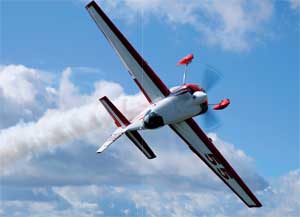
The Edge 540 photographed here is Paul Bonhomme's recently acquired aircraft - bought from Kirby Chambliss who must be wondering now if he did the right thing in selling it to the Brit. Steve Jones's Edge came from Kirby's arch-rival Mike Mangold, who admits it's a quick aircraft.

Both British pilots made the transition to the Edge easily. Paul: "It was pretty straightforward really. In terms of operating it, taking off and landing it, it's very similar to the Extra. However, in the air racing environment it's very different. We joked at the beginning you have to be fit for the whole course now, whereas in other types you just have to be fit for the first couple of corners then they run out of energy.

The Edge will keep its energy and you're pulling lots and lots of G at the end of the course.
"Typically you'll start as fast as you can - if they [the race organisers] say you have to start at 500ft then you'll get up to 210kt, or sometimes, if there's a safety issue, they'll say a maximum of 200kt. Starting from that speed, as you start manoeuvring you'll lose energy. In the Extra, and the Sukhoi certainly, after a couple of turns at low level, you will run out of speed whereas in the Edge you're still going like a train.

"It's very good at everything. The Edge I have has a big tail so it's particularly good at tumbling, it will go end over end seemingly effortlessly. As you pull up to the vertical, you've got what seems like days to sort out your manoeuvre on the up-line whereas other aerobatic aeroplanes run out of energy quite quickly.

"It is incredibly precise. Like all aerobatic aeroplanes, it depends how you've got it set up. The ailerons, for example, can be very, very light but they might not be very good at stopping, ie it's very difficult to find a natural stop position. But mine is set up almost perfectly.. for me anyhow. There's gradual pressure with the onset of aileron, and it's very light, but you just have to think about stopping and it will take you naturally back to neutral and stop exactly in the right place.

"You just have to think something and it'll do it. It's not a question of putting in a control and waiting for something to happen - it will happen. Whatever you do with the control column will actually take place. So long as you have enough speed on, it'll do exactly what you want."

Steve Jones: "To me, the Extra has never been quite as capable as the Sukhoi 26 but I reckon the Edge 540 is right up there. It's incredibly direct. If you snatch the stick back in the Sukhoi it'll give you an instant 9 or 10G, whatever,  and if you snatch the stick back on the Edge it'll do the same. It's like an aerial go-kart. In comparison with the Edge and the Sukhoi, the Extra is a little bit soft."

WHO THE HECK ARE ZIVKO?
The name might not be well-known in Europe but Zivko Aeronautics is a leader in  specialist aerospace engineering in the US these days - a long way from founder Bill Zivko's roots as a hands-on engineer.

He's worked with Jim Bede, who created the BD-5 jet kitplane, then Burt Rutan at Scaled Composites on the Beech Starship. Bill became shop manager at Scaled HQ in the Mojave desert, California and learnt how to use composite materials to best advantage - which he put to good use when setting up his own business at Guthrie Airport, Oklahoma, in 1986.

Zivko became involved in aerobatics when he designed and made a replacement composite wing for the Lazer aerobatic aircraft. The Lazer's existing wing had a one-piece 24-foot long wood main spar which was becoming hard to source, and was marginal in strength anyway. Zivko's new wing was rated at 20G, twice the maximum aerobatic pilots were pulling during manoeuvres, and stiffer and lighter than the original.

He also made some other airframe components for the Lazer and builders decided to call the modified aeroplane the Zivko 360 (it used a four-cylinder Lycoming O-360 engine).

Interview with Eric Zivko
Zivko Aeronautics Inc.

Q| Why did your company develop the Edge 540?
A| We developed the first E-540 back in 1992 - 6-cylinder mono-planes were somewhat rare then, especially US designed and manufactured. We listened to our customers and decided to design and develop the E-540 as a response. Kirby Chambliss was our first E-540 customer as he bought the prototype and flew it until 2000.
 
Q| How did you manage to develop an aircraft so good at a very specialist role?
A|The E-540 was developed first and foremost for competition aerobatics. Over the years, there have been small changes to make manufacturing easier and to lighten the aircraft. Honestly there have been only two major changes in the E-540s since 1992. The first change was a wing manufactured entirely of carbon fibre. This change was implemented primarily to lighten the aircraft empty weight approximately 50lb. The second major change was the development of an all-composite cantilevered empennage.

This change was done partly to make the airplane more modern looking and increase the empennage's control authority. Believe it or not, aerodynamically, the  aircraft has not changed in the past 14 years.

Q| What is the role of Kirby Chambliss?

A| Kirby was really part of the development team, in addition to Leo Loudenslager, during the early days. Because none of our engineers are pilots themselves, they needed input for goals to design to. I truly believe that our engineers not being pilots, helped in the development stage of the E-540. Pilots who are engineers tend to design to what they personally like - this has the potential to hurt a design overall as they might not be so open to criticism in their design. After all, they may truly believe their design flies wonderfully. 

Q| What are the essential differences between the Edge 540 and the Extra 300?

A| The largest difference between the E-540 and Extra is empty weight. One has to keep in mind that previous to the RBAR the airplanes were marketed to different crowds. The Extra is a certified aerobatic aircraft marketed to people who want a comfortable, high-performance aircraft that they can throw around on the weekend. The fit and finish in the cockpit is very nice.

The E-540, on the other hand, is a no-holds-barred, competition aerobatic  aircraft. The fit and finish is very nice but we do not incorporate comfort items. Because of this, the E-540 is approximately 250lb lighter than the  Extra 300. Weight is of absolute importance in both aerobatics and the air racing! It effects every aspect of flight.

Q| How have you achieved such a high thrust to weight ratio?
A| We achieved it though attention to detail. Things were designed to do their job and do it with minimal weight. We picked the lightest IO-540 engine that could be modified to make the required power reliably. The engine is not as widely available as the heavier engine Extra uses, but we decided it was an acceptable inconvenience for the performance gain. The fuselage tubing was  designed with CADD [Computer Assisted Design and Drafting] software and run through an FEA [Finite Element Analysis] to optimize tube sizes and structural fittings so they did not weigh more than they needed to, but yet do their job with safety margins.

Q| Why did you choose an advanced construction composite wing but stick with the traditional steel tube/fabric covered fuselage?
A| We chose a composite wing structure based primarily on weight and stiffness. To get the stiffness we desired at a low weight, the material was a natural. The wing design was  stiffness driven, meaning that we wanted a wing that was very stiff so as not to change airfoil shape under extreme G. Designing to a stiffness, dictates the strength, which just so happens to be very high as well.  Through testing, we determined the wing will break with approximately 27-28 G. To give an example of stiffness; the wing tips deflect 1.2in with a 20G load.

Initially, we looked at doing an all-composite fuselage, but during the early '90s, we found pilots  somewhat reluctant to an all-composite aircraft. Most people were used to being surrounded by traditional steel tubes. This was a decision we made in the beginning and have stuck with it throughout.

Q| Are  all the Edge 540s competing in the Red Bull Series identical?
A| All the aircraft competing in the RBAR are basically the same. The newest aircraft, used by Mike Mangold, does have some additional fairing work done at intersections. All the aircraft have a larger elevator and rudder, compared to stock, except for Paul Bonhomme's aircraft. Paul's aircraft has stock-size elevator and rudder. One of the largest differences between E-540s would be engine  builder. Even though there are three different engine builders  being used in the current E-540s, the engines are all based on the  IO-540.

Q| How many of the Edge 540s do you make a year?
A| In the past, we averaged  approximately 3-3.5 airplanes per year. Each aircraft is on average a 4400-hour  project, start to finish. We will probably not increase production a great lot. If we do, it will be to fulfil our current six orders.

Q| Finally, do you consider the Red Bull Air Races to be the Formula 1 of aviation?
A| My personal opinion of the RBAR is that it is well on its way to becoming the F1 of the air. I see the Red Bull  Air Race World Series becoming a venue for great technological advancement for aviation. For example, as most pilots know, aircraft engines are 40 to 50 year old technology. While being quite reliable for what they are, they  are not the most user-friendly. With the introduction of individual teams and additional money into the RBAR, I think there is huge potential to  develop new engine technologies, which could eventually  transfer over into GA.
 
EDGE 540

PERFORMANCE
Vne 230kt
Cruise speed 180kt
Stall speed 51-61 kt
Rate of climb 3700ft/min
Roll rate 420º/sec
Takeoff roll
Landing roll
Fuel burn
Range
Aerobatic load +10/-10G

POWER
Lycoming IO-540, produces 312bhp standard, tuned 325-350bhp.
Hartzell 3-blade constant-speed prop.

DIMENSIONS
Length 6.27mt
Height 2.84mt
Wingspan 7.42mt
Wing area 9.1 sq mt
Seats 1
Empty weight 522kg
Mtow 816kg
Max aero 703kg
Useful load 294kg
Fuel capacity 231 litres

PRICE
Base price US$231,655

MANUFACTURER
Zivko Aeronautics
502 Airport Rd, Bldg 6
Guthrie OK, 73044
USA
T: 00 1 405 282 1330
W: www.zivko.com

WORDS Dave Calderwood PHOTOS Jamie Hunter

News calendar
<May 2008>
SunMonTueWedThuFriSat
123
45678910
11121314151617
18192021222324
25262728293031
Partners
Aerobatics
Aeros with Alan – Opening your Personal Flight Envelope
Learning aerobatics is a great motivational tool for improving your flying.
Features
Learn to fly
So you want to learn to fly? What do you do? Take a look at our guide to get you airborne.
Find a school/club

Want to learn how to fly?
Click on the map above to find your nearest flight training school.

News
THE fierce competition between Brit Paul Bonhomme and American Mike Mangold came to a head in San Diego at the weekend as ... more
THE Microlight Fair due to be held at Popham Airfield over the Bank Holiday Weekend, 3-5 May, has been cancelled.Organiser ... more
THE Light Aircraft Association (LAA) and British Microlight Aircraft Association (BMAA) are to begin work on merging the t ... more
All material © LOOP Publishing (UK) Ltd 2005-2007