Register for LOOP

Get your copy of LOOP by registering for FREE! Go

Find a school/club

Book Flying Lesson

Click Here Go

Buy an aircraft

Click Here Go

Sell an aircraft

Click Here Go
Explore


MAY 2008
LOOP
OUT NOW


LOOP Features

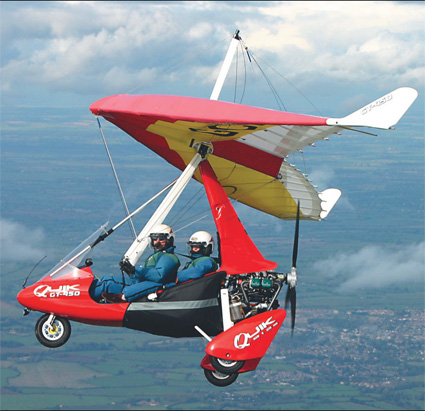
The Quik GT-450 is the first flexwing microlight from P&M Aviation, a new company formed from the merger of Pegasus and Mainair

P&M Aviation Quik GT-450

Geoff Weighell reports on the brand new P&M Aviation Quik GT-450

PEGASUS Aviation and Mainair Sports, the UK’s top two manufacturers of flex-wing microlights, merged a little over a year ago. Now, as P&M Aviation, the new company has produced its first aircraft, the Quik GT-450.

At first glance, the Quik GT-450 may just look like any other flex-wing microlight with a price tag borrowed from a mid-range family car, but to a dedicated fl ex-wing microlight pilot it represents an exciting step ahead in performance, comfort and desirability. Flex-wing microlights come in two parts: the wing and the ‘trike’ unit.

The wing of the GT-450 is entirely new. The most obvious feature is the pair of vertical fins at the wingtips. The purpose of the tips is to provide better yaw stability to the aircraft, particularly important when fl own fast at low weights, and to reduce induced drag.

The reduction in drag effectively increases lift, reduces sink rate and improves the glide performance significantly. The tips are held in place by a couple of pins and are easily removed when de-rigging the aircraft.

The sail is made from Dacron fabric. The leading edge has a series of holes in the outer surface to allow air to be forced in between the layers that make up the leading edge and inflate it in flight.

This inflation has the effect of maintaining the shape of the leading edge against the pressure of air giving a more efficient aerofoil. Flex-wing microlights are controlled in the main by weightshift – the pilot moves the centre of gravity of the aircraft under the wing and the wing reacts by pitching or rolling.

For many years designers have incorporated a type of ‘wing-warping’ to help speed up roll response and roll rate. The system is called billow shift. Billow shift alters the trailing edge shape as a response to moving weight giving an aileron effect to help roll control.

The GT-450 encourages the sail movement using a pair of cables attached to the sail which actually pull the trailing edge down and across on the rising wing increasing the aileron effect and speeding up roll response. It decreases the already swift roll time by up to a second between a roll reversal from 30 degrees either side of centre.

The trike unit of the GT-450 is based on the Pegasus Quik trike with a few changes. Starting at the front, the GT uses the latest nosewheel suspension which gives an improved ride and better rough field capabilities - an important feature when wanting to operate from farm strips.

The windscreen has been redesigned giving a clearer view and more rigid construction. The screen really does stop the airflow hitting the pilot. Owners can choose between the Rotax 912 or 912S as a power unit. Both will give more than adequate performance although for me the more relaxed feel of the 912S made it my choice. There is a choice of analogue or digital instruments available for the engine.

The engine has a top cover new to the Quik range. Although originally fitted for looks, the cover improves the airflow behind the passenger which reduces turbulence and buffeting, and associated noise. There is also a better airflow to the propeller. Most modern flex-wing microlights have some sort of pitch trimming system. The Quik and the Quik GT-450 both use an electrically operated system which simply moves the centre of gravity of the aircraft by pulling the trike unit back or releasing it forward in relation to the wing hang point. The system is very simple and effective. A solo trim range of between 40 and 85mph is achievable and from about 50 to 85 when flown at max weight. The wide trim range is unique among flexwings and certainly makes long distance touring at higher speeds less arduous.

So this aircraft has improvements to both the trike and wing which make it a desirable machine to own and fl y, but there is more. Microlights may weigh up to 450kg at max take off weight. The GT-450 is designed with that upper limit in mind. The GT-450 has a cockpit capacity of 220kg, and a maximum of 110kg (more than 17 stones!) in either seat. The dry weight of the aircraft is 217kg leaving a fuel/baggage allowance of 13kg, around 18 litres or 1.5 hours, at the max seat load. Operated at the European average pilot weight of 86kg per seat, this gives a carrying capacity for a full 65 litres of fuel and 14kg of baggage. Now this is a really useful capacity.

Flying the GT-450 is a pleasure. Handling is good throughout the speed range and climb performance fantastic. Sink rate is low and landings are very straightforward. Touchdown at less than 40mph means short field operation is a doddle. The stall is very mild and recovery simple with little height loss.

I bought my GT-450 to use as the principle training aircraft at Enstone. It will replace the well-tried Quantum, provide an easy aircraft for students to learn on, and also open up the microlight market to people with a ‘larger’ waist size. This aircraft is a real winner and streets ahead of its less well-equipped and lower performance rivals in the 450kg fl ex-wing market. Mine is available for demonstration flights if you want to try for yourself.

Specifications:

Performance:


Specifications:

Power Rotax 912S 4cyl, 4-stroke producing 100hp
Propeller 3-blade Warp Drive, fixed
Length 3.7m
Height 3.7m
Wingspan 9.25m
Wing area 13m2
Seats 2
Empty weight 217kg
Max take-off weight 450kg
Max load 220kg (+ fuel)
Fuel capacity 65 litres


Price: £24,750
Manufacturer
P&M Aviation
Unit B, Crawford Street
Rochdale
Lancs
OL16 5NU
T: 01706 655134
W. www.pmaviation.co.uk

Test Aircraft:
Enstone Microlights
Enstone Airfield
T: 01608 678741
M: 07860 864445
E:
W: www.enstonemicrolights.co.uk


New Quik designed for 450kg weight limit

Vertical wingtips give extra stability


New cover over top of 100hp Rotax engine

Leading edge 'inflates' via holes.


Choice of analogue or digital panel


Vne 110mph
Max level speed 38mph
Stall speed 38mph
Takeoff roll 216m
Landing roll 172m
Rate of Climb 1250ft/min
Ceiling 15,000ft
Fuel con @75mph 13l/hr
Cruise range 375 miles
Ultimate strength +6g, -3g
Manoeuvre loads +4g -0g

News calendar
<May 2008>
SunMonTueWedThuFriSat
123
45678910
11121314151617
18192021222324
25262728293031
Partners
Aerobatics
Aeros with Alan – Opening your Personal Flight Envelope
Learning aerobatics is a great motivational tool for improving your flying.
Features
Learn to fly
So you want to learn to fly? What do you do? Take a look at our guide to get you airborne.
Find a school/club

Want to learn how to fly?
Click on the map above to find your nearest flight training school.

News
THE fierce competition between Brit Paul Bonhomme and American Mike Mangold came to a head in San Diego at the weekend as ... more
THE Microlight Fair due to be held at Popham Airfield over the Bank Holiday Weekend, 3-5 May, has been cancelled.Organiser ... more
THE Light Aircraft Association (LAA) and British Microlight Aircraft Association (BMAA) are to begin work on merging the t ... more
All material © LOOP Publishing (UK) Ltd 2005-2007