Register for LOOP

Get your copy of LOOP by registering for FREE! Go

Find a school/club

Book Flying Lesson

Click Here Go

Buy an aircraft

Click Here Go

Sell an aircraft

Click Here Go
Explore


MAY 2008
LOOP
OUT NOW


LOOP Features

nil

Aeros with Alan -– Going with the flow

IT'S now April and I hope many readers will be looking forward to the forthcoming aerobatic season with relish. This month's essay is about training and making figures flow together.

Previously, I've said, "The second [skill], which is probably rather more elusive, is the ability to put together a series of figures into a sequence that is both safe and aesthetically pleasing." There is nothing instinctive about this, or any other aspect of aviation, for that matter. We have not evolved, physiologically, to fly and all the flying habits we demonstrate are learned, not inbred.
It should come as no surprise to the reader, therefore, that 'flow' is also a skill that can be learned.

STANDARD SEQUENCE
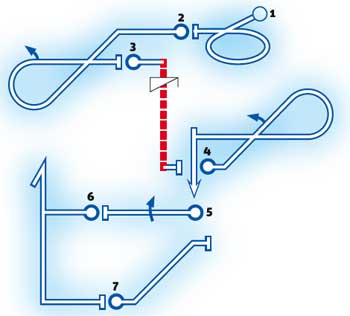
To illustrate my discussion this month I am going to use a sequence of aerobatic figures familiar to members of the British Aerobatic Association (BAeA). It is the Known sequence that will be flown at every Standard level contest in 2007. In the accompanying illustration, I have shown the first seven figures of the sequence. There are actually 10 in total.

Those of you not familiar with the international system of notation for aerobatic figures (the Aresti system, named after a famous Spanish pilot) need not be too concerned by the technicalities. I will explain a little as we go along.

You can fly this sequence for your own enjoyment, regardless of whether you intend to take part in any BAeA events. The whole thing may at first to be a bit daunting. Not to worry, though. Progress can be made gradually - in fact, should be made gradually, not by trying to take one huge step into the dark.
One of the biggest challenges for pilots wanting to fly this sequence is, of course, to learn the whole thing from start to finish. The aim of this article is to help you structure the learning process, so your training flights are successful and cost-effective.

THREE THREES ARE SEVEN
The first key to learning the flow of figures is to fly them in small groups. Three figures is the ideal number. Two presents insufficient complexity; four too much. The second key is always to break the sequence down into overlapping groups, not ones that simply butt up against each other. Hence the title of this sub-section can be explained, three groups of figures can be made from a total of seven, not nine.

When getting to grips with this sequence, therefore, my first practice flight would concentrate on figures 1, 2 and 3. My second would involve flying a mini-sequence of figures 3, 4 and 5. Only after that would I go on to try figures 5, 6 and 7. By making these small triplets overlap, I will reinforce my memory of "what comes next?".

SPEED CONTROL
If you own or operate an aerobatic aircraft you will be familiar with the Flight Manual (POH, whatever) and you will be familiar with the section that deals with recommended entry speed for various aerobatic figures.

Many such details are less than fully comprehensive. For example, they might not list an entry speed for a 45° down line or a 60° steep turn. There should be enough information, however for you to make an intelligent estimate of these.

Some manuals give a single recommended entry speed, for a loop perhaps, while others (better thought-out and more useful) give a range of suitable entry speeds. 'Flow', when performing a sequence, however, does not stem from concentration on entry speeds. Rather it comes from the ability to control accurately your exit speeds.

Your entry speed for Figure 1 in the Standard sequence, which is a 270° steep turn that finishes on a downwind heading, is a matter of concern and must be carefully planned. Equal effort, though, must go in to the execution of the turn so the exit speed is exactly right. Otherwise time will be wasted, and 'flow' lost while adjusting speed before entering Figure 2.

You will need a planned entry speed for all the figures in the sequence, of course. But your concentration when flying training sequences, or triplets as previously described, must be on learning the technique that matches the required exit speed. Speed must be something you are thinking about well before the end of the figure, so you can adjust your technique internally. Waiting until one figure is finished, before thinking about starting the next is no good. If you do this there will be no 'flow'. The sequence will not be aesthetically pleasing either to yourself nor to anyone watching.

FIGURES 1, 2, 3
Figure 1 is a 270° steep turn with a minimum bank angle of 60°. When I finish Figure 1, I am almost immediately going to 'pop' the nose of the aeroplane down onto a descending 45° line and to do this I must not be going very fast.

For a 60° banked turn, I must fly at least 50% higher than my 1g stalling speed. But if I let the speed increase during the turn, either by inadvertently descending or by having too much power, then I will have to slow down after I finish it. Slowing down with a tailwind gobbles up space much more than slowing down into a headwind. In this sequence, I just don't have that much time, especially if the wind is strong.
So in my training flights I will concentrate on throttle and elevator control, keeping the nose high and closing the throttle before completing the turn. Things I would not be doing if the following figure was one that needed more air speed.

Figure 2 combines a 45° down line with a half-roll off the top of a half loop. This puts me back into wind at relatively low speed which is ideal for the spin entry. I must fly the 5/8th loop in such a way that I have enough speed to complete the half-roll accurately. But I must get into the spin by the centre of my performance area, so throttle and speed control at the end of Figure 2 will vary with the wind strength on the day.

On my training flights, I must try different techniques to be able to vary the time between finishing the half-roll and stalling to enter the spin.

After stopping the one-turn upright spin that is Figure 3, my mind must be on the length of time I hold the down line before recovering to level flight. I must come level fast enough to fly Figure 4, a half-reverse Cuban Eight.

In most basic aircraft, Figure 4 will need a higher entry speed than you can reach in level flight. Attaining this speed must be a natural part of my technique for Figure 3. If I am too slow for Figure 4 I will have to dive or take a break and re-position. In either event, 'flow' is completely lost.

FIGURES 3, 4, 5
Having concentrated on Figures 1, 2 and 3 on my first training flight, it might seem that next I should practice Figures 4, 5 and 6. This would be a big mistake. At no time would I have flown the smooth, flowing transition from Figure 3 to Figure 4. I might become lazy and pay insufficient heed to leaving the spin at the right speed.

My second training triplet, then, will be Figures 3, 4 and 5.

I'll start with the centre-box spin entry and make sure I have enough speed to start Figure 4 when I come level after the down line. While making the 5/8th downward looping segment at the end of Figure 4 my mind will already be racing ahead to Figure 6, even though I am not going to fly it in this practice. Why? Because I must carry enough speed through the level roll (Figure 5) to properly enter the stall turn (Figure 6).

I must know whether my aircraft will slow down or speed up during the roll. This will depend on the type I am flying, but I must know which will happen. I must also make sure I don't climb during the roll as this will surely lose speed and compromise the stall turn.

During the flights when I am concentrating on this triplet of figures, I will fly each group four of five times. Between each repetition of the group I will review the speeds and heights I glanced from the instruments during the last attempt. I will take time to consider which numbers were good and which less good. I will plan a slightly different technique for Figure 4, perhaps, to change the speed at which I start the roll.
All the time my main goal is to fly smoothly and propitiously. No undue rush, no undue delays, no reacting late.

FIGURES 5, 6, 7
By now it should be obvious that my next planned flight will be founded on a triplet that starts with Figure 5, the roll. The roll is travelling down wind. Once I have finished it, I will want to get up into the stall turn without delay. I must be careful not to climb during the roll.

The down line from the stall turn does not need to be very long. I want to come level after Figure 6 with no more than the speed I can maintain in level flight. I may have to wait, in a strong wind, before starting the 45° climbing line that is Figure 7. If I have very high speed out of Figure 6 I will slow down while waiting to start Figure 7.

To slow down in level is to lose energy, and this is not usually a good plan for Standard level aeroplanes.

MENTAL CAPACITY
In all of the above, I have avoided any attempt to describe how actually to fly the figures described. There is no need here for images showing stick and rudder inputs. Developing 'flow' is about more than technique.

It is also about developing mental capacity. The ability to fly accurate figures while contemplating the effects of the wind on the aircraft's position. To make the various figures dovetail together in a seamless fashion, without apparent effort.

When practicing triplets, and later larger groups of figures, it is unlikely that fine technical points, such as details of the spin entry or optimum placement of the rudder for the stall turn, will improve. If further practice is needed on such things it must be gained on dedicated 'technique' flights. The purpose of these repetitions is to make your brain encompass more of the problem, to see the bigger picture.

SUMMARY
Start to learn a sequence by breaking it into bite-size portions. There is absolutely no point in trying to eat the whole meal in one gulp.

Always use small groups of figures that overlap, so no holes are left in the memory of the programme.
Stop once you have seen some improvement. Remember, two short flights will be better training than one long one.

STANDARD SEQUENCE IN SEVEN 

1. 270º STEEP TURN
Figure 1 is a 270º steep turn with a minimum bank angle of 60º. Crucial to control exit speed before going on to 45º down line.

2. 45º DOWN LINE & HALF-ROLL OFF THE TOP OF HALF-LOOP
Must fly the 5/8th loop to have enough speed to complete the half-roll accurately. Following spin (3) must be in centre of the performance area so throttle and speed control varies with wind strength.

3. ONE TURN UPRIGHT SPIN
Spin needs to be in the centre of the performance area. After stopping the spin, concentrate on the downline before recovering to level flight at a speed high enough to fly Figure 4.

4. HALF REVERSE CUBAN EIGHT
Entry speed is crucial and attaining it must be a part of Figure 3, otherwise you’ll have to dive or take a break and re-position. Either way, the flow will be  lost. Likewise, speed at the end of the 5/8th loop must be sufficient to carry you through the level roll (Figure 5) to enter the stall turn (Figure 6).

5. LEVEL ROLL
You need to know whether the aircraft will speed up or slow down during the level roll - and don’t climb!

6. STALL TURN
The downline from the stall turn need not be long. Come level with no more speed than you need for level flight.

7. 45º CLIMBING LINE
If you come out of Figure 6 with too much speed, you’ll have to wait to slow down before entering Figure 7. That’s not good in Standard level aeroplanes.

Be safe and enjoy your flying.

News calendar
<May 2008>
SunMonTueWedThuFriSat
123
45678910
11121314151617
18192021222324
25262728293031
Partners
Aerobatics
Aeros with Alan – Opening your Personal Flight Envelope
Learning aerobatics is a great motivational tool for improving your flying.
Features
Learn to fly
So you want to learn to fly? What do you do? Take a look at our guide to get you airborne.
Find a school/club

Want to learn how to fly?
Click on the map above to find your nearest flight training school.

News
THE fierce competition between Brit Paul Bonhomme and American Mike Mangold came to a head in San Diego at the weekend as ... more
THE Microlight Fair due to be held at Popham Airfield over the Bank Holiday Weekend, 3-5 May, has been cancelled.Organiser ... more
THE Light Aircraft Association (LAA) and British Microlight Aircraft Association (BMAA) are to begin work on merging the t ... more
All material © LOOP Publishing (UK) Ltd 2005-2007