
 |
|
|
Register for LOOPGet your copy of LOOP by registering for FREE! | Find a school/club | Book Flying Lesson
| Buy an aircraft
| Sell an aircraft
| |||
LOOP Features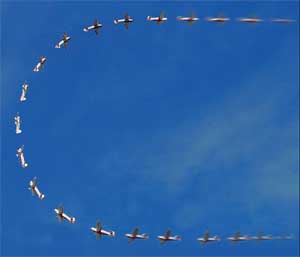 Half & Half - Aero's with AlanNO, it's nothing to do with the stuff you put in your coffee in the USA. It's Half Loop, Half Roll of course, but also Half Roll, Half Loop. So this month's article is in two parts, and even though the figures appear closely related, there are some key differences.HALF LOOP, HALF ROLL Our trans-Atlantic cousins call this an Immelmann Turn, even though it is not a turn and probably has no factual connection with anyone called Immelmann. In this country it has often been called a Roll-off-the-Top, or even a Roll-off-the-Top-of-a-Loop. It seems that aerobatics is riddled with obscure and inaccurate nomenclature. As 'Half Loop, Half Roll' has the same number of syllables as both the first two options, and I can think of nothing as accurate that is shorter, I tend to stick with that. Clearly, the objective is to fly half a climbing positive loop followed, at the apex, by a half aileron roll in order to fly off in the opposite direction from that in which the aeroplane started. The aim is to fly off level. Of course, this assumes that the aeroplane is capable of reaching the top of a loop, suffering the drag associated with the half roll, and still retaining sufficient speed to fly level without stalling. In lower-powered aircraft, this inevitably means a noticeably higher entry speed for the half loop than for a complete loop. Just starting faster, however, is not enough. HALF LOOP The speed remaining at the top of a half loop does not just depend on the speed at the bottom. The diameter of the half loop is also critical. For instance, say a normal loop is started at 100 knots, has a speed of 40kt at the top and gains 500 feet. This would be fine for a full loop, even in an aircraft with a 50kt '1g stalling speed' as the angle of attack over the top of the loop would be close to zero. Floating upside down in a gentle arc at 40 knots would be fine. To do the Half Loop, Half Roll, however, the aeroplane will need perhaps 70kt before the half roll to fly off at 60kt once the half roll is complete. Starting the half loop at 130kt will not guarantee this. It might be that from this higher speed the pilot takes longer to complete the half loop, gains perhaps 700ft, instead of the earlier 500, and still gets to the apex with only 40kt indicated. So it seems the solution will probably lie in starting the half loop faster, but also in keeping the size of the half loop the same as the smaller one. This requirement of more speed but the same diameter leads directly to a need for higher g-loading, for longer, than in a normal complete loop. It's a somewhat harder ride. Some experimentation will be required in any new aircraft to work out the entry speed and looping g-profile that gets the machine to the top with the right speed. My first guess is to start initially perhaps 20 knots faster than normal, to initially pull 0.5g more than normal (for a complete loop) and to keep the loop just that little bit tighter for that little bit longer to avoid simply converting the extra speed into unwanted height. FLOATING I refer to 'floating' as the top part of any looping segment where the load on the aeroplane is close to zero G. Typically, in a normal complete loop, this might be from 40 degrees nose-up to 40 degrees nose-down, symmetrically balanced over the crown of the loop. If I start floating this early in a half loop, however, I will probably gain too much height and lose too much speed. So in this figure I keep more G on for longer and only start floating when the nose-up angle is something like 20 degrees. Already I will have kept more speed on the clock and now, at full power and in this low drag configuration the aircraft will have the opportunity to accelerate just a bit more before I have to start the half roll. Starting to 'float' later than normal will make life easier in this context, but beware of pulling just that little bit too hard and getting into pre-stall buffet, as this will destroy speed rather than conserve it. STOPPING THE HALF LOOP In a high-powered, fast-rolling aircraft, I can afford to wait until I have truly completed the half loop, immediately move the control column forward to take the weight of the aeroplane at -1g and then start to roll. With full inverted systems there is no chance of the engine losing vital thrust. In lesser machines, however, it is better to sacrifice some geometric perfection for better controllability. It's better if I plan to be 10% inaccurate than to try to be perfect and make an error that is 30% inaccurate. It's a trade-off of capabilities. My best technique for these older or less capable aircraft is to judge the climbing angle at which the aeroplane will no longer slow down, perhaps 10 degrees nose up, and then to try for a half roll at more-or-less zero G. Starting even more nose up would actually make things harder or impossible, as climbing during the half roll would lose even more speed. Rolling at zero G should keep the engine working properly until I get back up the right way. HALF ROLL FROM INVERTED Let's assume, then, that I have reached the top of the half loop with enough speed. I have checked forward on the stick to adopt a straight-and-level-inverted attitude, about 10 degrees nose-up and with the G-meter showing close to -1g. Now I must start the half roll. Looking at some cloud directly ahead, I apply full left aileron (Lycoming engine, Yaks roll right please) and a small amount of right rudder. I'll say it again, left aileron, right rudder. Throughout basic training we are taught to add left rudder when rolling into a left turn, right rudder when turning right. Rightly so, under those circumstances. Pilots who learn first, or spend any amount of time, on gliders, have this drilled into themselves to an even greater extent. Many people, when I first fly with them clearly have left-left and right-right so heavily ingrained that they do it without even being aware that they are doing it. What was not made clear in basic, or glider, training is that the left aileron, left rudder, rule is based on a hidden assumption - that the wing has a positive angle of attack. While this unstated assumption is usually correct in basic training, it is certainly false on many occasions in aerobatic training. I have to nag students endlessly about it while their old habits are broken down. If there is a negative angle of attack when initiating a roll, the adverse yaw is in the opposite direction from upright and so the other rudder pedal must be pressed. It happens always to be the rudder nearest the ground, whether you are upright or inverted. So always use bottom rudder first, to counter adverse yaw. After 90 degrees of roll, it is necessary to have zero angle of attack, so I take care to keep the elevator in the true neutral point. This ensures the heading stays straight, and I confirm this by looking ahead and slightly down toward the ground throughout the half roll. In this knife-edge position, a little left rudder is needed to produce a little fuselage lift to stop descending. But the engine is generating nearly all I need due to the slipstream effect and I make the effort to apply very little, if any, myself. As the wings come level again and I have to assume upright flight at very low speed, I apply up elevator to keep the nose noticeably above the horizon. I now have a high positive angle of attack and the slipstream effect is joined by the p-Factor from the propeller. So I have to get onto the right rudder to balance the aircraft as I fly away. RIGHT-LEFT-CENTRE I must reiterate that the key to staying straight during the half roll is to have the elevator control in the right place, so the wings generate no lift at the 90-degree point. To balance the roll, I have to go right-left-centre very carefully with my feet, then apply right rudder again as I fly away. Take great care not to apply left aileron and left rudder at the start of the half roll. If you make this error the aircraft will be out of balance, suffer a lot of drag and may even stall with left-wing drop as the half roll is completed. That's all about the Half Loop, Half Roll; now for the Half Roll, Half Loop. SPLIT-S This figure, the Half Roll, Half Loop, is often called a 'Split-S', because, I presume, it is half of a full descending figure 'S'. Nowadays, however, you hardly ever see anyone fly a complete 'S'. If you want a slightly longer name than mine you might call it a 'Half Roll and Pull Through'. This figure is clearly going to lose height and gain speed. Consequently, many pilots believe they have to slow right down and make the initial half roll to inverted at very, very low speed. This is a fallacy. Just think for a minute about starting a half positive loop downwards from inverted. If you are very, very slow, you cannot initially pull very hard or you will stall the wing. So you must pull gently. The drag on the aircraft is then very low and speed builds up quickly even with the throttle closed. If you start a little faster, however, say at two times the normal 1g stalling speed, you can pull almost 4g right at the start of the half loop, without stalling. This makes a smaller radius start to the half loop and also adds considerably more drag. Assuming for the moment you have a fully aerobatic aircraft with at least a +6g limit, the profile for the half loop down, in G terms should be to start at just over 3g and then to keep increasing the G as the speed increases so that you have 5g or 5.5g at the end of the figure. This will keep the looping diameter small, keep drag on the airframe throughout and minimize height loss/speed gain. Only reduce power to maintain engine rpm within limits (if you have a fixed pitch propeller). Otherwise keep power on. This will give better elevator authority, better wing lift in the inboard sections and keep you further from the stall margin at high alpha. The added benefit of starting the half-loop at higher-than-minimum speed is that you have more air speed for the initial half roll, making the roll quicker and improving directional control. So plan an entry speed for the Split-S of approximately two times 1g stalling speed, or even a little faster if you expect to lose speed during the half roll. RIGHT, MORE RIGHT During the level half roll, I remember the lessons from the straight and level roll I described earlier in the series (LOOP, Jan 06). As I start the roll with positive angle of attack, I allow adverse yaw to help me stay straight. Some older aeroplanes, like a Zlin 226, with very long wings, may still need a little left rudder when starting to roll left. But most modern aircraft, with plain or Frise ailerons, will stay very close to straight even if I apply no rudder when starting to roll. I use enough up elevator when I start rolling to keep the aircraft level. No more. I know that if I climb I will lose precious speed. I apply a little right rudder as I approach knife edge, and by this time I am also moving the control column forward so that I have no wing lift at the 90-degree point. From knife-edge to inverted, I keep the elevator going forward to generate lift inverted (otherwise the nose will drop onto the looping arc early), and at the same time I increase my right rudder input because the adverse yaw (reversed with negative alpha) is increasing. I have the largest right rudder input just as I reach wings level inverted. Then I am off the rudder completely as I start my minimum-radius half loop down, as outlined above. I feel balance by the seat of my pants as I loop down and watch a line feature to make sure I am pulling straight. At the start of the half loop, slipstream effect and P-factor are largely countered by gyroscopic precession so I need very little rudder. As speed increases, the rate of pitch increases also, so this benign balance stays with me. Once I stop and fly level at high speed, however, I usually need a little left rudder as the rudder trim tab is working too well against the engine forces. Conclusions The Half Loop, Half Roll (going up!) is complicated by rolling at low speed, with accompanying risk of big heading and balance errors. Before I start the figure I always remember to run two key points through my brain in preparation.  Make a small loop  Use bottom rudder first during the half roll.  For the Half Roll, Half Loop I am very careful to have precise entry speed control and NOT to be too slow. The two key points in my mind for this are: Right, more right on the rudder during the half roll3, 4, 5, 5 1/2 in quick succession during the half loop downBe safe and enjoy your flying. |                     | ||||||
 Aeros with Alan – Opening your Personal Flight Envelope Learning aerobatics is a great motivational tool for improving your flying. |  Learn to fly So you want to learn to fly? What do you do? Take a look at our guide to get you airborne. | 
Want to learn how to fly? |
THE fierce competition between Brit Paul Bonhomme and American Mike Mangold came to a head in San Diego at the weekend as ... more
THE Microlight Fair due to be held at Popham Airfield over the Bank Holiday Weekend, 3-5 May, has been cancelled.Organiser ... more
THE Light Aircraft Association (LAA) and British Microlight Aircraft Association (BMAA) are to begin work on merging the t ... more | ||||
| All material © LOOP Publishing (UK) Ltd 2005-2007 |


