|
|
|
Register for LOOPGet your copy of LOOP by registering for FREE! | Find a school/club | Book Flying Lesson
| Buy an aircraft
| Sell an aircraft
| |||
LOOP News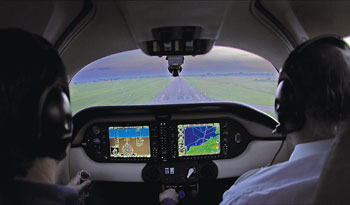 7 SEP 07: GPS GETS THE NODGPS is on the verge of being approved in the UK for non-precision approaches. This follows a trial at six UK airfields last year when Instrument or IMC rated pilots, flying suitably equipped UK registered aircraft where invited to try such approaches. Now the CAA has launched a publication detailing how to fly the approaches as part of the preparation for the introduction of non-precision Global Positioning System (GPS) approaches for general aviation. The publication, CAP 773 'Flying RNAV (GNSS) Non Precision Approaches in Private and General Aviation Aircraft', is available on the CAA website and also in printed form from the TSO. The publication includes: * Licensing requirements for pilots and the minimum aircraft equipment required * How to set up the aircraft's GPS equipment to fly an approach * A step-by-step guide to flying the approaches, including pre-flight checks * A guide for instructors * A recommended training syllabus for the approaches. Ron Elder, Head of the Licensing Standards Division in the CAA's Safety Regulation Group, said, "We know from the reports that pilots filed after completing GPS approaches during our earlier trial that there are some aspects of the operation that need to be carefully studied and practised. This publication should prove invaluable in helping to meet that requirement, and should be read by all pilots planning to fly one of the new approaches." Pilots with Instrument Ratings (IR) or Instrument Metrological (IMC) Ratings will be able to fly the approaches. However, the CAA recommends pilots undertake additional training on the non-precision approaches with a suitably qualified instructor. CAA Flight Examiner, Adam Whitehead, said, "One aspect of flying the approaches that pilots will need to be aware of is a difference in the way some GPS units show the miles to run to the airfield. "Some GPS installations show the distance to the start of the runway but others show the distance in a series of steps, or waypoints, down the approach. "Pilots therefore need to be aware that if a unit is displaying three miles as a distance to run this could be the distance to the next waypoint on the approach path rather than the distance to the runway threshold." W: www.caa.co.uk/publications PRECISION OR NOT? An instrument approach or instrument approach procedure (IAP) allows pilots to land an aircraft in reduced visibility (instrument meteorological conditions or IMC), or to reach visual conditions permitting a normal landing. Approaches are classified as either precision or non-precision, depending on the accuracy and capability of the navigational aids. Precision approaches use both lateral (course) and vertical (glideslope) information. Non-precision approaches provide lateral course info only. 'Approach Plates' show the procedure to be followed - altitudes and headings to be flown, obstacles, terrain, and potentially conflicting airspace. They also show the missed approach procedures and radio frequencies. |                      | ||||||
 Aeros with Alan – Opening your Personal Flight Envelope Learning aerobatics is a great motivational tool for improving your flying. |  Learn to fly So you want to learn to fly? What do you do? Take a look at our guide to get you airborne. | 
Want to learn how to fly? |
Maiden flight for new Italian light twin powered by RotaxA BRAND new light twin aircraft being developed by Italian manufa ... more
CESSNA has confirmed it is negotiating to buy Columbia Aircraft. Columbia ran into financial difficulties and filed for Ch ... more A SOLAR-powered aircraft has smashed the official world record for the longest-duration unmanned flight.The 18mt wingspan Ze ... more | ||||
| All material © LOOP Publishing (UK) Ltd 2005-2007 |