Register for LOOP

Get your copy of LOOP by registering for FREE! Go

Find a school/club

Book Flying Lesson

Click Here Go

Buy an aircraft

Click Here Go

Sell an aircraft

Click Here Go
Explore

LOOP News

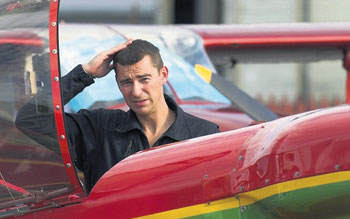
Alexandre Leboulanger

8 AUG 07: FRENCH FINESSE

Advanced European Aerobatic Championships 2007
Joensuu, Finland, EFJO
21-29 July 2007

COMPETING in aerobatics at the very top level requires extreme specialist aircraft. No-one has ever won the World Aerobatic Championship in a two-seat aircraft and it is 20 years since a 4-cylinder Lycoming could power a competitive aircraft. The sport at this level can be accessed by only a few.

Some years ago, the world governing body for aerobatics, the Commission Internationale de Voltige Aérienne (CIVA), introduced the 'Advanced' category and prohibited aircraft currently competitive at the 'Unlimited' level.

Additionally, no pilot can enter Advanced contests if they have represented their country in an Unlimited contest in the preceding two years. For younger pilots with high aspirations, Advanced contests are an ideal opportunity to gain experience in the testing nature of International competition, while still flying affordable aircraft. This contest also allows former Unlimited competitors, like myself, to continue taking part in major events without having to maintain an expensive specialist aircraft.

The figures flown in Advanced competition sequences are less complex, and require less pure aircraft performance, than in the Unlimited category. In all other respects, the types of sequence flown, the performance 'box' and the judging systems, Advanced and Unlimited contests are identical.

The Aircraft
At Unlimited contests nearly everyone flies a Sukhoi 26/31 or a CAP232, but the machinery used in Advanced is much more varied. Since they started in 1995, Advanced World Championships have been won in a Yak-55, a Zlin 50, a Sukhoi 29 and, several times, an Extra 230.
The Yak, Zlin and Extra are single-seat types that have been superseded since they also won in Unlimited in the 1980s. The Sukhoi 29 is a two-seat trainer with obvious differences in handling from its single-seat congeners.

Biplanes can also be competitive in Advanced. Indeed, the Ultimate 10-300 flown in this current event was a pre-championship favourite locally and showed very strongly throughout the event.
In this contest, I flew an two-seat, mid-wing Extra 300, rented locally. The other two British pilots, Steve Madle and Julian Murfitt, flew their shared Extra 230 which Julian flew to Joensuu from UK in a marathon 10-hour cross country flight.

The Repertoire
Pilots in Advanced category events must have almost all the basic skills of an Unlimited pilot. The only manoeuvres that do not have to be flown in Advanced are tail slides and negative flick rolls.
The other difference in Advanced is that compulsory sequences are designed so that they can be flown in aircraft with relatively modest performance.

The fist sequence flown is the Known Compulsory, or Qualifying Programme ('Q'). This sequence is published many months ahead of the event, so that all pilots can practice for the flight.

After the 'Q' comes the Free Programme. Within certain constraints, and with a set maximum possible score, each pilot is responsible for the design of his own Free Programme. So this tests not only flying skill but also the pilot's understanding of his aircraft and the preferences of the judging panel.

Then there are two Unknown Compulsory programmes to fly. Individual figures are nominated by the various nations competing, which are then assembled into a flyable sequence. E veryone gets to fly it without any practice at all. These programmes are the most severe test of a pilot's skill, experience and psychological preparation.

The Contest
In the Known programme, six different countries had pilots in the top ten. I finished third behind Eltonas Meleckis of Lithuania, flying a Yak 55, and Sami Kontio from Finland, flying the Ultimate 10-300.
French, Hungarian and Polish pilots also featured in the top group. Brit Steve Madle made a very good start to his international debut placing 18th in the Extra 230. Julian had a personal disaster, experiencing G-tolerance problems after waiting a long time to fly with probably insufficient food. Another valuable lesson.

The Free Programme, however, was dominated by the French, who gained five of the top seven places. Wind conditions on this day were light, and the judging panel clearly favoured sequences that stayed close to them. Pilots with more cross-wind correction built in to their sequences, and who thus spent some time further towards the back of the box seemed to score less well.

Julian did well to finish tenth in these circumstances, while my 13th place was a positive disappointment, leaving a lot to do to pick up places in the Unknowns. A noticeable casualty of the sport's merciless psychological stress was Sami in the Ultimate biplane. He completely missed out figure 10 of the 12-figure sequence, consequently flying 11 and 12 in the wrong direction for a loss of something like 500 points. That was effectively the end of his challenge.

French domination disappeared in the First Unknown which was won by Tamas Illes of Hungary, flying an Edge 540T. This very fast, rapid-rolling aircraft probably had the best actual performance of all those at the event.

In this programme I placed in a much more creditable 7th place. Julian was 9th. Overall, counting scores from both the Free and this sequence together, we both sat in the top 10 and looking forward to the last flight.

In the Second Unknown, Frenchman Alexandre Leboulanger was judged to have had the best flight, followed in second place by a resurgent Sami Kontio and in the bronze position by myself. For the other British pilots, concentration slipped a little. Their 20th and 27th places proved a somewhat disappointing way to end the week.

In the final analysis, the rewards as ever went to those pilots who could fly consistently well, with the top three spots going to those who also showed occasional glimpses of brilliance.

My own performance has given me enough satisfaction to keep me motivated for next year's World Championship in the USA. I managed sixth overall at the end and scored the fifth highest total of points when the Q Programme is added back in.

The other UK pilots, both putting themselves on the line for the first time, have proven their worth and gained a great deal of experience in what is a very difficult sport, both mentally and physically.
We are all looking forward to next year.
W: www.aeac2007.com

RESULTS
Advanced European Aerobatic Championships 2007
Joensuu, Finland, EFJO
21-29 July 2007


1 Alexandre Leboulanger FRA Cap 231 76.11%
2 Tamas Illes HUN Edge 540T 72.87%
3 Jean-Emmanuel Antal FRA Cap 231 72.29%
4 Eltonas Meleckis LTU Yak 55 72.08%
5 Vincent Lefeuvre FRA Cap 231 71.28%
6 Alan Cassidy GBR Extra 300 70.43%
7 Mikko Jägerholm FIN Yak 55 69.20%
8 Emmanuel Foulon FRA Cap 231 68.79%
9 Radoslaw Rumszewicz POL Zlin 50LS 68.43%
10 Sami Kontio FIN Ultimate Dash 300 68.08%
13 Julian Murfitt GBR Extra 230 64.67%
20 David Bruton IRL Extra 200 62.42%
27 Stephen Madle GBR Extra 230 50.47%

TEAMS
1 France
2 Finland
3 Poland
4 Hungary
5 GBR
6 Czech Republic
7 Germany

WORDS Alan Cassidy

News calendar
<August 2007>
SunMonTueWedThuFriSat
1234
567891011
12131415161718
19202122232425
262728293031
Partners
Aerobatics
Aeros with Alan – Opening your Personal Flight Envelope
Learning aerobatics is a great motivational tool for improving your flying.
Features
Learn to fly
So you want to learn to fly? What do you do? Take a look at our guide to get you airborne.
Find a school/club

Want to learn how to fly?
Click on the map above to find your nearest flight training school.

News
GA businesses given 30 days to move outSOUTH coast airfield Lee-on-Solent is facing closure to General Aviation. All aviat ... more
AIRFIELD licensing costs will rise 65-88% next year under the latest scheme of charges proposed by the CAA.The steep hike is ... more
Maiden flight for new Italian light twin powered by RotaxA BRAND new light twin aircraft being developed by Italian manufa ... more
All material © LOOP Publishing (UK) Ltd 2005-2007