Register for LOOP

Get your copy of LOOP by registering for FREE! Go

Find a school/club

Book Flying Lesson

Click Here Go

Buy an aircraft

Click Here Go

Sell an aircraft

Click Here Go
Explore

LOOP Features

nil

Dunsfold to Darwin in 32 days!

Flight of the navigator - Dunsfold to Darwin in 32 days!

TAYSIDE AVIATION
AIRFIELD: FIFE AIRPORT, GLENROTHES
WHERE: 2NM W OF FIFE TOWN CENTRE
RUNWAY: 07/25 (ASPHALT)
FACILITIES: FLIGHT TRAINING, CLUBHOUSE, TIPSY NIPPER BAR & RESTAURANT, HANGARAGE, FUEL. DUNDEE SITE: MAINTENANCE, ENGINEERING, COMMERCIAL TRAINING, FI TRAINING, ATC CADET SCHEME.
TEL: 01592 753792
WEB: www.taysideaviation.co.uk


NAVIGATION is one of the most important skills required in a pilot and flying in Scotland will certainly test your ability.


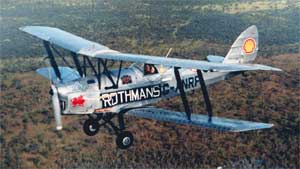
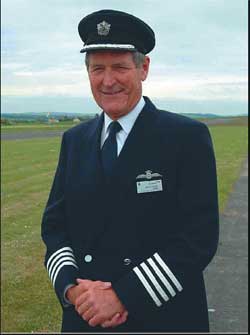
David Cyster, a former RAF Lightning pilot who is now a captain with BA Connect at Edinburgh, hangars his Tiger Moth at Tayside Aviation's base at Fife Airport. He admits flying in Scotland can be tricky for low-hour PPLs due to the mountains and strong crosswinds, but points out that the sky is full of unique features, lochs and glens which act as ideal VRPs.

"If I'm flying home from the Isle of Man, way south of Edinburgh I can see the East Lomond hills. You get to know them and they're wonderful.
"It puts another dimension into navigation because suddenly you're using vertical features."

David, now in his 60s, is an authority on navigating previously unexplored territory. In February 1978 he flew single-handedly to Australia in his faithful Tiger Moth. David and good friend Ivan Rendall planned the trip as a tribute to Bert Hinkler's 15 and a half day record-setting flight in an Avro Avian, 50 years earlier in 1928. David's trip took 32 days to complete, from Dunsfold Aerodrome in Surrey to Darwin, Australia.


"GPS didn't really exist then so I just used a compass and topographical maps," he said. David planned meticulously in advance, carefully folding each map ready and plotting a line down the middle, complete with distances and timings for each eight-hour leg.

"You can't be unfolding maps in an open-cockpit aeroplane. While you're navigating, you're flying and you've got no autopilot so you can't take your hands off the Tiger Moth.
"I remember going down south of Cairo, I had to turn through 90 degrees and go across the Red Sea, so I had the map chopped in half at that point.

"If the route starts going through many twisty bends, the best thing is to have a series of maps."
Despite endeavours to remain on time, a sandstorm over Saudi Arabia took its toll on the engine. By the time David arrived in Egypt, he was behind schedule.

"I'd planned everything using 70 knots as a ballpark figure but I noticed that every day I was behind schedule." Consequently, he rewrote the schedule, this time basing his calculations on an average speed of 60kt.

Travelling entirely by himself, with no back-up team, David carried only a bag of spare parts, spark plugs and points, and "a big wadge of small denomination dollar bills". There were a few mechanical challenges along the way, however, including a couple of fuel leaks and a ruptured oil tank over the Malay Peninsular.

"I had three tanks linked together and was burning about three pints an hour. On an eight-hour flight that's a lot of oil.
"I worked out that I lost 22 gallons overnight so it was going to be at least double that if it was hot."
An unplanned stop to conserve oil, and then David limped into Singapore, where he met up with his wife Cherry and persuaded the commercial maintenance team to repair the tank.

David says the most horrendous moment of the whole flight as when one of his internal fuel tanks ruptured.

"About 50 gallons of fuel was sloshing about, an inch and a half deep in the aeroplane.
"I had a battery behind the driver's seat, and the fuel couldn't get out. I was wearing the old-fashioned Spitfire woolly boots and they soaked up a huge amount of fuel. The smell was awful."
Knowing that at the rear of the aeroplane there was a naked flame from the exhaust, David was understandably frightened and without the comfort of a parachute. 

"I throttled back and started a very slow descent. After about an hour I landed at Nagpur and as I got within radio range, I asked if I could land on the grass."
Monsoon drains along the edge of the runway made that impossible so David brought the plane in to land using only the main wheels.

"I went trundling down the runway with the tail up and the fuel was still sloshing around. I thought if I put the tail down, it would run to the tail skid."

Unstrapped, David jumped over the side and ran away from the moving plane,
"I thought it was going to burst into flames. I had my hands on my knees, panting, soaked in fuel.
"When I looked closely I could see a white petrol vapour cloud coming off the red-hot tail skid, but the aeroplane didn't burn."
The complications didn't end there and without brakes nor tailwheel, the sandy runway at Cairo proved difficult. 

"The art is to recognise when you're going to lose directional control and exit the runway onto the grass, or in this case onto the sand.
"The second rule, if you're going to a place like Cairo, for God's sake don't tell them before you land that you will be forced to exit the runway at some point!"
David arrived in Darwin on 11 March 1978, after his 15,000km solo flight.
"All in all it was a hell of a challenge."  
That could possibly be the understatement of the year!


TRAINING AT TAYSIDE

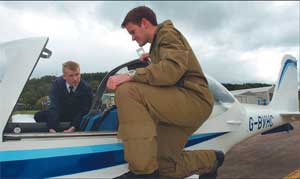
SINCE 1994, Tayside has trained successful candidates from the RAF's Scholarship scheme and is the sole training organisation to do so.

The Air Cadet Pilot Scheme gives around 200 budding pilots the chance to start their flight training each year, taking them through from ab initio to first solo.


The Cadets are awarded 12 hours of intensive training at Tayside's Dundee site, flying one of the school's five Grob 115s.

"It's all 'stick and bubble', which the RAF likes," explains Ops manager Jim Watt.
"Cadet training runs every three months and we have to get them up to solo standard in ten days."

Tayside also has a good relationship with regional airlines, Loganair and ScotAirways.
"Our instructor training is ideal for preparing pilots for roles with the Scottish airlines.
"We offer what we call an 'integrated modular system'. It's consistent from start to finish and it's flying in real conditions so instructors are more marketable."

With an Instructor Advancement Programme set up, Jim is committed to producing highly competent instructors.
"With some instructors, there can be a kind of staleness; a lack of oomph.
"We realised that's because instructors become undernourished, flying the same circuits.
"Hours should be a measure of experience. Our instructors follow a series of set routes to make their hour-building more valuable."

Jim takes a pragmatic approach to the high turnover of instructors in GA.
"We're an integral part of the system and most instructors are transient so we have to embrace this. The airlines need the pilots so instead of shedding a tear, we actually make a big deal of it when someone lands a job."

Words: Kirsten Corrigan

Main Photo: Whitehouse Studios
David Cyster photo: Bill Hill

News calendar
<October 2007>
SunMonTueWedThuFriSat
123456
78910111213
14151617181920
21222324252627
28293031
Partners
Aerobatics
Aeros with Alan – Opening your Personal Flight Envelope
Learning aerobatics is a great motivational tool for improving your flying.
Features
Learn to fly
So you want to learn to fly? What do you do? Take a look at our guide to get you airborne.
Find a school/club

Want to learn how to fly?
Click on the map above to find your nearest flight training school.

News
AIRFIELD licensing costs will rise 65-88% next year under the latest scheme of charges proposed by the CAA.The steep hike is ... more
Maiden flight for new Italian light twin powered by RotaxA BRAND new light twin aircraft being developed by Italian manufa ... more
CESSNA has confirmed it is negotiating to buy Columbia Aircraft. Columbia ran into financial difficulties and filed for Ch ... more
All material © LOOP Publishing (UK) Ltd 2005-2007