Register for LOOP

Get your copy of LOOP by registering for FREE! Go

Find a school/club

Book Flying Lesson

Click Here Go

Buy an aircraft

Click Here Go

Sell an aircraft

Click Here Go
Explore

LOOP Features

nil

Filling out a flight plan with Nick Heard

MANY PPLs rarely have to complete a flight plan and the process is often viewed with some trepidation. However, it really is quite a straightforward and, like all these things, when you’ve done it once you will wonder what all the fuss was about!

Once again the CAA has produced an excellent Safety Sense guide (Number 20) on completing a VFR flight plan, which can be downloaded from the CAA website. Do have a look at that guide, as there is a lot of useful detail.

The guide gives all the information about when you need to close a flight plan, depending on what sort of airfield you are going to – get to know this, as there could be circumstances where ATC will initiate overdue action if you have failed to comply with the proper procedures. You will not be popular if helicopters are being launched on a false alarm!

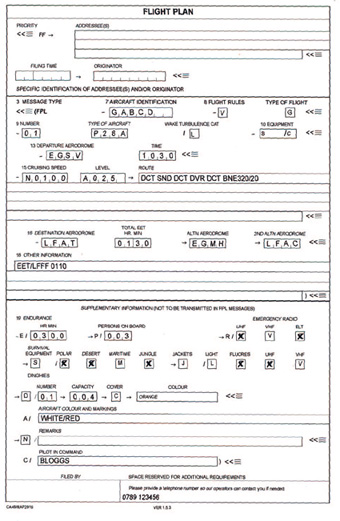
The example used here is a copy of the flight plan we might submit from my base of Old Buckenham (EGSV) to Le Touquet (LFAT) in a PA28. A flight plan is compulsory in this case as we will be crossing the UK FIR boundary.

Filing a flight plan is also a good idea if you are flying a long trip over the sea or over sparsely populated areas. Flight plan forms can be downloaded from the AIS website and can be either typed or handwritten.
W: www.caa.co.uk and www.ais.org.uk

Click here to see the full sized version and follow the steps below

Step by Step:

ITEM 7.
 
The first item pilots complete. Note, no hyphens in the egistration.

ITEM 8.
V = VFR, G = GA.

ITEM 9.
P28A = Fixed Undercarriage PA28 – see the Safety Sense guide for other types. L = Light wake turbulence category.

ITEM 10.
S = Standard equipment (ie, radio, VOR, ADF, ILS). C = Mode C transponder.

ITEM 13.
Enter ZZZZ if you are departing from an airfield without a four-letter ICAO designator (such as a farm strip) and clarify in Item 18. 1030 = Estimated brakes off time (UTC).

ITEM 15.
Cruising Speed: N0100 = 100kt TAS (IAS will usually do).

LEVEL.
 
A025 = 2500ft altitude. You can just write ‘VFR’ if you like, since it is not critical to ATC. F060 would be Flight Level 60.

ROUTE.
You can also write ‘VFR’ for the route, but that doesn’t give a rescue helicopter much chance of finding you. DCT = Direct (ie, not an airways route), and the route is Direct Southend NDB, Direct Dover VOR, Direct to a position radial 320, distance 20nm from Boulogne VOR (ie, Cap Gris Nez).

ITEM 16.
0130 is the total estimated time from brakes off to brakes on at Le Touquet. I have used Manston and Calais as alternate airfields – this gives these airfields a ‘heads-up’ of your intended flight should you find yourself diverting to one of them.

ITEM 18.
The catch-all block! Use this to resolve any ambiguities (use RMK/ to indicate a remark) and clarify departure/arrival airfields (if ZZZZ was entered for these). EET/LFFF 0010 = Estimated elapsed time from brakes off to entering the Paris FIR of 1 hr 10 mins. Again, a ‘heads-up’ for ATC.

ITEM 19.
 
An important block for Search and Rescue! Delete items that you do not have (eg, Fluorescein dye for sea use). Finally, enter your name and a contact number in case of a query. That’s it! Fax it to the appropriate unit (see the Safety Sense guide for the relevant numbers) at least an hour before you go and you are all fixed up.

Since Old Buckenham does not have an ATC unit, we activate the flight plan after takeoff – I normally contact London Information on 124.6 and, having confirmed that they have the flight plan, give an updated departure time and estimated arrival time (for example, ‘Departed EGSV at 1045, ETA LFAT 1215’). Flight plan activation can be done by phone as well as by a friend, but I like to do this job myself!

News calendar
<October 2007>
SunMonTueWedThuFriSat
123456
78910111213
14151617181920
21222324252627
28293031
Partners
Aerobatics
Aeros with Alan – Opening your Personal Flight Envelope
Learning aerobatics is a great motivational tool for improving your flying.
Features
Learn to fly
So you want to learn to fly? What do you do? Take a look at our guide to get you airborne.
Find a school/club

Want to learn how to fly?
Click on the map above to find your nearest flight training school.

News
AIRFIELD licensing costs will rise 65-88% next year under the latest scheme of charges proposed by the CAA.The steep hike is ... more
Maiden flight for new Italian light twin powered by RotaxA BRAND new light twin aircraft being developed by Italian manufa ... more
CESSNA has confirmed it is negotiating to buy Columbia Aircraft. Columbia ran into financial difficulties and filed for Ch ... more
All material © LOOP Publishing (UK) Ltd 2005-2007