Register for LOOP

Get your copy of LOOP by registering for FREE! Go

Find a school/club

Book Flying Lesson

Click Here Go

Buy an aircraft

Click Here Go

Sell an aircraft

Click Here Go
Explore

LOOP Features

nil

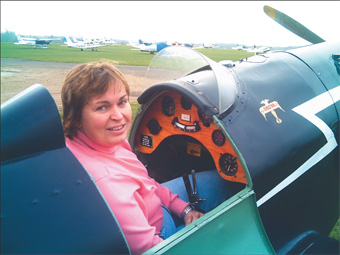
BA Captain Kathy McDonald - Work in aviation

BA Captain Kathy McDonald loves flying her 1939 Chilton- and the airliners

Name: Kathy McDonald
Age: 41
Position: British Airways Captain
Qualifications: ATPL

Q| How did you get interested in flying?
A| My father was in the RAF so I grew up around it. I learned to glide by working at Booker (Wycombe Air Park). After my A-levels, there didn’t seem to be any chance of going into flying. I didn’t have the money to pay for it and opportunities weren’t available, so I went into Air Traffic Control. I did two and a bit years of training and then just over two years working. I was fully valid at Edinburgh – Tower and Approach. Then I saw the ad for the British Airways Cadetship.

Q| Do you think that having been in ATC helps your flying?
A| It gives you a more rounded view of what goes on. It gives you a greater breadth of understanding of the commercial job.

Q| Where did you train?
A| I went to Prestwick in August 1988 and graduated in January of 1990. At that time there were jobs to spare, a choice of where you went. So I went to fl y the BAC 1-11 jet from Birmingham. After that type was phased out, I went onto the 737 at Birmingham. I had to choose where I went next so I went to the ATP base at Manchester to become a captain in August 1995. I was a captain on the ATP at Manchester for a couple of years. As the ATP was phased out, I went over to the 737 at Manchester and in 2001 came down to Heathrow on the 737 before converting to the 757/767 a couple of years ago.

Q| What are the best and worst things about the job?
A| I enjoy operating the aeroplane as a whole. It may sound trite but for me one of the best things are the views from the flight deck which are stunning. The worst thing about it is getting up at 4am, or still being awake at 4am having been at work for the previous nine hours.

Q| What are your destinations?
A| The 757 goes to Europe. The 767 does Europe and about five African destinations and sometimes the US east coast.

Q| Are the African destinations more challenging?
A| There are challenges to every environment we operate in, whether it’s European, trans-Atlantic or down into Africa. They each have interesting aspects. Africa is such a different environment. Air Traffic Control is utterly different.

Q| When did you get back into General Aviation?
A| I had quite a long spell when I didn’t do much in the GA world, particularly when I was based in Manchester. Various pressures prevented it, but I really picked it up in a big way when I came back south. I have a Chilton which I own with my father. We share major bills, but the general running costs are down to me. Only four originals were built and there’s a variety of replicas. Two of the originals are flying and the other two are close to it.

Q| How often do you fl y your Chilton?
A| Not enough. Over the last year we’ve had some very frustrating engine rough running problems, but we think we’ve solved them now. However I don’t want to put a vast number of hours on it because it is 70-odd years old. I want to keep it running nicely but I don’t want to put hundreds of hours on it.

Q| Is it a challenge to fly?
A| It’s interesting. It’s a beautifully harmonised, delightful little aeroplane, but it has absolutely classic elliptical wing stall characteristics – it usually drops a wing. The flap limiting speed and the stall speed are closer than would be ideal. Most aircraft are at 1.3 to 1.35 Vstall for the approach. I’m usually a fraction below that to keep well within the flap limiting speed.

Q| And your Yak 52?
A| That’s in a syndicate with four other people. Last year I did 25 hours on it. That’s more than I did on the Chilton because being a two-seater you tend to share. I went touring with my partner Nigel (also a BA captain). We went up the west coast of Scotland for a few days.

Q| Does BA have any opinion about their pilots who fly GA?
A| They don’t have any formal opinion provided you stay below the weight limit which requires it to be declared as part of your commercial flying hours. As long as it does not impact upon your availability for work, I don’t think they have any formal opinion. I know from conversations that many of our flight managers like the idea. Some of them have asked to come up and have a go.

Q| Do you think GA flying makes you a better airline pilot?
A| We must maintain our flying skills, but we shouldn’t be practicing on the passengers! Basic flying practice in a light aircraft is good – and it’s fun.

Q| Are you glad you became an airline pilot?
A|Yes. I wouldn’t want to do anything else. We might gripe about early starts and late finishes, but not many pilots leave the job. Generally those who fl y GA as well are passionate about it.

Q| What would you say to aspiring commercial pilots?
A| Don’t listen to airline pilots when they’re being grumpy. On days when the ATPL exams are looking hard and vile, and the Instrument Rating is looking even worse, hang on to that motivation and keep going.

News calendar
<October 2007>
SunMonTueWedThuFriSat
123456
78910111213
14151617181920
21222324252627
28293031
Partners
Aerobatics
Aeros with Alan – Opening your Personal Flight Envelope
Learning aerobatics is a great motivational tool for improving your flying.
Features
Learn to fly
So you want to learn to fly? What do you do? Take a look at our guide to get you airborne.
Find a school/club

Want to learn how to fly?
Click on the map above to find your nearest flight training school.

News
AIRFIELD licensing costs will rise 65-88% next year under the latest scheme of charges proposed by the CAA.The steep hike is ... more
Maiden flight for new Italian light twin powered by RotaxA BRAND new light twin aircraft being developed by Italian manufa ... more
CESSNA has confirmed it is negotiating to buy Columbia Aircraft. Columbia ran into financial difficulties and filed for Ch ... more
All material © LOOP Publishing (UK) Ltd 2005-2007