Register for LOOP

Get your copy of LOOP by registering for FREE! Go

Find a school/club

Book Flying Lesson

Click Here Go

Buy an aircraft

Click Here Go

Sell an aircraft

Click Here Go
Explore

LOOP Features

nil

Seaplane Heaven - Amphibious Flying Club

Relocating to Northern Ireland is paying off for seaplane instructor Steve Powell

THE AMPHIBIOUS FLYING CLUB

AIRFIELD ST ANGELO AIRPORT (EGAB), ENNISKILLEN, COUNTY FERMANAGH, NI
WHERE 3NM N OF ENNISKILLEN
RUNWAYS 15/33 ASPHALT
FACILITIES FUEL, HANGARAGE, CAFÉ
FLIGHT TRAINING SEAPLANE, FIXED-WING, HELICOPTER, MICROLIGHT
TEL 07962 213976
WEB www.the-amphib-flyingclub.co.uk

NORTHERN Ireland could become a major centre for seaplane flying following the re-launch of The Amphibious Flying Cub in the area this summer.

Instructor and club owner Steve Powell sees great potential there, after two years trying to find a permanent base. The Club has been in operation since 2004, at Lowestoft initially, before moving to Fritton Lake and the National Water Sports Centre in Nottingham.

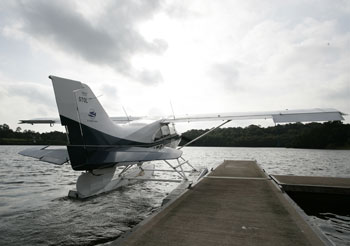
Steve decided to take his Maule M7 to St Angelo Airport, County Fermanagh for a number of reasons.
First, it's located on the banks of Lough Erne - a vast stretch of water that divides the town of Enniskillen in two and provides the perfect terrain for seaplane flying.

Second, the Airport has seen huge investment, both financially and personally, since local businessman Alan Cathcart bought the business just over two years ago.

Steve's company is the only seaplane flying school in the whole of Ireland and he's eager to open up the Emerald Isle as an alternative to Scotland, where most UK-based pilots head to get a seaplane rating.
Steve's Maule M7 has both floats and wheels - hence the amphibious title -  which means he can base himself on land and make use of the facilities at St Angelo, such as the asphalt runway and newly-built hangarage.

Lough Erne is an almost untouched expanse of water and ideal for 'waterwork' - where students learn to manoeuvre the aircraft using the water rudders. The seaplane course requires a minimum of five hours instruction, followed by an exam, carried out by Steve's former instructor Alan Newton from Wellesbourne-based On Track Aviation, who flies over to test students.

Natural bays and headlands around the shoreline of the Lough mean it's perfect for teaching the different types of landings for a floatplane - on glassy, normal and rough water.

Lough Erne is rarely congested which allows Steve to teach students without interruptions from other aircraft or boats. Basically he's found the perfect spot.

Steve plans to add another Maule to his fleet, so he can offer pilots self-fly hire in the future. He wants to buy a 'straight float' version for this, as the wheels on his current Maule add 680lb to the empty weight. With a lighter model, four people would easily be able to tour and really explore the delights of the island - another thing Steve feels strongly about.

He's been working with the local tourist board to promote the Airport and raise the profile of GA in the region. He is aware, however, that the real market for his flying school is mainland UK. He is eager to educate people about Northern Ireland - and Enniskillen in particular.

Flying over the Lough, you experience breathtaking views and back on the ground, the flying community is exceptionally welcoming. Airport owner Alan Cathcart is philosophical about this, "Historical trouble has put people off in the past, but in aviation everybody mixes together, regardless of political or religious belief.

"We see more Irish registered aeroplanes than G-reg these days - it's a sign of the times, 15 years ago you wouldn't have seen that."

According to Alan, GA is safe in Enniskillen. The Airport is licensed and there are four flying schools on site, plus two maintenance operations. Additional hangarage has been built to accommodate this growth, something which seemed unlikely a few years ago.

The Airport was closed in 2002 by its owner Fermanagh District Council. A two-year campaign ensued to reopen it as an active GA site. "As a pilot it was frustrating," said Alan. "I live beside the airport and I was slowly watching it deteriorate.

"It was a frustrating few years with lots of obstacles to overcome. We almost gave up."
Alan is pleased Steve chose St Angelo and has plans to build a permanent mooring and docking facility for The Amphibious Flying Club on the Lough.

"When we took over, we hoped that a seaplane operator would start up, but didn't expect it to happen so quickly, " said Alan. "We're really pleased with how things are going."

The Airport is surrounded by Class G airspace, making it the perfect destination for pilots tired of the heavily restricted airspace across much of England.

"It makes navigation a lot easier and you've got the freedom to go where you want. The south-east of England is a minefield of zones and altitudes so pilots are always worried about busting zones - we don't have that issue!" Alan explains.

The local business community also benefits from the facilities at Enniskillen and helicopter movements are numerous - indicative of the rise in helo activity across Ireland. Sloane Helicopters has recently opened a maintenance facility on the site, confirming the Airport's status as a key player in the business aviation market.

Alan is wholly committed to recreational flying, though, and points out that St Angelo combines various types of flying, nurturing a healthy community that opens its arms to pilots from all branches of aviation.
"We've a mixture of types here: microlights, fixed-wing, amphibious and bizjets. At the weekend you see everything from million pound jets to microlights and everything in between."

A rich seaplane history


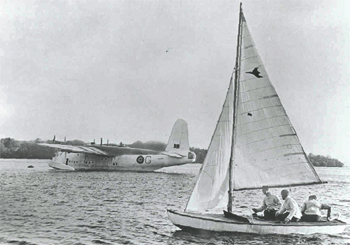
Fermanagh is steeped in aviation history. During WWII, nearby Castle Archdale was a vital seaplane base, with a fleet of Catalina and Sunderland aircraft stationed here.

Local historian Breege McCusker, a retired teacher, is from nearby Irvinestown. A keen local historian and author, she has written many books documenting the area's history and provided these photos, which illustrate seaplane activity on Lough Erne first time around.

In 1940 the construction of an RAF base on the Castle Archdale estate on the shores of Lough Erne was designed to close the gap between mainland UK and the Atlantic.
 
No. 240 Squadron, equipped with Stranraer Flying Boats and Catalinas, carried out the first sorties from the newly established base on Lough Erne, known as No. 15 Group Coastal Command, on 21 February 1941, bringing Fermanagh into the frontline of the 'Battle of the Atlantic'.

The most notable success of planes based at Castle Archdale was the location and chase of the German battleship, the Bismarck. The sighting, by a Catalina, led to LOOP hero John Moffat and crew torpedoing the ship from their Fairey Swordfish. An entry in the Castle Archdale log on 27 May 1941 reads, "German battleship sunk at 1100 hrs. Aircraft of 209 and 240 squadrons operating from this station were responsible..."

The troops, which included many Americans and Canadians, were also responsible for protecting the shipping containers arriving from America. There was another seaplane base at Killadeas, where pilots trained for the Coastal Command.

Words Kirsten Corrigan Photos Destination North West

News calendar
<October 2007>
SunMonTueWedThuFriSat
123456
78910111213
14151617181920
21222324252627
28293031
Partners
Aerobatics
Aeros with Alan – Opening your Personal Flight Envelope
Learning aerobatics is a great motivational tool for improving your flying.
Features
Learn to fly
So you want to learn to fly? What do you do? Take a look at our guide to get you airborne.
Find a school/club

Want to learn how to fly?
Click on the map above to find your nearest flight training school.

News
AIRFIELD licensing costs will rise 65-88% next year under the latest scheme of charges proposed by the CAA.The steep hike is ... more
Maiden flight for new Italian light twin powered by RotaxA BRAND new light twin aircraft being developed by Italian manufa ... more
CESSNA has confirmed it is negotiating to buy Columbia Aircraft. Columbia ran into financial difficulties and filed for Ch ... more
All material © LOOP Publishing (UK) Ltd 2005-2007