
 |
|
|
Register for LOOPGet your copy of LOOP by registering for FREE! | Find a school/club | Book Flying Lesson
| Buy an aircraft
| Sell an aircraft
| |||
LOOP Features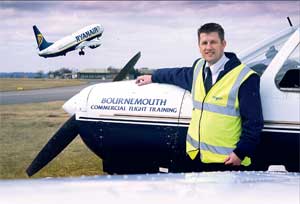 Back to their roots with Bournemouth Flying ClubThe Flying Club at Bournemouth is what you might call a work in progress. Although it's been in existence since the 1930s, the club has had to reinvent itself over the past few years in a bid to get back to grass roots flying. Under the guidance of Andy Townsend, the club has separated recreational flying from commercial flight training, in an attempt to return to the club culture nurtured by former owners, the Norris family, until they sold up in 1998. Bournemouth Commercial Flight Training moved to the opposite side of the airport, where the groundschool training area was already located. "That way all the professional training was in one place and it enabled us to concentrate on rebuilding the hobbyist side of things at this end," Andy explains. It seemed that the good old days of club flying at Bournemouth were nothing more than a distant memory when Andy took over as MD in April 2004. "There were no more than a dozen PPLs flying and to be honest, I feared for the future of the club," he said. Andy has since set about growing the non-commercial side of the business, encouraging PPL students to stay on and fl y once they get their licence. So how have things changed? "By introducing a membership fee, we gave people an incentive to use the facilities and basically fly more often," says Andy. "Until then, our PPLs didn't feel part of anything, which is detrimental to the success of any flying club." Growing a club is not easy. "PPLs are generally holding down a fulltime job and can't dedicate 100% of their time to flying, so there is always the risk of people falling by the wayside. "Sadly, there are also a few PPLs out there satisfied that they've obtained their licence, and can simply tick that box and move on. We need to change that!" The team has made a real effort to boost club activity since then, promoting post-PPL flying and holding regular fly-outs. In particular, Deputy Ops Manager and CPL Shane Harper has pulled out all the stops to get more people through the door. At the end of last year, Andy set him the task of booking as many trial flights for the start of the 2006 season as possible. He's lined up 180, an exciting prospect for the club. The challenge now, however, is to inspire those people and set them on the path to getting their PPL and flying in their spare time. Is Andy confident? "I'd be really happy with 20% of those continuing. It's up to us now to show them what learning to fl y is all about, and why they should learn here." That's a good point. Why choose Bournemouth? The clubhouse is bigger than most, serves good food and unlike many other airports, you get a great view of the runway so you feel part of the action. You get the best of both worlds at Bournemouth: a club committed to the traditional values associated with flying for fun, but with the advantages of an international Class D airport environment, giving private pilots a greater level of competence and keeping your RT skills razor sharp. The GA presence in this area has seen a decline in recent years, with Southampton's GA community gradually being pushed out to make room for the commercial operators. That doesn't seem to be the case at Bournemouth, however, where the GA fraternity is still strong and remains an integral part of the airport. But for how long? The Manchester Airport Group, which owns Bournemouth International, was due to release its Master Plan at the end of last month. With carriers like Thompsonfly, Ryanair and easyJet having established a solid base at the site, the potential for further expansion is a reality that could have serious consequences for GA. Andy remains optimistic though and in the last communication meeting, held by the Airport in February, it was indicated that for the next ten years at least, there would be room for everyone at Bournemouth.
Try to avoid lunchtime as this is the airport's busiest time for scheduled flights. Big jets can prove dangerous for light aircraft because of wake turbulence so remember to stay at least six miles behind. The airport falls in Class D airspace, roughly 10 miles wide and Bournemouth ATC operates up to 2000ft. Outside the Bournemouth CTR though is the Solent CTA and Southampton’s own CTR, all Class D. Remember... Words: Kirsten Corrigan |                      | ||||||
 Aeros with Alan – Opening your Personal Flight Envelope Learning aerobatics is a great motivational tool for improving your flying. |  Learn to fly So you want to learn to fly? What do you do? Take a look at our guide to get you airborne. | 
Want to learn how to fly? | AIRFIELD licensing costs will rise 65-88% next year under the latest scheme of charges proposed by the CAA.The steep hike is ... more
Maiden flight for new Italian light twin powered by RotaxA BRAND new light twin aircraft being developed by Italian manufa ... more
CESSNA has confirmed it is negotiating to buy Columbia Aircraft. Columbia ran into financial difficulties and filed for Ch ... more | ||||
| All material © LOOP Publishing (UK) Ltd 2005-2007 |








 Advice for visiting PPLs:
 Bournemouth
