|
|
|
Register for LOOPGet your copy of LOOP by registering for FREE! | Find a school/club | Book Flying Lesson
| Buy an aircraft
| Sell an aircraft
| |||
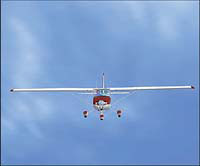
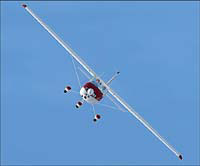
LOOP Features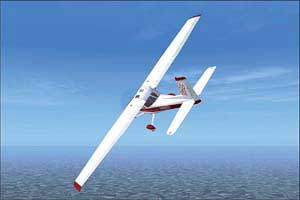 Steep Turns: Learner's Corner #3Steep turns are turns of 45° or more, technically speaking, though once much over 30° of bank it is a good idea to use the techniques involved. For training we normally use 45° to start, increasing to 60° for keener students. There are two reasons we learn and practice this manoeuvre. The first is simply so that we are capable of flying high banked turns – though inexperienced pilots have got into difficulties doing this at low level to show someone their house! It’s best practiced at altitude. The second reason is as a control and coordination exercise. LOAD AND SPEED In addition to our stall speed increasing the drag will increase, so if nothing is done we will have a much larger fall off in speed than for a 30° banked turn. This reduction in safety margin is best avoided by keeping the speed up using power. In a low-powered aircraft the maximum bank angle will be restricted by the power available to maintain the speed. Avoiding high bank angles and high levels of G also needs to be considered if you have passengers who are inexperienced or are nervous flying in light aircraft. CONTROL FORCES The entry is then started as for a medium level turn, coordinating aileron, rudder and back pressure. As the roll continues through 30° of bank, power is added and back pressure further increased to keep the correct nose attitude. If using more than 45° of bank, you will find the control forces on most training aircraft become quite heavy and considerably more power will be needed to maintain level and the correct speed. Once established in the turn it is maintained using aileron for bank, elevator for level and power to control speed. This will work well at lower angles and if the nose is not allowed to drop too much. If the nose drops at higher angles, you will find yourself in a spiral dive and pulling back further will just increase the rate of turn and rate of descent. If this should happen then you need to reduce the bank angle, remembering you may need to reduce power as you do so, sort out the level, then reapply the bank (and power if needed). When turning steeply it is very important to keep a good lookout. Once established you need to get into a routine of checking lookout, especially in the direction of turn, and attitude, checking visually that the picture looks correct, then instruments using just a quick glance inside to check for bank angle (AI), level (altimeter) and airspeed. Any adjustments are then made looking ahead at the attitude before repeating the scan again. As the turn continues the DI needs to come into the scan to allow correct anticipation for rolling out. ROLLING OUT It is then a case of coordinating aileron and rudder to roll out on heading, while reducing throttle back to cruise power and relaxing the back pressure to stay level. THE STALL If turning through more than 360° and you have managed to stay level then you may find buffet due to flying through your own wake – not something to worry about but you do need to differentiate between that and the stall buffet. Done well, the steep turn is a satisfying manoeuvre to fly. Even for experienced pilots, practicing changing from a steep turn in one direction straight to one in the other without changing airspeed or altitude is an excellent exercise in controlling the aircraft.
Sponsored by: |                      | ||||||
 Aeros with Alan – Opening your Personal Flight Envelope Learning aerobatics is a great motivational tool for improving your flying. |  Learn to fly So you want to learn to fly? What do you do? Take a look at our guide to get you airborne. | 
Want to learn how to fly? | AIRFIELD licensing costs will rise 65-88% next year under the latest scheme of charges proposed by the CAA.The steep hike is ... more
Maiden flight for new Italian light twin powered by RotaxA BRAND new light twin aircraft being developed by Italian manufa ... more
CESSNA has confirmed it is negotiating to buy Columbia Aircraft. Columbia ran into financial difficulties and filed for Ch ... more | ||||
| All material © LOOP Publishing (UK) Ltd 2005-2007 |