Register for LOOP

Get your copy of LOOP by registering for FREE! Go

Find a school/club

Book Flying Lesson

Click Here Go

Buy an aircraft

Click Here Go

Sell an aircraft

Click Here Go
Explore

LOOP Features

nil

Liberty XL2

WHAT A LIBERTY!
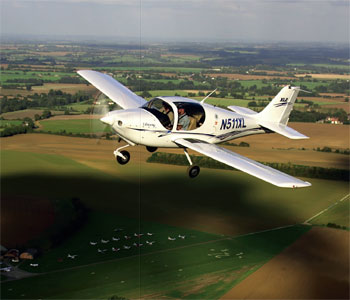
Liberty XL2: modern, roomy, comfortable, fun! Is this the future for flying schools looking for a 21st century trainer? Freedom of the skies for all!

DID you know it's 20 years since Cessna stopped production of its 150/152 two-seater? The aircraft which has trained countless pilots all over the world, including me, is now a near 50-year-old design. Imagine turning up to a driving school and being offered a 1958 Ford Popular? You'd laugh as you walked away. Gotta be kidding, right?

Fact is, there hasn't really been a major league alternative to the Cessna, apart from Piper's equally ancient but not so popular Tomahawk. Until, possibly, now, with the Liberty XL2.

You may know that the Liberty came out of the British Europa kitplane. Designed by Ivan Shaw, with airframe kit components manufactured in North Yorkshire, using an Austrian Rotax engine, the Europa is the UK's top-selling aeroplane with more than 1000 kits now sold worldwide. It's been a huge success.
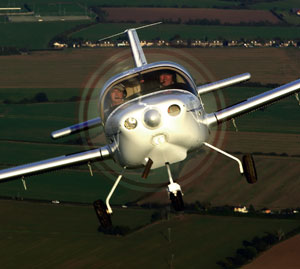
But while the Liberty may resemble the Europa overall and in certain features such as the upwards opening gull-wing doors, there's a world of difference between them.

The Liberty has been type certified to the latest FAA requirements which are much, much tougher than any kitplane has ever faced - and the Cessna 150/152 come to that. Crash-worthiness, cockpit visibility, airframe fatigue and vice-free handling are all areas current regs have improved upon.
The Liberty has also been designed with ease of maintenance in mind and has a modern computer-controlled engine, both of which help reduce downtime and operating costs.

All of these factors are important to flying schools but there's more. People are bigger, generally, than they were 50 years ago so the Liberty's cabin is  a full 48 inches across - just one inch less than, say, a Cirrus SR22. The Liberty is also modern inside without being freakishly futuristic. There's a digital engine management display but the other instruments are conventional in appearance.

LOOP took the Liberty XL2 to Andrewsfield in Essex for a flight test. We had hoped to fly one of the airfield's instructors and possibly some students, but the good old British weather intervened. Our flight was alongside Ivan Shaw, now back in the UK after a period spent in Florida helping to get the Liberty through the type certification process. Ivan is handling the European end of Liberty, with EASA certification being sought early in 2007.

GETTING into the Liberty posed the first minor challenge. The best technique seems to be to sit on the wing, swing both legs into the cockpit then slither across into the seat. A step is going to be added to the fuselage soon which will make this process a little more gainly - and hopefully avoid damp bottom syndrome from a wet wing.
Once in, the first surprise is just how roomy the Liberty's cabin is. There's none of the shoulder rubbing that you can't avoid in a cosy Cessna 152. As the gull wing doors come down, there's plenty of headroom - a good two to three inches even with the headset on.

The plush leather sports seats aren't adjustable but the rudder pedals are. I'm sitting in the right seat and my left knee is pretty tight to the lower edge of the panel, but I soon find a comfortable position.

The control stick is conventional - between the legs rather than the sidestick used on, say Cirrus and Columbia - and perfectly placed. Only the finger brakes are unusual.

Next surprise is just how quiet the engine is on start-up.


It's a revelation and you could easily operate this aircraft without headsets if you wanted to. As we taxi, I have to get used to the finger brakes to steer the Liberty. The nosewheel is not connected to the rudder pedals and simply casters - steers - in the direction the aircraft is pointing, which is directed on the ground by the brakes. Anyone who's flown a tailwheel aircraft which get it in seconds, others might take a few minutes.

We line up alongside our Cessna 172 cameraship but let it go ahead, catching it easily in the air. Our photo sortie is to be flown at 90kt, which equates to 49% power or 2249rpm according to the Liberty's digital display.

We've no need to worry about mixture control or carb heat because the Teledyne Continental engine upfront has electronically controlled fuel injection, mapped to the ignition timing, just like a modern car. This is called FADEC - Full Authority Digital Engine Control - and not only does the engine run smoothly without human intervention but it also uses less fuel and suffers less wear and tear.

As Ivan flies the photo formation, I keep a good lookout for other aircraft and can't help but be impressed by the aircraft's visibility. The view is unimpaired in every direction, including above, which is important for aircraft spending a lot of their time in the circuit. The leading edge of the wing is also behind the seat front edge, helping the view when making, say, an overhead join.

I'm also impressed how the engine instrument display is perfectly readable from my side of the cockpit - the instructor's side - even in the bright sunlight. I might be tempted to add a translucent sunshade to the roof panel however, just to keep direct sun off the top of my head.

Photo shoot over, we fly some standard manoeuvres - stalls, steep turns, etc - which the Liberty handles perfectly. The stick is perfectly weighted during these, giving feedback while allowing the pilot to flick the aircraft around. Ivan takes control and shows me his party trick. He slows the aircraft down, nose high to set it right on the stall and then banks and turns it. It feels as though the aircraft is bumping over a cobbled surface as it stalls and recovers repeatedly. Any minute I'm expecting the wing to drop, but it doesn't, just keeps flying.

Into the circuit and there's remarkably few checks - no mixture, no carb heat. Although the Liberty's shape is clean, we have no problem slowing down and then  implementing the electrically controlled flaps. I wish I'd learnt on an aeroplane with a control stick rather than yoke. It makes crosswind landings so much simpler to get right because it's easier to understand what you're trying to do, to offset the drift.

Sure enough, the landing is straightforward and we let the aircraft roll and slow naturally. Taxiing up to Andrewsfield's fuel pump takes some more finger work with the brakes, and as we switch off I realise I haven't been tense at all. My ears aren't ringing, bottom isn't numb, back isn't aching... gosh, this really is how a modern aeroplane should be.

Move over Cessna 150/152s. You're tough old birds but your time is up.

TRAINING ON THE LIBERTY
Ormond Beach Aviation operates five XL2s

SINCE the Liberty XL2 received its FAA certification, 12 aircraft have been delivered to flying schools in the US. One of the first was Ormond Beach Aviation, run by Brit Adrian Thompson on Florida's east coast. Many Brits have trained for their CAA/JAA PPL with Ormond Beach (OBA), with many returning to take further ratings.

Adrian has 35 Liberty XL2s on order - 35! - and he's able to charge a higher price for the XL2 over the standard Cessna 150/152s on the fleet.

This is what he told LOOP about the Liberty:
"It's been absolutely great. No problems at all. We now have close to 1000 flight hours since last April, with five aircraft on the fleet..
"It's proving very popular with students. Yes, we do charge more but it's an awful lot more plane.
"Operating costs are pretty much on budget. Fuel [consumption] is 4 US gallons an hour, as opposed to the 5.5 to 6 USG an hour used by a Cessna 150/152.

"Maintenance is just ordinary inspections as they come up. We had a few teething problems at first but only what you'd expect with a new aeroplane."
OBA has its own in-house maintenance facility os they've been able to see the Liberty's labour-saving design first hand.

Adrian again: "The belly panels on the fuselage open up to reveal all the systems and controls, control linkages. Removing the panels is 30 minutes, and putting them back on is another 30 minutes, and you've got a lot more room to do things.

"We're seeing a 30-40% saving on maintenance, mostly labour because it takes less time to do things. For example, to replace an instrument, it's four screws to get the panel out.

"Not only does the engine runs to optimum mixture control, it also has constant engine monitoring. We can check the last 100 hours of operation - power settings, oil and cylinder head temperatures, all recorded. This gives very early warning of any engine problems."

Adrian is aware of some uninformed gossip about the aircraft and counters this with, "I think one of the issues is this belief that it's an all-electronic glass cockpit aeroplane. But it's not. It has conventional instruments with a modern computer-controlled engine. It has modern avionics with GPS and modern presentation.

"The Liberty XL2 has moved out of the Jurassic age of aeroplanes."
W: www.flyoba.com

COSTS TESTED
THE US Aircraft Owners and Pilots Association (AOPA) put a Liberty XL2 up against a Cessna 172 in a comparison of annual inspections, just to see if Liberty's claims of lower maintenance costs stood up.
The XL2 should take 10 hours for its annual, according to Liberty, but actually took 13 hours 40 minutes.

The Cessna was predicted to take 25 hours, but actually took 21 hours 20 minutes. Part of the reason for the time difference was that one of the two mechanics had never seen a Liberty before, whereas both were familiar with the 172. New procedures took time to explain. "A second inspection would be much closer to the 10-hour prediction," said AOPA.

AOPA also carried out fuel consumption tests on the Liberty. During an hour of typical circuit work, the aircraft used 5.1 US gallons of avgas - that 19.3 litres.
W: www.aopa.org


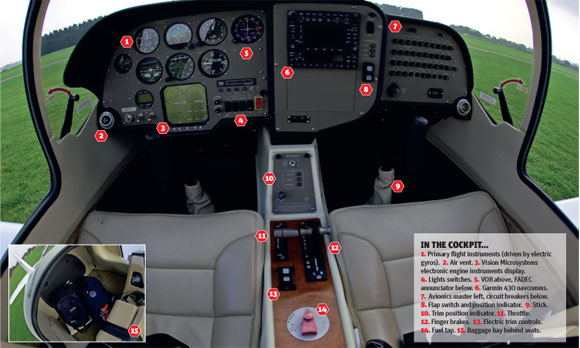
1. Primary flight instruments (driven by electric gyros).
2. Air vent
3. Vision Microsystems electronic engine instruments display.
4. Light switches
5. VOR above, FADEC annunciator below.
6. Garmin 430 navcomms.
7. Avionics master left, circuit breakers below.
8. Flap switch and position indicator.
9. Stick.
10. Trim position indicator.
11. Throttle.
12. Finger brakes.
13. Electric trim controls.
14. Fuel tap.
15. Baggage bay behind seats.

SPECS
LIBERTY XL2
PERFORMANCE
Vne 162kt
Cruise @ 65% 120kt
Stall (clean) 50kt
Rate of climb  682ft/min
Takeoff roll 250mt
Landing roll 256mt
Ceiling 12,500ft
Fuel burn 21 litres/hour
Range 500nm

POWER
Engine 125hp Continental IOF-240-B, with PowerLink FADEC
Prop 2-blade fixed ptch, Sensenich wood and composite

DIMENSIONS
Wingspan 8.8mt
Wing area 10.41sq mt
Length 6.22mt
Height 2.28mt
Seats 2
Mtow 750kg
Empty weight (VFR fit) 483kg
Useful load 267kg
Fuel capacity 106 litres

PRICE
Base price $159,000

MANUFACTURER
Liberty Aerospace
1383 General Aviation Drive
Melbourne
Florida 32935
USA
T: 001 321 752 0332
W: www.libertyaircraft.com

UK DISTRIBUTOR
Ivan Shaw
Head of European Operations
T: +44 (0)1751 417000
E:

News calendar
<October 2007>
SunMonTueWedThuFriSat
123456
78910111213
14151617181920
21222324252627
28293031
Partners
Aerobatics
Aeros with Alan – Opening your Personal Flight Envelope
Learning aerobatics is a great motivational tool for improving your flying.
Features
Learn to fly
So you want to learn to fly? What do you do? Take a look at our guide to get you airborne.
Find a school/club

Want to learn how to fly?
Click on the map above to find your nearest flight training school.

News
Maiden flight for new Italian light twin powered by RotaxA BRAND new light twin aircraft being developed by Italian manufa ... more
CESSNA has confirmed it is negotiating to buy Columbia Aircraft. Columbia ran into financial difficulties and filed for Ch ... more
A SOLAR-powered aircraft has smashed the official world record for the longest-duration unmanned flight.The 18mt wingspan Ze ... more
All material © LOOP Publishing (UK) Ltd 2005-2007