Register for LOOP

Get your copy of LOOP by registering for FREE! Go

Find a school/club

Book Flying Lesson

Click Here Go

Buy an aircraft

Click Here Go

Sell an aircraft

Click Here Go
Explore

LOOP Features

nil

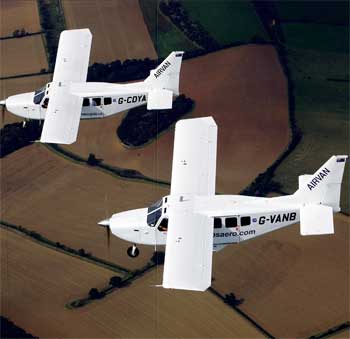
Gippsland GA8 Airvan

Gippsland's GA8 Airvan from Australia, a people carrier... and people dropper

JUST what goes through your mind as you chuck yourself out of an aeroplane? Hope the 'chute opens? Glad to get out of there?  Household bills? Laundry bills?

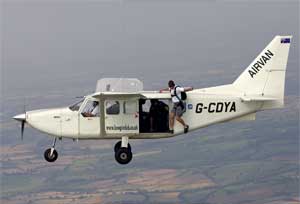
Who knows. All I'm sure about is that seven perfectly rational, if a little loopy, men and women filled the skydiver Airvan to the brim and didn't hesitate for a second as they jumped... except to show off as they left the aircraft.

Three went out individually clutching copies of LOOP, three went out in a stream and the final jumper, Justine, went for a Freestyle exit.

Skydiving is one of the most popular UK uses for the, full name Gippsland GA8. The seven passenger seats are stripped out, including the right front next to the pilot, and special lap seatbelts are securely fitted for the jumpers who squat, or slump, on the Airvan's flat floor.

The aircraft's sliding side door is closed for takeoff and the climb - a real boon say jumpers because it can get very cold at altitude - and is opened in-flight at a slow cruise speed around 80kt, leaving a one-metre square opening in the left side of the fuselage. Handles at the top of the doorspace, both inside and out, help jumpers manoeuvre into position, then it's a leap into the unknown. No one actually shouted 'Geronimo' but I bet someone was thinking it...

As each jumper positions, it's like a giant airbrake kicking in on one side of the aircraft. First time we attempted to photograph this, the cameraship whizzed past as the Airvan suddenly lost airspeed. Regular skydive pilot Geoff Kent says you soon get used to it and the massive changes in the aircraft's weight and balance.


Think about it... seven skydivers with equipment, each weighing an average of 90kg (roughly 200lb), that's 630kg (roughly 1400lb - well over half-a-ton!) going out in a little over 20 seconds. The centre of gravity shoots forward.

As pilot you've got to pull the nose up a bit for every jumper without over-reacting, re-trim, cope with the airbrake on-off effect, keep the aircraft straight & level, on heading, maintain a lookout... and then descend as fast as you can without shock-cooling the engine.

The reward is the spectacular sight of skydivers flying their multi-coloured, wing-shaped parachutes towards the dropzone, in our case the lovely Oxfordshire airfield of Hinton-in-the-Hedges. It was surprising to see how much ground the skydivers can make up into wind - the wing's action can give a forward speed of up to 30kt, very apparent as they get close to the ground.

All seven jumpers made highly accurate landings, neatly lined up one after the other, flaring just like an aircraft a couple of feet above the ground. None of the landings was hard - all landed upright as though stepping off a small box. If ever there was encouragement to go and try a tandem jump, this was it...

SIMPLE AND ROBUST
Passenger and cargo flying is another use for the Airvan, a more common use in many countries around the world where travelling by road is either too difficult or too far. The Airvan originates from Australia, where the distances are huge and the airstrips often unprepared - just gravel roads or grassy paddocks.

The aircraft's cavernous interior can have its seats removed, or replaced, in around 5-10 minutes, or a combination of seats and cargo space configured. The side door sill is exactly the right height to line up with the payload tray of a one-ton 'Ute' (pickup truck), the right width for a pallet, and the right height for a pallet carrying four 200-litre oil drums standing up!

Gippsland's founders, designers and engineers George Morgan and Peter Furlong certainly hit the numbers correctly when developing the Airvan. They've kept the Airvan dead on target as a 'flying Transit van' with multiple uses. Their attention to detail is as impressive as their desire to keep the aircraft simple and robust.

As well as the VFR-equipped skydive Airvan, we also had an IFR-equipped passenger Airvan along for the test. The right seat is removed from the skydive version (replaced by a rigid post for a jumper to lean against without interfering with the
aircraft's controls),so for our flight test we flew the pax version with factory rep Neil Plumb in the right seat.

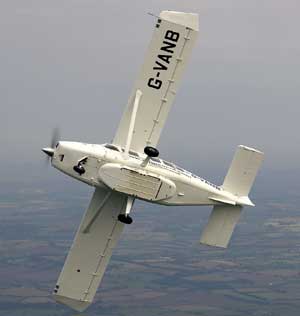
Both pilot seats have their own large doors, which can be locked open  and released from the seat, plus an easy to use handhold and step. You step up into an Airvan, swinging a leg around the floor-hinged control column as you get in. Being floor-hinged, the control column does not have anything going through the instrument panel, leaving plenty of room behind for whatever equipment fit you want.

The pax Airvan shared the flight instruments with the skydive version, but had twin Garmin 430s fitted for IFR use (as opposed to a single BendixKing KMD150 moving map and twin radios). It's all very simple and straightforward - even the checklist is printed on the central bulkhead - and anyone used to a standard non-glass Cessna 172 would feel straight at home. That's not surprising since the main market for the Airvan is currently filled by Cessna's big piston single, the six-seat 206.

Upfront, the engine and prop are exactly the same as fitted to Piper's Cherokee Six and similar to the 206's. It's a fuel-injected six-cylinder Lycoming
IO-540, producing a max of 300hp at 2700rpm and 275hp at 2500rpm. The prop lever has a 'gate' which needs to be pushed past to obtain the final 25hp for short-field or heavyweight takeoffs. Using 2500rpm helps keep the aircraft's noise level down.

Taxiing out to Hinton's 06 for the first sortie, the rudder pedals felt incredibly heavy because they're directly steering the nosewheel. Once rolling, however, they lightened up and it was easy to keep the aircraft tracking straight despite a strengthening crosswind. With just the two of us on board, and roughly half-fuel, we were off in well under half the 700-metre hard runway, climbing strongly with one stage of flaps, 14 degrees, set on the manual Cherokee-like handle.

There's a large trimwheel by the pilot's right hand which moves the whole tailplane, taking quite a few turns to be noticed. There's no rudder trim and a bit of right boot is required during the climb. Not a huge problem but tiring for pilots of the skydive version who are climbing most of the time.

Flaps up, we tried max angle of climb with the airspeed coming back to 60kt, the Vertical Speed Indicator showing 1300ft/min and the wing angle at around 30 degrees with the horizon. Useful if you're surrounded by hostile terrain. Even at max takeoff weight, the Airvan can still manage a respectable 787ft/min, thanks to a highly effective wing.

Despite being one of the biggest aircraft I've ever flown, the Airvan took just minutes to adapt to. Handling the aircraft is a piece of cake. Turns are straightforward and the excellent visibility - the pilot sits ahead of the wing's leading edge - means blind spots are minimal. Steep turns were just as

straightforward, and stalls, clean and with full flap,power on-off, just had the aircraft mushing along, refusing to drop a wing even when full aileron was applied right at the stall.
The aircraft's benign flying behaviour is down to it having been certified to the latest US FAR Part 23 regs for public transport aircraft. These are much tougher than in years past, with the aircraft's stall and spin characteristics having been tested thoroughly. Basically, the aircraft has to recover all by itself whether or not the pilot does the right things.

Back to Hinton, our first landing was a touch and go to demonstrate how the aircraft can do a go-around with full flap of 38 degrees. The big rudder, extending well below the tailplane, had plenty of power to control the crosswind, gusting sportingly at right-angles to the runway, and we landed about a quarter of the way into the runway.

Approach speed is 70kt - any more than that and that big wing will float the aircraft for ages - and touchdown is at around 60kt. Full power and we were off again in metres, pushing the nose down against the full flap, almost in helicopter-like attitude and climbing strongly.

We had several more sorties during the day and the Airvan impressed more and more. The wind became stronger so on one sortie we followed the fully-laden skydive Airvan down Hinton's grass 09 and were amazed to see it takeoff with more than a third of the available 900-metres left. This time we had six on board the pax Airvan and performance seemed identical. Handling the aircraft with the extra weight seemed no different from when empty. Landing back on the grass was no problem either with the big 8.50in mainwheel tyres absorbing the bumps easily.

According to European factory rep Neil Plumb, the market in Europe for the Airvan will be mainly pleasure flying, special role and parachute use. This could open up even more if a proposal to allow Single Engine IFR goes through for Europe.

A 400hp turbine version is underdevelopment which should be an even better performer, and of course it will burn JetA1 fuel which is not only cheaper but also more available in many parts of the world.
Gippsland should be winning design and engineering awards for the Airvan. It has a simple, straightforward sense of purpose and it delivers in bucketloads.


PLUMB JOB
- Neil Plumb, European factory rep

NEIL Plumb took over as European rep for the Airvan from Oxford-based NAC. Son of Barry Plumb, creator of the eponymous Plumb Biplane, 30-year-old Neil has been immersed in general aviation all his life as an engineer and commercial pilot.

"Skydiving is a big part of the market in this country at the moment but we have a couple of operators interested in using it for pleasure flights.
"Nearly 50% of Airvans worldwide are used in the pleasure flying or tourist industry. It has big bubble windows for every seat so everyone gets a good view.


"A turbocharged version is being certified at the moment, ready for early 2007. That'll give it another 20-odd horsepower but it'll keep it up to 14,000ft.

"Due to market pressure to use JetA1, we're looking into turboprop and diesel versions. After that there's the GA10, stretched to give 10 full seats."


'Up and down a lot'
-Geoff Kent, Airvan pilot

GEOFF Kent flew the jump Airvan for our shoot and has over 180 hours on the aircraft since Skydive London started operating it at Redlands, Swindon. Before that, he'd accumulated more than 1000 hours of jump-flights on Cessna 206s.

"It's not everybody's cup of tea," said Geoff. "You're up and down a lot! I think that to be a jump pilot you should have done some skydiving yourself. I jumped for a couple of years, from '81 to '83, then learned to fly.
 
"If you're doing  a high lift, say 10-12,000ft, with an Airway above you as we have at Swindon, I have to route out via Marlborough, under the base of the airway at 6500ft. We talk to Lyneham who get on the phone to Swanwick to get us clearance up into the Airway.
"On takeoff, I've got 7 or 8 people in  the back, all with kit. You don't want to be carrying too much fuel but you need enough so that you don't have to shutdown too often. The aircraft burns about 1 litre a minute, but sometimes we get held by air traffic so a lift can take 40 minutes.

"It's quite a nice plane. It has a professional cockpit with switches and circuit breakers in the roof, and a dual bus so if something does go wrong you've still got one radio, and  one nav."


'A nice litle earner'
- Pete Marsden, Airvan operator

OK, so Pete Marsden, owner of the skydive Airvan, didn't actually say it was a 'nice little earner' but that's what it is.

Pete runs a company called The Boogie Club which sounds like a '70s disco but is in fact based on specialist travel for skydivers. These days he's more and more into supplying aircraft for skydiving and looking to expand into charter flights.

He explained the Airvan's appeal:

"The Skydive market is pretty constant. There's about 4500 jumping regularly. The vast majority of skydiving is first-time jumpers with a static line or a tandem jump - more and more tandem these days.


"The Airvan is a good middle ground aircraft. A lot of clubs want to expand but you need ten times the volume to operate a turbine aircraft. The 206 was OK when it was all static line and you were going to 3500ft - you could get a lot of students out in a day. But if they all need to go to 10,000ft for a tandem jump, it's much slower.

"I work with parachute clubs that run as a business and operating to 10,000ft for a faster turnover is where the business is, not to 14,000ft which is really for the hardcore skydivers. It is a lot easier to make that successful with an Airvan than with a 206.

"We're pleasantly surprised with the operation - it's better than we thought, better on fuel. It works like the 206 but with three more people on board. It's roomy, you can see out of the windows well. It's simple to fly and it's nice to be operating brand new aircraft, not old, that's a very big plus.

"The main two aircraft [in skydiving] are the Islander or 206. I thought the Airvan would be competing with the 206 but it's really competing with the Islander - it's Islander performance on 206 costs."

GIPPSLAND GA8
PERFORMANCE
Vne 185kt
Cruise speed 120kt
Stall speed 52kt
Rate of climb 787ft/min
Takeoff roll (to 50ft) 457mt
Landing roll (fr 50ft) 371mt
Fuel burn 55 litres/hour
Range 730nm (no reserve)

SPECIFICATIONS
Power Lycoming IO-540 producing 300hp
Prop Hartzell 2-blade constant-speed prop
Length 8.95mt
Height 3.89mt
Wingspan 12.28mt
Wing area 19.3sq mt
Seats 8
Empty weight 998kg
Mtow 1814kg
Useful load 816kg
Fuel capacity 332 litres

PRICE
£265,000+VAT

MANUFACTURER
Gippsland Aeronautics               
Latrobe Regional Airport
PO Box 881, Morwell,
Victoria 3840. Australia
T 00 61 3 5172 1200
W www.gippsaero.com

EUROPEAN REP
Neil Plumb
11 Novello Croft
Old Farm Park
Milton Keynes
MK7 8QT
T 07881 623459
W www.gippsaero.com


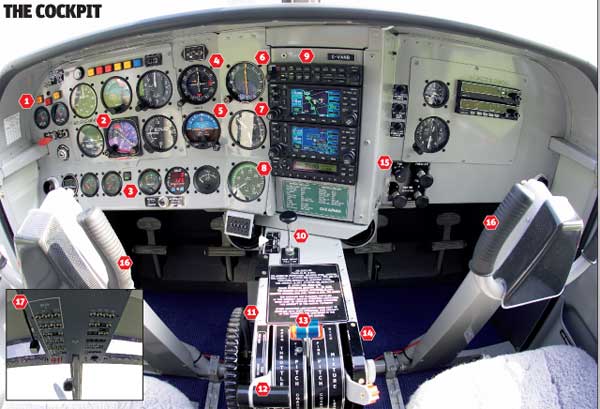
1. Fuel gauges for wing tanks and ignition switch
2. HSI surrounded by primary flight instruments
3. Engine oil tempreture and pressure gauges, plus cylinder head temperature, fuel computer.
4. VOR
5. Battery powered backup AI
6. Relative Bearing Indicator
7. Manifold pressure and fuel pressure gauges
8. Tachometer
9. Navcomm stack with two Garmin  430s
10. Parking break
11. Trim wheel
12. Throttle
13. Prop lever
14. Mixture
15. Fresh air and heater controls, plus spare altimeter, DME and ADF
16. Control columns, hinged at base
17. Roof-mounted master switches and circuit breakers

WORDS Dave Calderwood PHOTOS Dave Spurdens

News calendar
<October 2007>
SunMonTueWedThuFriSat
123456
78910111213
14151617181920
21222324252627
28293031
Partners
Aerobatics
Aeros with Alan – Opening your Personal Flight Envelope
Learning aerobatics is a great motivational tool for improving your flying.
Features
Learn to fly
So you want to learn to fly? What do you do? Take a look at our guide to get you airborne.
Find a school/club

Want to learn how to fly?
Click on the map above to find your nearest flight training school.

News
GA businesses given 30 days to move outSOUTH coast airfield Lee-on-Solent is facing closure to General Aviation. All aviat ... more
AIRFIELD licensing costs will rise 65-88% next year under the latest scheme of charges proposed by the CAA.The steep hike is ... more
Maiden flight for new Italian light twin powered by RotaxA BRAND new light twin aircraft being developed by Italian manufa ... more
All material © LOOP Publishing (UK) Ltd 2005-2007