Register for LOOP

Get your copy of LOOP by registering for FREE! Go

Find a school/club

Book Flying Lesson

Click Here Go

Buy an aircraft

Click Here Go

Sell an aircraft

Click Here Go
Explore

LOOP Features

nil

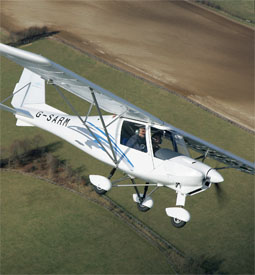
Ikarus C42 FB100

Firmly established with flying schools as a training aircraft, the Ikarus C42 is another extraordinary performer, accelerating to takeoff speed with two 12/13-stone pilots on board in just the first 50 or so metres of Old Sarum’s 06 grass runway. (This flight was a few days earlier.)

This was a formation takeoff behind a Cessna 152, our cameraship for this sortie, and the difference in takeoff performance was outstanding. We were 200 feet above the 152 and catching it by the end of the runway despite throttling right back.

Once the cameraship ahead had picked up speed and height, we continued the climb at around 900ft/min, using the electric button on top of the stick to trim out the forces. A display on the panel shows how much trim is deployed.


Visibility good from Ikarus C42, thanks to deep windows

The control stick reminds me of the gearlever in a BMW 5-series – short and chunky. It’s at elbow height so your arm can sit on the rear of the centre console. Each pilot has a throttle which is a metal rod between your legs, angled upright. You can see why instructors like the C42 – they can smack a hand off the stick if the student gets a bit out of shape.

It’s a very stable aeroplane, smoothing out bumps and flying as though it has the inertia of a much heavier aircraft. That means it’s a bit harder work to turn than, say, the Eurostar, with slightly heavier stick forces, but that’s only relative.
Compared with a C152, the Ikarus is a sporting aircraft. That said, the C42 feels as though it’s running on rails, and doesn’t have the twitchiness which sometimes affects the Eurostar.

The C42 cruises happily at 83kt – the ASI is calibrated in knots – at which speed it’s burning 11 litres per hour. That speed is hugely variable with the aircraft happy to bat along at 100kt, or slow right down to 65-70kt. Three stages of flap are available – the first is used for takeoff – deployed by a handle in the roof.

Coming back into the circuit and to land was a doddle. This really is a very straightforward and seemingly viceless aircraft to fly. There was a bit of a crosswind but the large powerful rudder easily held that in check and being so low to the ground meant judging the fl are and holdoff was a piece of cake. It’s all over in seconds anyway – the aircraft seems to use even less roll during landing than takeoff.

This aircraft was Aerosport’s full-loaded demonstrator, to ‘Touring’ spec with a Kevlar finish panel surface, and a conventional Attitude Indicator – the only one of the three aircraft with this – and also powered by a 100hp Rotax 912 ULS. A 80hp version is available with marginally lower performance. What’s remarkable about the C42, apart from its ease of flying, is its roominess.
German engineering and manufacturing, in this aircraft at least, is still the force it used to be. Hinges, joints, bolts, brackets… all are finished in precisely machined aluminium, with proper bevelled edges and tight tolerances. The empennage is a work of art in itself. So, although it may be the Eurostar that steals your heart, the Ikarus C42 is more likely to win over your head.


BMW gearlever-like control stick

Most spacious cockpit of the three

100hp Rotax 912 and 3-blade prop.


Standing alongside it, it seems small, especially when it’s next to a Cessna. Get in and it’s the Tardis effect – where does all that space come from? The cockpit is 48 inches wide, giving plenty of shoulder room, the supportive seats are sports car-like (the padding did start to feel a bit thin on the second sortie), and the view forwards is tremendous over the low nose. Being high wing, there’s less visibility in turns, but there is a clear panel in the roof which helps. Inspect the aircraft closely, as in a pre-flight, and you start to appreciate how well it’s built.

1. Air speed indicator
2. Attitude Indicator (an optional extra)
3. Vertical Speed Indicator, left and Tachometer
4. Rudder pedals
5. Altimeter
6. Garmin 196 GPS (non-standard)
7. Radio
8. Stick with electric buttons on top
9. Compass and slip ball
10. Circuit breakers
11. Engine instruments

Specification:
Ikarus C42 FB100
Performance
Vne 121kt
Max level speed 108kt
Cruise speed 85kt
Stall speed 32kt
Takeoff roll 80mt
Landing roll 110mt
Rate of climb 1050ft/min
Fuel burn 11.5lt/hr
Cruise range 449nm
Specifications:
Power Rotax 912 ULS producing 100bhp
Propeller 3-blade Neuform, ground adj
Length 6.25 mt
Height 2.2 mt
Wingspan 9.45 mt
Wing area 9.84 sq mt
Seats 2
Empty weight 265kg
Mtow 450kg
Max load 185kg
Fuel capacity 65 litres
Price: Base: £46,532
As tested: £51,148
Manufacturer:
T. 0049 07572 60080
W.
www.comco-ikarus.de
Comco Ikarus
Flugplatz Mengen
D-88367
Hohentengen
Germany
UK Distributor:
T. 001384 221550
W.
www.aerosportuk.com
Aerosport
Wolverhampton Airport
Bobbington
Stourbridge
DY7 5DY


Now showing on:


News calendar
<October 2007>
SunMonTueWedThuFriSat
123456
78910111213
14151617181920
21222324252627
28293031
Partners
Aerobatics
Aeros with Alan – Opening your Personal Flight Envelope
Learning aerobatics is a great motivational tool for improving your flying.
Features
Learn to fly
So you want to learn to fly? What do you do? Take a look at our guide to get you airborne.
Find a school/club

Want to learn how to fly?
Click on the map above to find your nearest flight training school.

News
AIRFIELD licensing costs will rise 65-88% next year under the latest scheme of charges proposed by the CAA.The steep hike is ... more
Maiden flight for new Italian light twin powered by RotaxA BRAND new light twin aircraft being developed by Italian manufa ... more
CESSNA has confirmed it is negotiating to buy Columbia Aircraft. Columbia ran into financial difficulties and filed for Ch ... more
All material © LOOP Publishing (UK) Ltd 2005-2007