Register for LOOP

Get your copy of LOOP by registering for FREE! Go

Find a school/club

Book Flying Lesson

Click Here Go

Buy an aircraft

Click Here Go

Sell an aircraft

Click Here Go
Explore

LOOP Features

nil

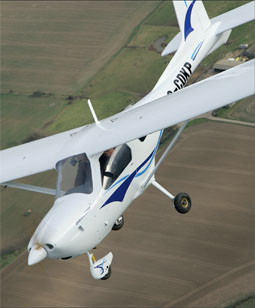
Jabiru Calypso UL-D

It has taken the Australian manufacturer of Jabiru aircraft five years to develop this aircraft to satisfy the UK certification requirements for a factorybuild aircraft. That’s despite Jabiru having sold 1000 aircraft as kitplanes over the past 15 or so years, and they’ve had to make substantial changes in the process.

The main changes you’ll see between the Calypso and previous microlight Jabiru kitplanes is that the fuel is now contained in the wings rather than a tank behind the seats – a boon for weight and balance as well as for safety – and the fin is bigger and has been moved forward. Winglets have also been fitted and they’re said to improve aileron response.

Upfront is Jabiru’s own 2200cc 85hp four-cylinder four-stroke aircooled engine, which uses direct drive to the propeller rather than a reduction gearbox (as on the Rotax 912 used in both the Eurostar and Ikarus C42). None of these aircraft is noisy but the Jabiru is appreciably quieter inside and out, and has less vibration thanks to direct drive. The Calypso is also significantly less expensive at £38,000 all-in.

That price includes basic instruments, radio, headsets, spats, fuel sampler and heater (not fitted in this first UK example). One reason for the lower price is that Jabiru makes practically everything on the aeroplane – airframe, engine, prop... even the wheels. Just the tyres, instruments and radio are bought in.

Walking up to the aircraft, the outside finish is superb. It’s the only all-composite aircraft here and beautifully made. The engine cowling was a bit of an effort to get off and on, but revealed an easy to work on engine with plenty of space around it. There’s no coolant plumbing unlike the Rotax, which saves weight and cost.

It’s as you duck under the wing to get in that you realise the Jabiru is appreciably smaller than the others. You enter in front of the strut with the two side doors opening conventionally, putting your bottom on the seat and then lifting your legs. As the door closed and Kevin Pearce, the UK distributor, sat alongside me, the cockpit felt tight. Sure enough, our elbows and shoulders were rubbing. It’s as cosy as a Cessna 152 but with less window area.
The nosewheel is steered directly by the rudder pedals, which I found too close together.
Sitting in the right seat, I couldn’t push the left rudder bar without overlapping my foot (admittedly, they are size 11s) onto the right rudder bar. The only way I could avoid this was by angling my foot sideways. Now, obviously, if this was your regular aircraft you’d experiment with narrow shoes such as car racing boots, but to my mind this is a design flaw.

Happily, the other controls are much better. The central stick is at a convenient height, the throttle is between the legs with a large red knob… did I really just write that? Anyway, the trim lever is also easy to get at on the centre console. Takeoff roll was slightly longer than the other two aircraft but still sprightly with plenty of Rochester’s runway 34 left as we climbed out at around 1000ft/min.

This is where the Jabiru’s strengths lie – performance. That small cockpit pays off in the air with its lower frontal profile giving less drag. We accelerated to a cruise speed of 100kt quickly with plenty of power in hand as we caught up with the Cessna 172 cameraship. The Calypso is burning 14 litres an hour at this speed and feels absolutely solid and comfortable.

The Jabiru engine is remarkably smooth and quiet throughout the rev range and it would be possible to fly comfortably without a headset in this aircraft – not the case with the others. Perhaps that’s partly due to the pale blue insulating material used on the inside of the Jabiru composite shell. It’s not the most stylish of finishes, but it is sound-absorbent.


Handling of the Calypso is excellent

Visibility good forwards, not so good in turns

Long wings, slim shape equal speed

Visibility is fine straight ahead, with a low panel and nose – much better than most Group A aircraft – but not so good sideways, especially in turns. There’s no window in the roof so you end up angling your head forward to see past the leading edge. Small windows behind the B pillars help rear three-quarters vision but there’s no rear window as such.

This was a brand new aircraft with just 5.1 hours on the clock and perhaps it needed a little fettling here and there. The stick had a small amount of stiction in roll, not much but enough to be aware of it. I found the combination of that and the too close rudder pedals a bit of an issue when trying steep turns – I just couldn’t pin the nose in a nice level turn though Kevin Pearce, with many more hours on Jabirus, managed it perfectly.

Coming back into the circuit at Rochester showed the slipperiness of the aircraft. Close the throttle in the Jabiru and it’ll keep whistling on, unlike the Eurostar and Ikarus which slow immediately, as most draggy microlights do. We approached at 55kt, deployed flap – the lever is only on the left side by the wing root – and landed neatly just past the numbers.

It’ll be interesting to see how flying schools take to the Calypso. The price will appeal, as will the simplicity of the engine, and the aircraft looks terrific. It’s smaller in the cockpit than the others, and the rudder pedals don’t suit bigfooted pilots. It’s fast and thus will appeal to pilots wanting to go places, and the composite construction means it can be left outside in most weathers.

1. Choke
2. Air speed indicator
3. Microair radio
4. Altimeter
5. Trim lever
6. Carb heat- only one of these aircraft to need it
7. Vertical Speed Indicator
8. Brake lever
9. Engine instruments
10. Rudder pedals
11. Tachometer
12. Fuel warning lights (for 6-litre header tank)

Specifications
Jabiru Calypso UL-D
Performance:

Vne 120kt
Max level speed 120kt
Cruise speed 100kt
Stall speed 34kt
Takeoff roll 100mt
Landing roll 160mt
Rate of climb 1200ft/min
Fuel burn 14lt/hr
Cruise range 468nm
Specifications:
Power Jabiru 2200 producing 85bhp
Propeller 2-blade Jabiru, fixed pitch
Length 5.77mt
Height 2.01mt
Wingspan 9.56mt
Wing area 9.31 sq mt
Seats 2
Empty weight 255kg
Mtow 450kg
Max load 195kg
Fuel capacity 76litres
Price: Base: £38,000
As tested: £38,000
Manufacturer:
T. 00 617 4155 17882
W.
www.jabiru.net.au
Jabiru Aircraft
Airport Drive
Bundaberg West
Queensland
4670 Australia
UK Distributor:
T. 0870 300 0501
W.
www.jabiru.co.uk
ST Aviation
Oaklands Farm
Coltstaple Lane
Horsham
West Sussex
RH13 9BB

Now showing on:


News calendar
<October 2007>
SunMonTueWedThuFriSat
123456
78910111213
14151617181920
21222324252627
28293031
Partners
Aerobatics
Aeros with Alan – Opening your Personal Flight Envelope
Learning aerobatics is a great motivational tool for improving your flying.
Features
Learn to fly
So you want to learn to fly? What do you do? Take a look at our guide to get you airborne.
Find a school/club

Want to learn how to fly?
Click on the map above to find your nearest flight training school.

News
AIRFIELD licensing costs will rise 65-88% next year under the latest scheme of charges proposed by the CAA.The steep hike is ... more
Maiden flight for new Italian light twin powered by RotaxA BRAND new light twin aircraft being developed by Italian manufa ... more
CESSNA has confirmed it is negotiating to buy Columbia Aircraft. Columbia ran into financial difficulties and filed for Ch ... more
All material © LOOP Publishing (UK) Ltd 2005-2007