Register for LOOP

Get your copy of LOOP by registering for FREE! Go

Find a school/club

Book Flying Lesson

Click Here Go

Buy an aircraft

Click Here Go

Sell an aircraft

Click Here Go
Explore

LOOP Features

nil

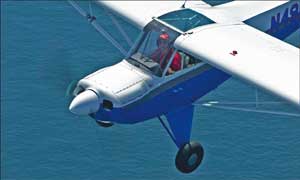
Go Anywhere in the Husky A1-B-200

Just how 'short' does a short takeoff and landing aircraft need to be? Any shorter than the hop, skip and a jump required by the latest 200hp Husky and you're really talking helicopters. But listen to owner Brian Hill describe his 300-yard long strip in what's basically his back garden, with an approach over wires, and you realise that for some pilots, the shorter the better.

That's what the Husky is all about, and this particular aircraft, launched late last year by the Wyoming company, is the best yet. It's powered by the fuel-injected version of Lycoming IO-360, rated at 200hp, and fitted with the latest curved blade MT constant-speed prop.

Husky also changed the wing last year, adding 13 inches in length to the flaps, making them even more effective. The 13in had to come off the inboard length of the ailerons but these have been made deeper in chord to compensate. In refashioning the ailerons, Husky was able to do away with the old 'spades' and lighten the stick forces in the process.

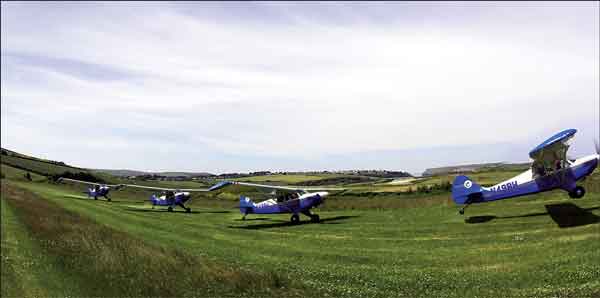
Takeoff and landing roll wasn't an issue for the Husky at Roserrow, the golf course with its own 700-metre grass strip near Polzeath, Cornwall, where this flight test was set. So Bob Pooler, MD of Aviat Aircraft UK, importer of the Husky and also Pitts aircraft, set an artificial target.


Having worked out with our stills photog, Dave Spurdens, and video cameraman, Steve Makin, exactly where they wanted wheels off the ground, Bob taxied the Husky back towards one end of the strip... for a couple of seconds. Then he spun the aircraft around, ran it up to full power, released the brakes, and well within 150 yards, the Husky was in the air, having taken off from a three-point attitude. What's more, it was going up at a heck of a rate, its two-blade prop clawing at the air. Max initial rate of climb for the Husky is a claimed 1700 feet per minute at gross weight.

Then it was my turn. There were some considerations to make. First, it was a hot day, with just a very light wind at right-angles to the strip. No gains there. The Roserrow strip, although quite long, starts off uphill, undulates, then plunges downhill over a brow which hides the end of the strip. The grass hadn't been mown for a while, so another loss there. And with Bob and I on board, plus almost full fuel, we'd be weighing a fair bit too.

Bob settled me into the rear seat - the Husky is flown solo/P1 from the front seat. You can't see all the instruments clearly from the rear seat and the trim wheel is adjacent to the P1 position. OK, so it's a no brainer - with all these factors, Bob would make the takeoff and landing with me following through on the controls.

After an age checking the two on-board in-flight cameras and their controls, and going through the plan once again, we finally lined up. Full flap - 30º - full power, off the brakes, stick right back - no easing forward to lift the tailwheel - and with no drama at all, we were heading skywards with barely a sign of the horizon through the forward view. The AI was deep into the blue, and the airspeed picking up nicely as we banked gently away towards the coast just a mile or so west of Roserrow.

From the air, the view from the Husky was superb and we could see the Yak 18T cameraship, doors off, line up to follow us into the air. Having landed at Roserrow in the 18T earlier that day,  I knew the aircraft would need a much longer run and you could almost see the ground shaking as the big Russian radial-engined beast thundered down the strip.

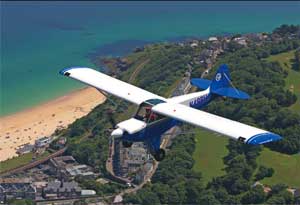
The two aircraft liaised over the rugged Cornish coast. In the clear early June sunshine, the sea looked an amazing, almost Mediterranean, deep blue. If ever there was an advertisement to holiday here, this was it.
As we crossed the estuary of the River Camel, upmarket Rock on one bank, Rick Stein's Padstow on the other, we talked to Mawgan Radar for a MATZ crossing. They were busy, with plenty of fast jet and helicopter traffic, but cleared us through, then handed us over to Perranporth, which looked equally appealing from the air.

The plan was to fly down the coastline to Land's End, shooting stills and video, while getting used to the Husky. We'd taken off with the right hand door of the Husky in the open position - the bottom, metal half, hinges downwards, and the top, perspex half clips under the wing. But the wind rush into the cockpit, buffeting the mikes, was making radio transmissions hard to hear, and it was surprisingly busy out there.

With the door shut, the Husky suddenly became a very calm place. It's actually a very comfortable aircraft with wide almost armchair-like seats. The rear seat, in particular, is wide and plush, finished in a soft leather. It's still a little awkward to get into, threading your left leg past the central stick and down the side of the front seat, but once in there's plenty of room.

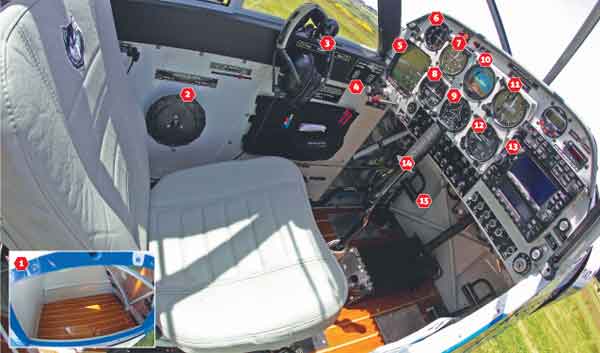
It's also extraordinarily well finished. First thing you notice is the floor, covered in teak and varnished like a boatdeck. Then there's the panel. You can choose from a variety of instrument fits, from basic VFR to the IFR panel seen here.

As well as the standard six-pack of primary instruments, there's a Garmin GNS430 navcomm unit and GTX327 Mode S transponder, plus an electronic display of engine instruments, the Vision Microsystems 1000. This remarkable bit of certified kit shows engine manifold pressure, rpm, CHT, fuel pressure, oil temps & pressures, volts & amps, OAT and, most impressive, the fuel flow. This last gauge can be used with the CHT to lean the mixture for best economy which, in such a draggy airframe, is a boon for long distance touring.

And yes, you could go touring in the Husky. Useful load is 367kg - 810lb - which is plenty for two normal-size adults, full fuel, and a fair amount of baggage. There's a huge space behind the rear seat for baggage, and another bay in the rear of the fuselage reached via a panel on the left side - deep enough for a tent and sleeping bags should you be keen on the great outdoors. The Husky is certainly capable of landing and taking off from next-to-nothing in terms of an airstrip.

What impressed me on the flight at 1000ft down the Cornish coast was just how steady and stable the Husky was. I'd imagined a STOL aircraft to be flighty and edgy, but nothing of the sort. Very confidence inspiring.

As we neared Land's End, we became aware their circuit was busy and we were asked to remain clear for a while. With the Scilly Isles' Islander service departing, we were cleared through to continue the photo shoot over the top of the Longships lighthouse and even asked by the Tower for a flypast!

Pix done, we turned around to head north up the coast. This time Mawgan was preoccupied with helicopter traffic and we were cleared through at 3000ft which necessitated a full power climb, followed by a sinus-clearing descent on the other side to bring us into Roserrow.

Bob had already made several landings here so had worked out the routine, which seemed to consist of hugging the hillside, adding power to counter possible sink as we crossed a ravine-like valley just before the threshold, then flaring at an impossibly low speed to touchdown and roll to a

halt in less than 100yards. It was all over extremely quickly. Bob's technique is to wind on plenty of trim so that he's actually holding the stick forwards on the approach, then he relaxes the stick against the trim force for the flare, pulling back for touchdown and roll-out.

With a pilot of Bob's calibre at the controls, the Husky is an extraordinary STOL performer but it's not a stripped-down boneshaker either. Far from it. The new Husky has real bite, a quality finish and touches of luxury that belie its backcountry origins.

 OWNERS REPORT
Owner of the 200hp Husky tested here is Brian Hill, a West Midlands businessman. Brian has operated a succession of aircraft - 28 over 31 years of flying including RVs, Archers, Pups. What prompted him to buy the Husky was vandals causing damage at his old strip. "That decided it," he said. "I wanted to move the aircraft to my home." That meant operating from a 300-yard strip with a less than perfect approach.
"I looked at all sorts of aircraft, including a 180hp American Champion Scout and a Maule. The Scout had similar performance but the finish of the Husky was much higher. The Maule was a non-starter because of the yoke and the forward visibility wasn't good enough.

"The Husky just looks at my strip and laughs," he says. He admits to taking extreme care of his aircraft (he built his previous RV8 to immaculate standard). "Every time the Husky flies, it's cleaned afterwards. I like to do as much of the work on the aircraft as I can - if you want something done right, do it yourself!"

 HUSKY HISTORY
The Husky is made by Aviat Aircraft Inc in Afton, Wyoming - cowboy country! It's conceptually based on the Super Cub, but is a completely new design created in 1986 and fully certified in 1987. More than 650 have now been made and are in use all over the world. Stuart Horn acquired Aviat Aircraft in 1996, making immediate changes to "refocus the core business of the company". It's worked, sales are up and new models and derivatives keep coming.

Husky A1-B-200
PERFORMANCE
Top speed 126kt
Stall speed 37kt
Cruise speed 113kt
Range 695nm
Rate of climb 17000ft/min
Fuel burn 29 litres/hour

SPECIFICATIONS
Power Lycoming IO-360 producing 200hp
Prop 2-blade MT constant-speed, 210cm diameter
Length 6.9mt
Wingspan 10.8mt
Wing area 17 sq mt
Seats 2
Empty weight 540kg
Mtow 907kg
Useful load 367kg
Fuel capacity 197 litres

PRICE
As tested £136,000

MANUFACTURER
Aviat Aircraft, Inc
672 South Washington Street
PO Box 1240
Afton, WY  83110
USA
W: www.aviataircraft.com

UK DISTRIBUTOR
Aviat Aircraft (UK) Ltd
Lower Grounds Farm
Sherlowe
High Ercall
Shropshire TF6 6LT
T 01952 770428
W www.aviataircraft.co.uk


1. Behind seats luggage bay - there's another in the rear of the fuselage
2. Trim  wheel
3. Throttle
4. Propeller control (black knob) and mixture (red)
5. Vision Microsystems electronic engine instrument display
6. VOR
7. Air Speed Indicator
8. Turn coordinator
9. Direction Indicator
10. Attitude Indicator
11. Altimeter
12. Verticle Speed Indicator
13. Garmin GNS 430 navcomm unit, with Garmin transponder below
14. Stick
15. Left rudder pedal. Note the plush soft leather seat, teak floor and general high standard of finish

GO TO ROSERROW
JUST a mile outside the north Cornwall town of Polzeath, Roserrow is a very special place. It's a golf and leisure centre, with swimming pool, fitness rooms, beauty salon, restaurant, bar and, of course, golf. Various houses and flats are available to rent, or buy, all within a short walk of the club's facilities.
The airstrip is available for daylight hours only and at pilot's own risk. The strip is orientated 09/27, 700 metres long and 60 metres wide. The best approach is for 09 as this gives an uphill section for the first part. W: www.roserrow.co.uk

NOW WATCH THE HUSKY IN ACTION ON  

News calendar
<October 2007>
SunMonTueWedThuFriSat
123456
78910111213
14151617181920
21222324252627
28293031
Partners
Aerobatics
Aeros with Alan – Opening your Personal Flight Envelope
Learning aerobatics is a great motivational tool for improving your flying.
Features
Learn to fly
So you want to learn to fly? What do you do? Take a look at our guide to get you airborne.
Find a school/club

Want to learn how to fly?
Click on the map above to find your nearest flight training school.

News
GA businesses given 30 days to move outSOUTH coast airfield Lee-on-Solent is facing closure to General Aviation. All aviat ... more
AIRFIELD licensing costs will rise 65-88% next year under the latest scheme of charges proposed by the CAA.The steep hike is ... more
Maiden flight for new Italian light twin powered by RotaxA BRAND new light twin aircraft being developed by Italian manufa ... more
All material © LOOP Publishing (UK) Ltd 2005-2007