|
|
|
Register for LOOPGet your copy of LOOP by registering for FREE! | Find a school/club | Book Flying Lesson
| Buy an aircraft
| Sell an aircraft
| |||
LOOP Features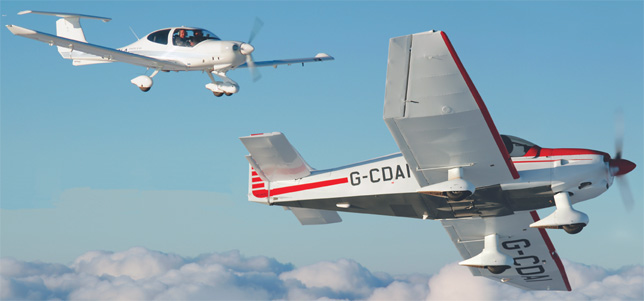 Robin DR400 and Diamond DA40 in flight Diamond Twin Star DA40- TDIA few months ago, as you might have read in the very first edition of LOOP, I flew the Diamond Twin Star. I really liked this twin, particularly the modern styling and swept-up cockpit. So I was really looking forward to seeing the DA40 to compare it with its big brother. First viewing impressions were very favourable, and given that the fuselage is essentially the same for both the single and the twin (albeit with the obvious lack of a propeller on the front of the Twin Star), this came as no surprise. The smooth curves, modern construction, and (like the twin) winglets give the DA40 an eye-catching look. The seats are equally stylish and comfortable; the front seats are fixed (the rudder pedals are adjustable), so rear seat passengers are not squashed by rearwards movement of the front seat by a tall pilot. I did find that, although leg room was sufficient with rudder pedals adjusted, the top of my headset occasionally touched the canopy above my head. The DA40 we flew featured a conventional IFR instrument panel with twin Garmin GPS navigation units. Engine indications were contained on one dial featuring red/amber/green LEDs. This was a very easy instrument to use, as the colour coding clearly indicated when all was well in terms of temperatures and pressures. Starting these Thielert diesel engines is so easy. Engine Start Master ON, wait for the glow plug annunciation to extinguish, turn the key to turn the engine. Seconds later the engine is ticking over with the throttle at idle. Minimal engine checks are required – merely press and hold the Engine Control Unit (ECU) Test button, and watch and hear the engine test itself! The flaps have a take-off and landing position, so with the minimum of fuss, we are ready to go. This test took place at two different airfields, although that wasn’t the original plan. The first part, for the Diamond, was at Rochester Airfield on a damp, miserable day. The airfield was particularly wet, almost boggy, and taxying had to be done with care. I was mindful of the dangers of operating off wet grass (more take-off run is required, of course), but with full power applied the DA40 accelerated surprisingly well. We eventually took off with the assistance of a gentle bounce with lots of runway remaining, and we accelerated away in a steady climb of around 900fpm. There was a notable sink as the flaps are raised to up, so the flaps should not be raised too soon after lift-off! The DA40 was quite happy to remain at 100% power (as shown in large digital numbers) and we snapped up to 120 knots at which point we brought the power back to 80% to maintain that speed. Fuel consumption (again shown in large digits) stabilised at 5.7 gallons/ hr (and this is Jet fuel at around £1.25/ gallon). The DA40 is fitted with a control column with electric elevator trim, the throttle is pleasantly light, and the view is superb, so it is easy to get the aircraft set up in a very comfortable cruise. With the low noise levels, you could really enjoy long trips in the DA40 – up to five hours is possible although natural functions would probably limit trip lengths! The Diamond is very stable in flight, but with crisp control response making it easy to fl y accurately – in formation, for example. Fuel is contained in the left and right wings, but feeds to the engine from the left tank only. It is necessary to transfer fuel occasionally from the right wing to the left wing using the crossfeed pump to remain in fuel balance. And apart from monitoring that large digital engine display, there was little else to do but enjoy the ride! Returning to the airfield we set up for a long straight-in approach, initially to go-around. The DA40, being so sleek, is pretty slippery so reducing speed in a descent can be a slight problem if you are not careful; however, closing the throttle completely puts the propeller at fully fine, which acts as an effective speedbrake. After the go-around, flying the circuit was straightforward, although you have to be mindful of accelerating downwind. With full flap selected, the final approach was very stable with a good view forwards to the runway. I was again careful to consider the landing on the same wet grass – I wanted to be right on speed (70kt) as that super wing is aching to give extra lift in the fl are if too fast, extending the landing run! However, the DA40 settled smoothly onto the grass shortly after closing the throttle, and with careful braking we comfortably slowed the aircraft down to vacate the runway. So that was the Diamond DA40 – modern, sleek, stylish, and lovely to fly. How would the Robin compare to this? Now showing on:
|                      | ||||||
 Aeros with Alan – Opening your Personal Flight Envelope Learning aerobatics is a great motivational tool for improving your flying. |  Learn to fly So you want to learn to fly? What do you do? Take a look at our guide to get you airborne. | 
Want to learn how to fly? |
GA businesses given 30 days to move outSOUTH coast airfield Lee-on-Solent is facing closure to General Aviation. All aviat ... more AIRFIELD licensing costs will rise 65-88% next year under the latest scheme of charges proposed by the CAA.The steep hike is ... more
Maiden flight for new Italian light twin powered by RotaxA BRAND new light twin aircraft being developed by Italian manufa ... more | ||||
| All material © LOOP Publishing (UK) Ltd 2005-2007 |