Register for LOOP

Get your copy of LOOP by registering for FREE! Go

Find a school/club

Book Flying Lesson

Click Here Go

Buy an aircraft

Click Here Go

Sell an aircraft

Click Here Go
Explore

LOOP Features

Robin DR400-135 CDI
Robin DR400-135 CDI

Robin DR400-135 CDI

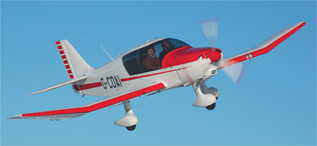
The Second part of the Diesel Duel had to be carried out on another day, as the Robin could not get out of its home field due to the weather. So we reconvened at Cambridge Airport, LOOP’s local, a few days later with Bob Cole, one of the UK’s two Robin distributors, flying the DR400-135 CDI in.

As Bob taxied across the apron at Cambridge, the diesel-powered Robin looked identical to its avgas equivalent– large canopy, cranked wings, traditional construction with fabric covering. On closer inspection, a few extra bulges on the lower sides of the cowling gave away the bulkier engine. The Robin’s large canopy slides forwards for cockpit entry, and (in contrast to the DA40) the rudder pedals are fixed and the front seats slide fore and aft to suit pilot size.

There is more headroom in the Robin – I did not bump my head on the roof! The seats are comfortable, but perhaps not so stylish as the Diamond. The instrument panel is more conventional than the DA40, with a single Bendix GPS unit. The same engine instrument is fitted, however, and engine start accomplished in the same effortless way. Cockpit noise after start was minimal, and even less when the ANR headsets were activated. Taxying is as simple as the Diamond, made easier of course by the hard surfaces at Cambridge. With the same short engine checks completed we were ready for take-off.

With a near full fuel load and two of us on board, the Robin briskly accelerated down the runway and lifted off easily. A little bit of sink was again apparent on raising the flaps to up, but the aircraft climbed away very comfortably at 100% power. Flying the Robin was just as pleasant as the Diamond. Again fitted with a control column rather than a yoke, control forces in pitch and yaw were similar to the DA40, with roll control slightly heavier but still quite acceptable.

Properly trimmed out, the Robin was stable and required little effort to maintain heading. The view outside was possibly better than the DA40! And remarkably enough, the Robin cruised at the same 120kt with 80% power as the DA40 – the Robin was not fitted with a fuel flow gauge, but factory figures show fuel usage a tad higher to that of the Diamond. The Robin is not as slippery as the DA40, so decelerating the aircraft was not a problem in a descent. The Robin was stable on the approach with a good view of the landing area, but with full flap selected there was a fair amount of drag. Care must be taken to keep a reasonable amount of power up to avoid speed decay on short finals and a firm landing. It’s hard to make any adverse comments about either of these aircraft. Both are roomy, comfortable touring types, fitted with the same Thielert diesel engine which provides excellent fuel economy.

The diesel engine has the added advantage with the simplicity of operation – easy starting and a single lever control, with all power and propellor pitch changes looked after by the Full Authority Digital Engine Control (FADEC), and no mixture or carb heat to worry about. As an aside, I noticed when flying both aircraft in formation with a cameraship that the diesel engine has a little bit of response lag, which is similar to the response of jet engines.

This could make diesel engines even more suitable for training jet pilots. Back to the Robin DR400 and Diamond DA40. Potential owners can be confident of buying good looking aircraft with pleasant flying characteristics and great touring potential.

Like many other things, it may come down to cost! With its modern construction the Diamond is more expensive. Owners might also consider the established design of the Robin preferable to the relatively new Diamond (and perhaps easier and cheaper to repair). I suspect that the Robin might be more rugged if operating off grass strips. But the DA40 perhaps wins it on looks and style. So there we have it – two good aircraft, powered by modern diesel aero engines, perhaps indicating the direction of long-term GA design.

Now showing on:


News calendar
<October 2007>
SunMonTueWedThuFriSat
123456
78910111213
14151617181920
21222324252627
28293031
Partners
Aerobatics
Aeros with Alan – Opening your Personal Flight Envelope
Learning aerobatics is a great motivational tool for improving your flying.
Features
Learn to fly
So you want to learn to fly? What do you do? Take a look at our guide to get you airborne.
Find a school/club

Want to learn how to fly?
Click on the map above to find your nearest flight training school.

News
GA businesses given 30 days to move outSOUTH coast airfield Lee-on-Solent is facing closure to General Aviation. All aviat ... more
AIRFIELD licensing costs will rise 65-88% next year under the latest scheme of charges proposed by the CAA.The steep hike is ... more
Maiden flight for new Italian light twin powered by RotaxA BRAND new light twin aircraft being developed by Italian manufa ... more
All material © LOOP Publishing (UK) Ltd 2005-2007