Register for LOOP

Get your copy of LOOP by registering for FREE! Go

Find a school/club

Book Flying Lesson

Click Here Go

Buy an aircraft

Click Here Go

Sell an aircraft

Click Here Go
Explore

LOOP Features

nil

Zenair Zodiac CH601

The builder:

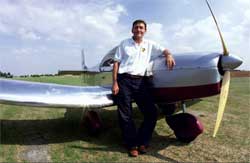
James Tannock
Zenair Zodiac

HAVING learnt to fly in New Zealdn in a Cessna 182, it was quite a jump for James to go to the Zenair - the only other aircraft he's ever flown. He chose to build the aircraft from plans, not a kit. He bought raw sheet aluminium which then had to have the sections drawn onto it before being cut out by hand, and shaped on a plywood former. He did buy the wing kit in order to obtain the main spar, but otherwise it was a long slog.

He started building in 1996, calling it his "Millennium Project" and sure enough he was flying in late 2000. "Thousands of hours" is the nearest estimate he can come to when asked how long it took.


The Zenair has a standard analogue panel but if you look closely, you'll notice the instruments have a vintage look. The Air Speed Indicator is from a 1943 Tiger Moth, unused when James bought it, the Altimeter is also 1940s and the Turn and Slip is similar to that used in a Chipmunk.

It's impossible to put a cost on James' Zenair, but a current Zodiac CH601 HDS with the latest slimmer wings costs costs $23,975 for the basic Quick-Build kit, to which you
have to add engine - choice of Rotax, Continental or Jabiru - instruments, avionics and paint.

The Aircraft

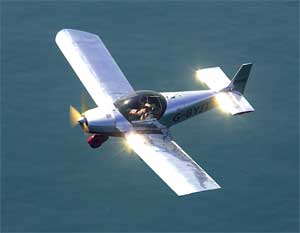
WE wanted to include a more traditional PFA aircraft in this review and James Tannock's Zenair Zodiac is just that. It's simple, with chunky wings, and very much adapted to James' desire to travel long distances as inexpensively as possible.

Getting in and out is probably the easiest of any of these three. The bubble can be opened from either side, so the passenger gets in first, the canopy closed, then opened up the other side for the pilot. The firm seats are deep in the fuselage - the sides are almost up to shoulder level - and the visibility is wonderful. It's not a big cockpit, cosy rather, but it didn't feel cramped. Hot, yes, very hot...

The little Zenair handled the takeoff crosswind with no problem and we were off about 300 metres down Fenland's runway - everyone was keen to avoid a rutted bump just after halfway. No flaps are fitted to the Zenair, nor constant-speed prop, so this was simple flying.

That big thick wing dictates a lot about this aircraft. First, it gives the Zenair plenty of lift at low speed which is how it gets away with such spritely takeoff performance on a hot day, two-up.

Second, the drag it creates limits the speed to around 90-92kt at 75% power (that's around 5000rpm for the 100hp Rotax). At this speed, it's burning 14-15 litres per hour. Flat out is 105kt at 5800rpm and at the other end of the sacle, the Zenair can be flown at 60kt for a thrifty 8-10 litres/hour if you just want a gentle bimble.

Third, the wing and its abrupt chamfered wingtips, endow it with a steadiness that's both reassuring, particularly on a hot, thermally, bumpy day, but also quite hard work. The stick is a centrally-mounted Y-shape, meaning pilot and passenger hold it at an angle.

That plus the heaviness of the roll gives the aircraft a ponderous feel, and also makes your wrist ache after a short while. James admits to 'swapping' hands on the control stick on long trips, just to ease the ache. He has later style HDS slimmer wings under construction at the moment which he hopes to have ready by the end of the year.

They will improve roll rate and the feel of the ailerons, as well as the cruise performance, and also move the fuel from a central fuselage tank to the wings.

But while the T-shape throttle - one on each side - and rudder pedals are also quite heavy, the pitch control is the opposite in being sensitive. This is an aeroplane that takes a while to tune into and make best use of.

And James has done just that, flying the Zenair on several long European trips including to Corsica, Majorca, the Amalfi coast in Italy and even to Morocco and back. Although the cockpit doesn't have a lot of room, there are large compartments in each wing which can each hold up to 60lb of luggage - "enough for a couple of overnight bags in each one".

What the Zenair shows is that a relatively low tech aircraft, built traditionally, can still deliver hugely enjoyable flying and take you places for very little money.

PERFORMANCE
Top speed 105kt
Cruise speed (75%) 90kt
Stall speed 38kt
Rate of climb 1200 ft/min
Takeoff roll 131m
Landing roll 168m
Fuel burn 15 litres per hour
Range approx 360nm (no reserve)

SPECIFICATIONS
Power Rotax 912S producing 100hp
Prop 2-blade fixed-pitch
Length 5.8m
Wingspan 8.2m
Wing area 12 sq m
Seats 2
Empty weight 267kg
Mtow  544kg
Useful load 277kg
Fuel capacity 60 litres

PRICE
Base kitprice $23,975

MANUFACTURER
Zenith Aircraft Company
Mexico Airport
PO Box 650
Mexico
Missouri 65265-0650 
USA
T: 00 1 573 581 9000
W: www.zenithair.com

News calendar
<October 2007>
SunMonTueWedThuFriSat
123456
78910111213
14151617181920
21222324252627
28293031
Partners
Aerobatics
Aeros with Alan – Opening your Personal Flight Envelope
Learning aerobatics is a great motivational tool for improving your flying.
Features
Learn to fly
So you want to learn to fly? What do you do? Take a look at our guide to get you airborne.
Find a school/club

Want to learn how to fly?
Click on the map above to find your nearest flight training school.

News
AIRFIELD licensing costs will rise 65-88% next year under the latest scheme of charges proposed by the CAA.The steep hike is ... more
Maiden flight for new Italian light twin powered by RotaxA BRAND new light twin aircraft being developed by Italian manufa ... more
CESSNA has confirmed it is negotiating to buy Columbia Aircraft. Columbia ran into financial difficulties and filed for Ch ... more
All material © LOOP Publishing (UK) Ltd 2005-2007