Register for LOOP

Get your copy of LOOP by registering for FREE! Go

Find a school/club

Book Flying Lesson

Click Here Go

Buy an aircraft

Click Here Go

Sell an aircraft

Click Here Go
Explore

LOOP Features

nil

VANS RV-8

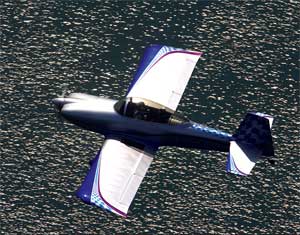
SUFFOLK businessman Nic Hart has lavished a great deal of care and attention to detail on the construction of his RV-8, and the result is a beautifully finished aeroplane that flies as well as it looks.

With its exotic blue-and-silver paint scheme, sculpted wing tips, and curvy three-blade prop, G-XSEA has a thoroughly modern appearance. The 21st century theme continues inside the cockpit with a Garmin 296 moving-map GPS, and Dynon EFIS and engine monitoring systems.
The cockpit provides plenty of room at the shoulders and elbows to make getting seated and strapped in easy, and while the seat is fixed the rudder pedals are adjustable.

I needed the rudder pedals close to fully aft to suit my short legs, and I used an additional seat cushion to get a comfortable position. Even then there was plenty of space between the top of my headset and the canopy, so accommodating pilots over six feet tall should be no problem.

The RV-8 is designed to accept engines from 150hp to 200hp, and G-XSEA is fitted with a new Superior Air Parts XP Series IO-360 180hp engine, with an inverted oil system. Inverted fuel supply is provided via a flop-tube in the left tank.

Starting the XP engine follows the standard Lycoming IO-360 procedure - prime with the electric fuel pump, then mixture lean, throttle set, engage starter, and when the engine fires, mixture to full rich and set 1000rpm for warm-up.

Sitting on the ground ready to taxi, visibility over the nose is exceptional. So much so, that it's easy to forget you're in a tailwheel aeroplane, and it means that weaving is not necessary while taxiing.

G-XSEA is not fitted with a flap position indicator, so the correct takeoff position for the flaps is found by applying full aileron and then matching the flap setting to the deflection of the down-going aileron.

Applying full power for takeoff results in better acceleration than might be expected for a 180hp aeroplane, so the constant speed propeller does make a difference in this area. The aeroplane is very easy to keep straight in the takeoff roll, and there is almost no swing as the tail is lifted. After takeoff, with climb power set, we had a rate of climb of about 1500 feet per minute.

In the air the handling is sharp and precise - the ailerons in particular are remarkably light. While the RV-8 can be cleared by the PFA for aerobatics, approval requires an individual evaluation of each aeroplane. This has not yet been carried out on G-XSEA we limited our manoeuvring to steep turns, wing-overs, and chandelles. With the responsive controls and tremendous all-round visibility, enthusiastic manoeuvring is completely effortless and great fun.

The clean stall comes at an indicated 55kt and is preceded by an unmistakeable buffet. The buffet continues until the nose drops gently at the stall. In the approach configuration the stall comes about 5kt slower, and still without a hint of wing drop.

Cruising speed at 75% power is about 175kt, but Nic generally tends to use lower cruise power settings - more like 55% - to benefit from fuel consumption of less than 30 litres per hour. At this power setting, the TAS is still around 130kt and I found the aeroplane to be remarkably quiet.

Back in the circuit the aeroplane in not unduly slippery and slows up to flap limiting speed easily. Nic had advised that closing the throttle completely in the flare could result in a high sink rate developing due to the 'discing' effect of the constant-speed MT prop. So I kept a trickle of power on all the way to the ground, which worked well and led to a gentle three-point touchdown.

Once on the ground the aeroplane tracks straight as a die right down to taxiing speed.
In the cruise the aeroplane is fast, stable, economical, and quiet, and with its decent baggage space and fuel endurance the RV-8 is a great touring aeroplane. Add this to good handling and the prospect of aerobatic capability and you've got a very desirable sport aeroplane.- Phil O'Donoghue

G-XSEA is fitted with a Dynon EFIS-D10A Electronic Flight Information System (click here for review) and a Dynon EMS-D10 Engine Monitoring System. The body of each of these instruments is cylindrical and fits into a standard 31/8" instrument panel hole, with the 4" LCD screen sitting neatly against the panel.

The EFIS-D10A display is dominated by a colour attitude indicator onto which other flight parameters are superimposed. The most prominent of these are the vertical reading tapes for airspeed and altitude at either edge and a 'ribbon' style heading indicator across the top.

In flight the Attitude Indicator is clear and instantly familiar. It is easy to read in sunlight and very responsive. Only close to the RV's maximum roll rate of about 140°/second is a slight lag in the angle of bank presentation detectable.

I found the other EFIS displays a little harder to get used to. However, after about half an hour in the air I got to like the tape presentations, both of which accurately reflected the indications of the traditional ASI and altimeter fitted to G-XSEA.

The EMS-D10 replaces the traditional engine gauges with a colour, graphical representation of a variety of engine parameters including RPM, manifold pressure, oil temperature and pressure, CHT and EGT for each cylinder.

The RPM and manifold pressure displays seem a bit small at first when you're used to mechanical gauges. Both of these displays show the precise value of each parameter with a digital indication, and show a representation of a needle against a colour-coded band to show trends and limitations. However, I would have liked some intermediate 'tick-marks' on the bands, for example at 2500 RPM and 25" MP.

The best feature of the EMS-D10 is that it constantly monitors the various engine parameters and generates an alarm when any abnormality is detected. The alarm condition is shown on the display by the measurement value changing colour to yellow or red. In addition an audible tone can be generated or a separate warning light illuminated.

Another handy feature is the "Lean Function". This changes the EGT display from showing absolute values to show instead the order in which the cylinders reach peak EGT as the mixture is leaned, together with the difference between the peak EGT and current temperature. This makes it easy to operate the engine at a chosen value on either the lean or rich side of peak EGT.

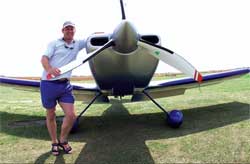
Nic Hart

AFTER a flight in one of the first RV-8s to be built in the UK, Nic Hart knew the aircraft was exactly right for him. "It only takes one flight!" he says.


Nic chose the Vans' QuickBuild Kit which cuts the total build time by 35-40%, leaving around 800 hours of work to be completed by the builder. Basically, the wings and the fuselage arrive more or less complete, having been rivetted together by an expert team. Messy jobs like sealing the fuel tanks are also complete.

Even so, it still took Nic 18 months to build the RV-8, and the trickiest part was cutting and fitting the canopy. It's a wonderful piece of work, the one-piece canopy for the tandem seat RV-8, but you can the complex curves required would be a challenge to get right.


Van's kits are ordered direct from the factory. The hugely informative website gives detailed prices, build times etc. The basic kitprice for the QuickBuild RV-8 is $26,460, to which you have to add engine, instruments, avionics and paint, plus VAT when you import the kit.

Specifications
PERFORMANCE
Top speed 185kt
Cruise speed (75%) 174kt
Stall speed (full flap) 50kt
Rate of climb 1600 ft/min
Takeoff roll 175m
Landing roll 152m
Fuel burn xx litres per hour
Range approx 677nm (no reserve)

SPECIFICATIONS
Power Lycoming IO-360 producing 180hp
Prop 2-blade, constant-speed
Length 6.4m
Wingspan 7.3m
Wing area 10.78 sq m
Seats 2
Empty weight 499kg
Mtow  816kg
Useful load 317kg
Fuel capacity 159 litres

PRICE
Base kitprice $26,460

MANUFACTURER
Van's Aircraft Inc
14401 NE Keil Road
Aurora
Oregon 97002
USA
T: 00 1 503.678.6545
W: www.vansaircraft.com

News calendar
<October 2007>
SunMonTueWedThuFriSat
123456
78910111213
14151617181920
21222324252627
28293031
Partners
Aerobatics
Aeros with Alan – Opening your Personal Flight Envelope
Learning aerobatics is a great motivational tool for improving your flying.
Features
Learn to fly
So you want to learn to fly? What do you do? Take a look at our guide to get you airborne.
Find a school/club

Want to learn how to fly?
Click on the map above to find your nearest flight training school.

News
AIRFIELD licensing costs will rise 65-88% next year under the latest scheme of charges proposed by the CAA.The steep hike is ... more
Maiden flight for new Italian light twin powered by RotaxA BRAND new light twin aircraft being developed by Italian manufa ... more
CESSNA has confirmed it is negotiating to buy Columbia Aircraft. Columbia ran into financial difficulties and filed for Ch ... more
All material © LOOP Publishing (UK) Ltd 2005-2007