Register for LOOP

Get your copy of LOOP by registering for FREE! Go

Find a school/club

Book Flying Lesson

Click Here Go

Buy an aircraft

Click Here Go

Sell an aircraft

Click Here Go
Explore

LOOP Features

nil

Europa High-Top

The Builder:
Peter Kember  
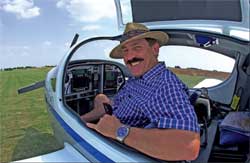
IT took Peter an estimated 1400 man-hours to build his Europa High-top, spread over 14 months. He was able to work two whole days a week, plus two evenings.
"It was just like an Airfix kit in a box," he says. "There was very little fabricating to do. It was almost easy!"

That's quite a contrast to the stories of early Europa builders who had to mix resin and lay up wings with glass fibre, then cure the lot in a controlled temperature and humidity for hours. That's down to the Accelerated Kit which Europa introduced.

"I built it in a wood jig which I built first and cost me £170 for the timber. That kept everything lined up, and I managed to sell the jig for £100 afterwards."
Peter's aircraft was the first High-top kit to come out of the Yorkshire factory, and he had the one and only 'hollow' tailplane - it is meant to become standard but hasn't done so yet.


The worst part of the build was constructing the triangulated rib that supports the main gearlegs at the base of the fuselage. "I had to look down into the hull to apply the glue, with fumes from various noxious chemicals coming up. It was awful."

To the base kitprice of £21,295, you have to add £2475 for the Accelerated Stage 1 kit with virtually all the glass fibre work finished, £1875 for the Accelerated Cockpit Module, £8938 for the 100hp Rotax 912 engine, instruments (your choice), avionics (ditto), plus VAT on top.


The aircraft:
"I WANTED an aircraft that could handle a crosswind halfway down Italy," said Peter Kember, owner and builder of the Europa. Peter was one of the first to join the Europa revolution when it started in the mid-1990s, building one of the original monowheel aircraft and then flying it all over Europe, clocking up more than 800 hours.

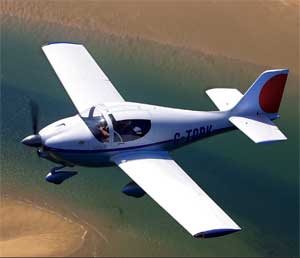
That original Europa, designed by Ivan Shaw, now deeply involved with the factory-built Liberty XL2 two-seater, was the best in terms of inflight handling, says Peter. But it could prove a bit of a handful on landing, especially in a crosswind. Europa then launched the Tri-gear version with conventional nosewheel and main wheels undercarriage, which has been a huge success, and last year added the High-top. This has an extra 3in in height added to the cockpit sides to give improved headroom.

Peter snapped up the first one, which also happened to be kit no 1000, spent just over a year building it, and has now clocked up 110 hours. Although 10kt slower, with a fuel burn 2.5 litres/hour worse than his old monowheel Europa, the added room and convenience of the Tri-gear makes the High-top much more usable for Peter.

Still, it was still with a bit of trepidation for me when we lined up at Fenland with a sporting crosswind across the runway. The heat - around 33ºC - was also a factor. We'd just seen a C152 stagger off with two people onboard using pretty much all the runway - just as well it's flat around Fenland.


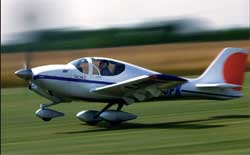
The Europa cabin was stifling and even when we started to bat down Fenland's grass, the airflow through the cabin was still poor. Still your mind concentrates on flying when the controls come alive, and we lifted off at about the halfway mark (about 300 metres).

At around 200ft, reached by the perimeter, Peter retracted the 15-degrees of flap used for takeoff, and we climbed to 1500ft, quickly catching the C172 cameraship ahead
The Europa High-top cruises economically at 110-115 knots, 
when the 100hp Rotax upfront is revving at around 4800rpm and burning 14 to 15 litres an hour of fuel (Mogas). It's helped by an Airmaster.

 constant-speed three-blade prop controlled semi-automatically - you test it manually on the ground, switching to auto for the final check, then choose one of three positions: takeoff, climb or cruise. This also helps keep the aircraft quiet both inside and out - there's just a gentle, reassuring purring going on, with little vibration.

The extra 3in of headroom is a real boon - without it, a six-footer like me would feel cramped, As it is, sitting in the right seat the edge of the panel digs in a knee and the full and free movement check of the dual sticks proved challenging. But the seats are comfortable and there's plenty of cubby holes and surfaces to put things, including a sizeable luggage area behind the seats. Peter had opted for clear perspex - for when night flying becomes legal in suitably equipped PFA aircraft, he said - but to keep the sun off tops of heads he had stuck on a couple of opaque patches. Gosh, it was hot in there...

Fortunately, the view out of the Europa was surprisingly good - the front windscreen looks very narrow from outside - and no problem at all for the sides and three-quarter views. As we traversed the north Norfolk coast for the photo shoot, we could see clearly the beaches and salt flats, complete with basking seals and... blimey! A Eurofighter! Where did that come from? He was a few hundred feet above us, circled, checked us out and decided we weren't a threat so headed off towards the Wash.

The Europa proved easy to fly in formation thanks to its steady controls. The pitch is a tad sensitive, but not overly so, and roll is nice but a bit slow, especially compared to the original, said Peter. So it's no mock fighter, like the Vans RV-8, but more of a GT sports car - good for touring and going places.

For us, the place was back to Fenland and by now it was getting pretty bumpy. The Europa rode out the thermals pretty well, returning to straight and level hands off, and we made a straightforward landing.
Taxiing the aircraft requires a strange dance with the finger brakes to steer the castoring nosewheel, and we were glad to be able to stop and lift the dual doors for some fresh air.

FAST FACTS

EUROPA HIGH-TOP
PERFORMANCE

Cruise speed: (75%) 115kt
Stall speed: (full flap) 44kt
Rate of climb: 1000 ft/min
Takeoff roll: 180m
Landing roll: 184m
Fuel burn: 14 litres per hour
Range approx: 575nm (no reserve)

SPECIFICATIONS
Power: Rotax 912ULS producing 100hp
Prop: 3-blade constant-speed Airmaster
Length: 5.84m
Wingspan: 8.28m
Seats: 2
Empty weight: 354kg
Mtow: 623kg
Useful load: 269kg
Fuel capacity: 70 litres

PRICE
Base kitprice: £21,295

MANUFACTURER
Europa Aircraft (2004) Ltd
7 Dove Way
Kirkby Mills Industrial Estate
Kirkbymoorside
York YO62 6QR
UK
T: +44 (0)1751 431 773
W: www.europa-aircraft.com

News calendar
<October 2007>
SunMonTueWedThuFriSat
123456
78910111213
14151617181920
21222324252627
28293031
Partners
Aerobatics
Aeros with Alan – Opening your Personal Flight Envelope
Learning aerobatics is a great motivational tool for improving your flying.
Features
Learn to fly
So you want to learn to fly? What do you do? Take a look at our guide to get you airborne.
Find a school/club

Want to learn how to fly?
Click on the map above to find your nearest flight training school.

News
AIRFIELD licensing costs will rise 65-88% next year under the latest scheme of charges proposed by the CAA.The steep hike is ... more
Maiden flight for new Italian light twin powered by RotaxA BRAND new light twin aircraft being developed by Italian manufa ... more
CESSNA has confirmed it is negotiating to buy Columbia Aircraft. Columbia ran into financial difficulties and filed for Ch ... more
All material © LOOP Publishing (UK) Ltd 2005-2007