|
|
|
Register for LOOPGet your copy of LOOP by registering for FREE! | Find a school/club | Book Flying Lesson
| Buy an aircraft
| Sell an aircraft
| ||||
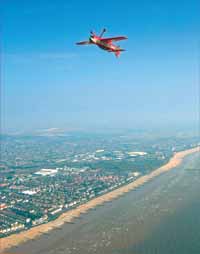
LOOP Features The ride of your life - The Sukhoi Su-29Sukhoi aerobatic aircraft, the model 26 and 31 single seaters, together with the tandem two-seat model 29, are the most remarkable light aircraft ever made. Their genesis came about through a combination of time, ambition, technology and economics that is unlikely to be repeated in any of our lifetimes. They are the ultimate ‘pilots’ aircraft’.
The Russians flew large, graceful Yak 18s and, then, Yak 50s with consummate skill founded on rigorous training at no personal cost in the financial sense. After the 11th world championships in 1982, however, pilots from other countries started to catch up. Not only the Czechs, but also the Americans and the French started winning. The first catalyst of change was the 200hp Lycomingengined Laser of Leo Loudenslager. Then along came the 300hp Zlin 50, also powered by a western engine. These new aircraft had wings with symmetrical cross section, which not only flew well inverted, as Pitts Specials had first done a few years before, but they were monoplanes. They scored well with clean lines and much more energy than the American biplanes had been able to muster. The Sukhoi design bureau stepped into the breach, and in 1984, in Hungary, the Sukhoi 26 burst into the world championship arena. But it did not win. There were teething problems and the pilots were finding the transition to this new, ultra-dynamic machine very testing. Things were different in ‘86 at the world championships in South Cerney, UK, and the Russians returned to their winning ways in ‘87 and ‘89, despite missing the ‘88 world event in Canada. Since then, only Russian and French pilots have been world champions in the men’s event and Sukhoi pilots, now with many years experience on the type, dominate modern competitions. This, then, was the timeframe of the rise of the Sukhoi. It was driven by ambition for sporting excellence. It embodied space-age materials, titanium alloys and carbon fibre composites, and was procured by a State economic machine for which cost appears not to have been an issue. I’m sure they never knew the cost of titanium. Then the most amazing thing happened: the wall came down. We could get these fairy-tale flights of fancy in the West.
From the start, the Sukhoi aircraft were designed to be the most agile thing you could fl y. The wing section created much less drag on corners than that of the Yak-55. Furthermore, the engine, wing and pilot were positioned to give the most aft effective centre of gravity that could be sustained without becoming unstable. As a result, incredibly tight corners could be flown at high speed with very little force required on the elevator. The third important revolution was the use of glass and carbon composite structure for the wing, in place of the wood or aluminium that had been prevalent until then. This didn’t so much result in a light wing as in a rigid one. The carbon-sparred wing is immensely strong but also has great torsional stiffness. This effectively means that you can hang huge ailerons on the wing and achieve preposterous rates of roll without the wing twisting and losing its strength and integrity. So great was the advantage of this technology in the late ‘80s that all serious French, American and German aircraft since have used carbon wings.
Switches and push buttons are of military design, function and durability. Nothing at all is cheap about the construction of this machine. Parachutes are designed specially to fit the seats. The harness is easy to get tight and then clips locked to stay that way. The instruments are invariably in metric units, kilometres per hour, metres high, millimetres of mercury for the pressure setting (760 = 1013) and manifold pressure. RPM in per cent – perhaps because the engine and prop turn at different speeds thanks to the epicyclic gearbox. The air-start system for the engine is now familiar to many Yak-52 pilots in the UK, thanks to the influx of Russian trainers imported by Richard Goode, Mark Jefferies and others. Like any other method, it is reliable once you get to understand the reasons for failure and learn to avoid them. When you fire up the engine, the aeroplane immediately comes alive, bouncing a little on the springy titanium alloy gear, twisting with the torque every time you move the throttle a little, straining at the brakes. The transmit button is reassuringly solid-feeling when you call for taxy information. You can’t imagine that even this small item would ever break or fail. The tailwheel castors or is locked central. It is free for taxiing and you drive the aircraft meaningfully with thrust on the rudder and differential brake. As in everything else, this machine demands commitment even for getting to the hold. Checks are simple. Electrics and instruments, propeller and magnetos, temperatures and pressures. Trim is irrelevant. Cooling gills open, tailwheel locked, thrust to maximum, sit still. A little left rudder to keep straight and the Sukhoi launches itself like a Harrier off a carrier deck (except perhaps quicker).
At first you’d better not try anything too adventurous. Just relax and guide the aeroplane gently on its course. Keep your mind ahead of the airframe. Think before you act. Then, once you have decided what to do, do it quickly. Then immediately think of what comes next. Look outside all the time, well 99% of the time anyway. Pottering along is not an option. It’s a complete waste of time and an insult to the designer. You want to try out something every second of the flight. There is so much to learn. The power is at max continuous and you are moving fast without realising. What is 360kph in real money anyway? Want to climb? Look down the wing at the horizon. Pull just a little on the stick and you will quickly reach the vertical, providing you don’t pull hard. Well, actually you can’t pull hard. There is just no stick force as the g builds up. The stick position changes but not the feel. The corner radius just depends on where you put the stick, not how hard you pull it. If you pull expecting some resistance you will be surprised. There is none. But you will very quickly reach the buffet and a high speed stall, “Oops, sorry about that!”. Everyone does it the first time. And quite a few more times after that. Want to roll? Just move the stick to the right as far as it will go. You can do it with one hand, even at 360kph, whatever that is. Stop rolling after 360 degrees. “What do you mean, ‘that was two rolls.’?” And you are still in the vertical. Going up for over 2000 feet without a thought. I actually did a triple flick roll instead of a double in a competition sequence at Sywell back in the ‘90s. I got a little distracted by something halfway round and lost count. I was sure it was two but they all told me three afterwards. Unlike in ice skating, however, you don’t get extra points for a triple! In a single flight, no one can possibly get to grips with the enormous potential of a machine like this. Nor in a single newspaper article can I possibly explain it all to you. It took the dedicated Russian pilots years to master the Sukhoi. Eventually, in 2002, a westerner beat the Russians in their own machine. Ramon Alonso of Spain won the European championships in Lithuania that year. He had been flying the Su-26 for over ten years - having been one of the first to get his hands on one in the early ‘90s. He only did it once. The Sukhoi design bureau added more horsepower to the Russian team aeroplanes, tweaked the wing a bit more. They have won everything since. If the Sukhoi has a shortcoming, and I wouldn’t feel I was doing my job properly if I didn’t find one, it is in the fuselage lift department. You test this by turning fl at. Rudder to turn and no bank angle. Just like the Wright brothers did! A Pitts, inferior to a Sukhoi in every other respect, will just keep on turning as long as you keep applying rudder. A CAP 232 can almost match the biplane. The Sukhoi, unfortunately, turns a bit and then just slides sideways. An Extra does the same, so does a Yak 55. Does this matter? Clearly not, as this is really only of consequence in rolling turns and Sukhois have won a lot of world championships. The reason is not to do with rudder authority, the ability to produce side force, but rather with the distribution of sideways lift generated by the fuselage relative to the centre of gravity position. The Sukhoi, the Extra and the Yak could all benefit from more keel area forward of the centre of gravity. It is a minor defect, but it would be nice if they could fix it. “I WANT ONE, NOW!” Flying a Sukhoi is the ultimate handling experience, but it is also demanding. Physically demanding, sure, but also mentally demanding because you sure as hell need to know why things happen the way they do. Newcomers to aerobatics will need to be sure they get lots of theory and practical training before they try to invent anything new in one of these. Not only have you got to learn to walk before you run; you have to learn to crawl, walk, trot, and canter before you get anywhere near a gallop. Don’t expect to become a Sukhoi ace overnight. Make it a ten-year project. Isn’t ten years of fun a better prospect than one night?
PERFORMANCE SPECIFICATIONS MANUFACTURER UK DISTRIBUTOR
|                    | |||||||
 Aeros with Alan – Opening your Personal Flight Envelope Learning aerobatics is a great motivational tool for improving your flying. |  Learn to fly So you want to learn to fly? What do you do? Take a look at our guide to get you airborne. | 
Want to learn how to fly? |
Massive order for Phenom takes Embraer into new leagueEMBRAER announced a mammoth order for up to 150 of its Phenom execut ... more
PIPER is working flat out to get its prototype VLJ in the air for next summer, with innovative new wings and an all-new ma ... more
THE Middle East has become the battleground for... who can fly the biggest banner!Dubai's Aerogulf Helicopter Services ann ... more | |||||
| All material © LOOP Publishing (UK) Ltd 2005-2007 |