|
|
|
Register for LOOPGet your copy of LOOP by registering for FREE! | Find a school/club | Book Flying Lesson
| Buy an aircraft
| Sell an aircraft
| |||
LOOP Features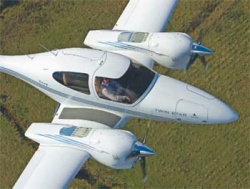 TWIN STAR OVER LONDONThe first examples of Diamond’s new turbodiesel powered twin are arriving in the UK and London’s Capital Radio ‘Flying Eye’ will be using two operated by Stapleford Flight Centre. Nick Heard flew one of them. THERE is an old saying that if an aircraft looks right, it probably is right. Well, I will apply that maxim to the Twin Star. With its curvy design, high aspect ratio wings with trendy winglets, four comfortable leather seats, and some even trendier anhedral at the tips of the tailplane, the Twin Star is a strikingly good looking aircraft. And with features such as diesel engines running on cheap Jet A1 (jet fuel), a Garmin 1000 ‘glass cockpit’, and Full Authority Digital Engine Control (FADEC), it has some really great, up-to-date kit. Being more familiar with the cockpit of a 747-400, I was keen to see the cockpit displays of the Twin Star – and I was really impressed! The Twin Star catches your eye even if it’s parked the other side of the airfield. When you get closer you can see the smoothness of the aircraft surfaces. Getting into the front seats requires the front part of the canopy to be pivoted upwards and forwards, easily done. A useful feature of the canopy is that it can be lowered to a ‘not fully closed’ position on the ground, to keep a cool draft going when the engines are running. The seats are not adjustable, but rudder pedal adjustment made the cockpit perfectly comfortable for my 6 ft 4 in. And then you can start to sit and absorb the cockpit and its simplicity. Two large screens (blank at this stage) hide a wealth of information that will shortly appear when power is applied, and above these displays are a set of conventional flight instruments as a back-up to the glass displays. The rest of the cockpit is remarkably uncluttered, particularly in the area of the throttles. Where one would expect to find six levers (throttles, mixture and RPM controls for two engines), there are only two (a power lever for each engine). Welcome to the world of FADEC and diesels! And, unusually, a control column exists where one would expect to find a yoke – some would argue that this is incompatible for training future airline pilots, but Airbus use a sidestick, of course, so I think Diamond have done the right thing with the use of a stick in the Twin Star. Turn on the electrics and avionics master switches and the glass screens spring to life. The Twin Star has an Attitude and Heading Reference System (AHRS), which takes 90 seconds or so to erect itself, after which you have a Primary Flight Display (PFD) on the left screen and a multifunction navigation display (ND) on the right. The PFD displays an attitude indicator together with an airspeed indicator and an altimeter (both in vertical ‘strip’ form), and below which is situated the horizontal situation indicator (HSI) for VOR/ILS/GPS steering information. The PFD is a bit daunting when you first see it, but with a bit of time and training (you do need training for glass cockpits) you begin to enjoy having all the information on the one screen. Similarly the ND, with its multi-scale map display and added stuff like terrain information, together with systems information (engine, fuel etc) makes you wonder how you ever coped before. Starting the engines is very easy. Swithc on the respective Engine Master, wait for the Glow Plug warning to go out, turn key, and a moment later sit back and admire a smooth running engine, now idling effortlessly at 900rpm (note, idle not 1200rpm!). Repeat for other engine, and you are ready to go. Taxying is no problem, the aircraft skips along quite happily at idle on tarmac. Engine run-up? Press and hold the two Engine Control Unit (ECU) test buttons for 20 seconds, and let the test run itself! After a few pre-takeoff checks, we are ready to fly. Takeoff is very straightforward, with very little yaw to counteract as the power comes up (the propellers are not contra-rotating). Rotate at 69kt and climb at 8° nose up to establish a climb at 95kt. The gear comes up a little clunkily and beware of flap sink on retraction. We climb away at a comfortable 1200fpm, and I enjoy operating the electric trim, always a handy piece of kit. Power is measured in % terms (like older jets, or torque in a turboprop), which makes it all very easy – level flight at 70% and 2000ft gives around 140kt indicated, at a fuel burn of 10 US gph (and don’t forget, cheap gallons!). And if you need to, you can just leave it at 100% all day. The view is excellent, and controllability is super, particularly with the ‘fighter stick’. You really want to throw this aeroplane around a bit! And that’s just what we do for a while after levelling off. Although it’s an aircraft clearly designed to maximise comfort on a long trip, it almost asks you ‘see what it can do’. It is also great to fly formation (not, I grant you, a requirement for most owners), which again is testament to the Twin Star’s capability, although it was a little uncomfortable alongside the 172 camera aircraft at 95kt, somewhat towards the bottom of the Twin Star’s speed range. The Twin Star really does have the sort of things that many modern airliners have, and the engine restarting system is one of them. Shutting an engine down in flight is accomplished by turning off the engine master switch; the engine quickly stops and autofeathers to minimise the drag of the stopped propellor. There is still plenty of performance to climb with the engine out. Restart: engine master to ‘on’ and the engine automatically carries out a windmill restart (ie no starter motor required) to leave the engine running at idle again. Truly awesome for a little twin. Back to the circuit, and again it’s all very straightforward. A setting of 60% power is set for the downwind leg while we lower the undercarriage and set the first stage of flap (called ‘approach flap’). Power to 50% on base leg to settle at the approach speed of 95kt. Landing flap is taken when assured of landing and speed reduced to 80kt over the threshold. The landing rollout is without drama and we taxy back in with the engines at idle in preparation for shutdown. The future is here, and it’s with the Twin Star. As a light twin for cruising, it must be hard to beat. With a maximum takeoff weight of 1700kg and an empty weight of 1250kg, there are plenty of useful combinations of fuel (maximum 150kg, around 200 litres), passengers, and bags (75kg capacity) to go places. As a training aircraft for airline recruits, it will provide ‘glass’ experience from the start, and that’s going to be useful as the years go by and conventional display cockpits disappear completely. Sadly the cost will preclude a flooding of the skies with Twin Stars. But it’s a cool aeroplane, and I think I’d better start getting to know that elderly rich aunt of mine a bit more… Diamond DA42 TDI Twin Star PerformanceMax airspeed 194 kt KIAS SpecificationsPower 2 x Thielert Centurion 1.7-litre turbodiesels, producing 135bhp each. 1,000 hour TBO. FADEC digital engine and propeller management system. ManufacturerDiamond Aircraft Industries GmbH UK distributorDiamond Aircraft UK Ltd Test aircraft owned by:Stapleford Flight Centre |                      | ||||||
 Aeros with Alan – Opening your Personal Flight Envelope Learning aerobatics is a great motivational tool for improving your flying. |  Learn to fly So you want to learn to fly? What do you do? Take a look at our guide to get you airborne. | 
Want to learn how to fly? |
GA businesses given 30 days to move outSOUTH coast airfield Lee-on-Solent is facing closure to General Aviation. All aviat ... more AIRFIELD licensing costs will rise 65-88% next year under the latest scheme of charges proposed by the CAA.The steep hike is ... more
Maiden flight for new Italian light twin powered by RotaxA BRAND new light twin aircraft being developed by Italian manufa ... more | ||||
| All material © LOOP Publishing (UK) Ltd 2005-2007 |