|
|
|
Register for LOOPGet your copy of LOOP by registering for FREE! | Find a school/club | Book Flying Lesson
| Buy an aircraft
| Sell an aircraft
| ||||||||||||||||||||||||||||||||||||||||||||||||||||||||||||||||||||||||||||||||||||||||||||||
LOOP Features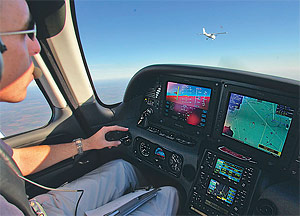 Cessna 182T, outside, and Cirrus SR22-GTS cockpit ON SCREEN RIVALSWhich one would you choose? The Ultra Modern Cirrus SR22-GTS or the traditional Cessna 182T?IT'S a big deal sitting in the left front seat of a Cirrus SR22 for the first time. This is a seriously well-equipped aeroplane with 310 horsepower up front. As you line up on the runway, takeoff checks done, and advance the single thrust lever and start to accelerate, the normal level of adrenalin rush is several times higher. The SR22 is in a hurry to get going, especially with just two of us on board. Within seconds, we're batting down Turweston's 27, increasing the pressure on the right rudder to keep straight, bit of aileron to deal with the crosswind from the left, and as 70kt comes up, a gentle pull back on the sidestick and we're off and climbing out at an astonishing rate. Almost immediately we turn right to follow Turweston's noise abatement procedure, flaps up with hardly any noticeable effect, and we settle at a 100kt climb giving around 1400 feet per minute climb. My earlier worries about coping with a sidestick, the glass cockpit, and the sheer performance of this all-composite rocketship have evaporated. I realise the sidestick takes seconds to get used to and that the basic information I want at this stage is easy to find on the huge Avidyne displays. As we reach 2500ft and level off, Russ Gordon of Cirrus UK, sitting in the right seat, adjusts the right multi-function display to show traffi c as well as the map. This fully-equipped GTS model has its own TCAS unit which picks up transponder signal from other aircraft, assigning them position and altitude (if Mode C equipped). We see that the Cessna 182T which took off behind us, is just leaving the Turweston circuit and on a heading direct to Grafham Water, over which we intend to do some air-to-air photos. We orbit to the left, away from the direct track and come in behind the Cessna, accelerate and move into formation position on its right. For 15 or so minutes we manoeuvre for the camera, then break away to explore the SR22's handling a bit more. Russ demonstrates the SR22's party trick; he puts the aircraft into a left turn, banked at 30? and takes his hands off the stick. It stays in the turn, scribing a perfect level turn, and only rolls out when told to do so. As well as that stability, the stick also gives the SR22 extraordinary precision. You can roll it left or right to exactly where you want and stop it right there. It's not cleared for aeros but you feel the aircraft could deliver a fairly potent and precise display. Steep turns are an absolute delight, though it takes me a bit longer to produce one that's level rather than climbing a little; I've a tendency to pull back on the stick a little in the turn. Finally, we try some stalls and with the aircraft nose high the speed comes back to the mid-60s before the left wing starts to drop a little, easily noticed and corrected. With flaps deployed, the same thing happens but slower, at just below 60kt. Two days earlier, as a passenger in the back of the same aircraft, I'd seen Cirrus UK's Nick Tarrant demonstrate holding the wing drop with a touch of rudder, pulling the stick right back; the aircraft had remained stable though with a high rate of descent. Games over, we head for Cambridge Airport, our changeover point for this exercise. We're showing a true air speed of 175kt, a ground speed of 180kt so we're getting there pretty quickly. This speed is against a bit of a headwind, with a power setting of 2550rpm and 25in manifold pressure, a setting of 85% power, and the engine is leaned to burn 15.5 gallons per hour. Russ achieved this by bringing up a screen which showed how each of the six cylinders was performing, leaning using the separate mixture lever. It's an indication of just how much there is to learn about operating an SR22 - a two day training course is part of the purchase package. As we approach Cambridge from the north and descend to circuit height, there's quite a bit of haze. I'm blowed if I can see the airport but according to the map display we're dead on course and, sure enough, it soon becomes visible. We're about to go into the circuit when we're aware of a bit of drama over the radio, and we're asked if we can accept left base for an immediate landing. Russ takes control, with me following through, and keeps the speed up. "How on earth are we going to land at this speed?" The thought goes through my head but apparently not Russ's. Final is short and we're fast, full flap is deployed, power eased back - the thrust lever automatically adjusts the prop to fine - and we're descending at a rapid rate. Amazingly, it's all fine. We're over the threshold at about 75kt, flaring at what seems very low level, touching down at about 60kt for a greaser, and braking to make the first turn-off. Fire crews are rushing to the runway and a Piper Aztec, being fl own by Ian Young, Chief Test Pilot of Marshall's, operators of Cambridge, approaches. He has a problem with one of the undercarriage legs and isn't sure if it will stay extended. He makes text book landing, fi rst on the good leg, holding off the other leg until the speed has reduced, then gently eases it down. The leg stays extended. Phew! We continue to the grass GA parking area and it's apparent how easy the Cirrus is to taxi. The nosewheel is free castoring so to turn requires rudder and/or differential braking and it can turn in amazingly tight spaces, virtually about one wheel. Just about the only naff bit on the Cirrus is the parking brake which lurks somewhere down by your right knee. Shutdown and there's time to look around the Cirrus. It's said the brief to the cockpit designer was to make it like a BMW 5-series, and it's certainly as roomy and luxurious as the Bavarian express. There are many, many touches about the aircraft which take a while to appreciate. Getting in and out of the scissor doors - they open upwards, right out of the way - is a cinch. You step down onto the floor to get into the back - no treading on seats required - and there's plenty of leg, head and shoulder room. The cabin is 124cm (49in) wide, and the side stick really opens up the area in front of the pilot. With no central yoke or stick, holding a chart or using a kneepad is so much easier and there's noi chance of interference with the controls. Much is made of the Cirrus Airframe Parachute System, the whole aircraft parachute which is deployed by pulling a lever in the roof. It's been used nine times so far in the US, not at all in Europe so far. Cirrus UK says it's a last line of defence, if the situation is too far beyond the pilot's ability to cope and that seems fair. I know I'd rather have the system than not in that situation. Of course, we were flying the top of the range GTS model which has just about every item of equipment available fitted. But even the standard SR22-G2 at $334,700, not hugely more expensive than the Cessna 182T, is well-equipped and flies exactly the same as the GTS. Bottom line: this is the best single engine piston aircraft in the world today, bar none. and there are some details changes to the airframe to gain a few extra knots. The panel grabs your attention straightaway with the displays replacing most of the old clocks. Slightly intimidating though are the collection of buttons and controls around the edges of the Garmin displays - there's no doubt that several days training are required to make the most of this aircraft, and a couple of hours at least before even starting up the engine. Lining up at Cambridge and applying full power required the usual right rudder, and with a fairly stiff breeze blowing we were off in next to no time despite the aircraft's acceleration being nowhere near as quick as the Cirrus's. Immediately we were airborne, the 182's overwhelming characteristic came through - its controls are steady, heavy even, giving the aircraft a slightly ponderous feel. In the gusty conditions, that was quite welcome and reassuring. Off back to Grafham Water then, for more photos and a chance to get used to the handling of the 182. For someone used to the 172, the much heavier engine upfront takes a bit of getting used to, as did the fairly high coaming which reduced the over-the-nose view ahead. But as we slid into some steep turns, first one way then the other, it felt very Cessna - stable, surefooted - but again almost reluctant to deviate from a standard rate one turn. Stalling was a non-event, as with most Cessnas, just a gentle wing drop, bobbing up and down of the nose but I did notice the torque reaction of the engine as full power was applied and then the stronger pull required on the yoke to come back to the straight and level. En route to Turweston, the primary flight display suddenly snapped off, with a message saying no connection to the AHRS unit which provides the Artificial Horizon and much of the data, leaving just some of the instruments working. It seemed like just a loose connection because it came back on a few seconds later. Coming into Turweston, the crosswind had picked up so Steve McKenna, CSE's pilot beside me, took control rather than risk me bending a brand new aircraft. Despite being bumped around quite a bit on the approach and with constant corrections necessary to counter the wind, the 182 came down steadily and on course, landing smoothly. I could see how, with a bit more practice, the 182 could cope with almost anything most private pilots could throw at it. Of course, what's really new about this model is the Garmin glass cockpit, which has taken a while to get certified by EASA. They required the wiring loom to be lightning proofed apparently, and our CAA requires an ADF and DME to be fitted to be IFR compliant. The display is fantastic, no doubt about it, with tons of information available, from wind direction and strength to airfield and approach plates, a seeming unlimited number of navigation options but no traffic overlay just yet. The Garmin traffic display available in the US uses the Traffic Information System (TIS) uploaded via a Mode S transponder - that's not available in Europe just yet. So where do the updates leave the 182? There's no doubt there's a dedicated following for the 182; equally, the aircraft is feeling dated in comparison with newer designs such as the Cirrus - something Cessna has recently acknowledged. I Bought one
| ||||||||||||||||||||||||||||||||||||||||||||||||||||||||||||||||||||||||||||||||||||||||||||||||||

|
|||||||||||||||||||||||||||||||||||||||||||||||||||||||||||||||||||||||||||||||||||||||||||||
| Performance | |
| Cruise Speed | @75% 185kt |
| Stall Speed | w/flaps 59kt |
| Takeoff distance | 310m |
| Landing | 396m |
| Rate of Climb | 1400 ft/min |
| Cruise Range | 700nm |
|
Specifications |
|
| Power | Continental IO-550-N producing 310hp |
| Propellers | Hartzell 3-blade, constant speed, 78in diameter |
| Length | 7.92m |
| Height | 2.62m |
| Wingspan | 11.73m |
| Wing aera | 13.46m2 |
| Cockpit Width | 124cm |
| Seats | 4 |
| Empty weight | 1021kg |
| Maximum takeoff weight | 1542kg |
| Maximum useful load | 521kg |
| Fuel capacity | 307 litres |
| Price | $434,145 as tested |
| Manufacturer Cirrus Design Corporation 4515 Taylor Circle Duluth Minnesota 55811 Tel: 001 88 750 9926 www.cirrusdesign.com |
|
| Uk Distributor Cirrus UK Building 10 Turweston Airfield Brackley Northants NN13 5YD Tel: 01280 841110 www.cirrusunitedkingdom.com |
|

| Performance | |
| Cruise Speed | @80% 145kt |
| Stall Speed | w/flaps 49kt |
| Takeoff distance | 242m |
| Landing | 180m |
| Rate of Climb | 924ft/min |
| Cruise Range | 845nm |
|
Specifications |
|
| Power | Lycoming IO-540-AB145 producing 230hp |
| Propellers | 3-blade, constant speed, 79in diameter |
| Length | 8.84m |
| Height | 2.84m |
| Wingspan | 10.97m |
| Wing aera | 16.2m2 |
| Cockpit Width | 107cm |
| Seats | 4 |
| Empty weight | 860kg |
| Maximum takeoff weight | 1406kg |
| Maximum useful load | 550kg |
| Fuel capacity | 333 litres |
| Price | $312,000 as tested |
| Manufacturer Cessna Aircraft Company Single Engine Piston Aircraft 2625 S. Hoover Road Wichita Kansas 67215 Tel: 001 316 517 6056 www.se.cessna.com |
|
| Uk Distributor CSE Aviation Sales Oxford Airport Kidlington Oxon OX5 1RA Tel: 01865 844255 www.cseaircraftsales.com |
|
Words Dave Calderwood, Photos: Dave Spurdens


Want to learn how to fly?
Click on the map above to find your nearest flight training school.
| All material © LOOP Publishing (UK) Ltd 2005-2007 |