|
|
|
Register for LOOPGet your copy of LOOP by registering for FREE! | Find a school/club | Book Flying Lesson
| Buy an aircraft
| Sell an aircraft
| ||||||||||||||||||||||||||||||||||||||||||||||||||||
LOOP Features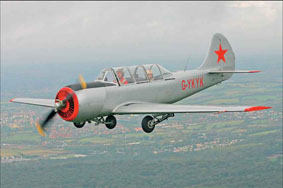 YAK 52There are about 70 Yak-52s on the UK register. That's a good measure of the popularity the type has achieved with British pilots - a popularity mirrored in several other Western countries. The reasons for its appeal are fairly apparent: a 360hp engine, +7g/-5g aerobatic capability, good handling, the promise of reasonable operating costs, and the fact that it is different to the Cessnas and Pipers most people learn to fly on. Sitting on its long undercarriage legs, a Yak-52 appears, from a distance, somewhat ungainly. On closer inspection it still isn't pretty, but the rows and rows of big dome-headed rivets along the wings and fuselage immediately give the impression of the battleship toughness for which the type is famed. For our test flight at North Weald I was accompanied by Mark Jefferies from Yak UK. Once seated and strapped in, the cockpit is comfortable, although the rudder pedals, which do allow some adjustment, still feel a bit too close. Given its origins and design role, it's no surprise that the general feel in the cockpit is overwhelmingly military. In G-YKYK everything is clearly labelled in English so while Mark strapped in I was able to gain a basic familiarity with the essentials. The units of measurement used in some of the instrumentation (for example, kgf/cm2 for oil and fuel pressure) might seem alien to those used to Western aircraft, but the copious use of green and yellow arcs, and red radial lines eliminates any problem with interpretation. Starting the 360hp Vedeneyev engine using the pneumatic starter is a straightforward procedure, but must be followed by a careful warm-up before taxiing and power checks. The nosewheel is castoring so steering is provided through differential braking applied by pressing the appropriate rudder pedal and squeezing the brake lever on the stick. This sounds like it could be awkward, but actually works very well. With checks completed and lined up on the runway for take-off, the application of full power results in brisk acceleration, surprisingly reasonable noise levels, and a slight and easily controlled swing to the right. Lift-off is at 120kph (65kt), and then following gear retraction and power reduction, the climb is continued at 170kph (92kt). Initial rate of climb is an impressive 1800 feet/minute. Levelling off at 2000ft and setting an economic cruise setting of 60% power gives an indicated airspeed of 200kph (108kt), and a fuel burn of about 45 litres/hour. However, at that speed the aeroplane is loitering, so setting 70% power and 237kph (128kt) felt much more comfortable. Fly some aerobatic figures and the aeroplane really comes into its element. All the controls are powerful and nicely balanced. However, the stick loads are relatively high and I found that for aerobatics I needed both hands on the stick. At about 140(/second the roll rate is not quite up to that of many specialist aerobatic machines but it's perfectly in keeping with the 'large radius and long line' style of aerobatics that suit the '52 so well. Fuel consumption during aerobatics could be 90 litres/hour or more at maximum continuous power, but basic aerobatics can be flown quite comfortably at reduced power. Back in the circuit, slowing down to the 200kph (108kt) gear limiting speed is no problem. In addition to the three green cockpit lights to indicate the gear is extended, there are also mechanical indicators on the wings and cowling to provide a direct indication of gear position. With the flaps extended, the final approach speed is 150kph (81kt). The visibility over the nose on final is good, and the aeroplane is nice and stable in the approach configuration. I made the common mistake of flaring a little higher than ideal, but made a passable landing nevertheless. The Yak-52 is successful because there are many different ways to enjoy it. It also provides exactly the type of challenge and capability that can keep newly qualified PPLs active and interested. For that reason it's not just a successful aeroplane, but an important one too. - Phil O'Donaghue SPECS:
| ||||||||||||||||||||||||||||||||||||||||||||||||||||||||
| Performance | |
| Vne | 243kt |
| Cruise Speed | @ 70% 124kt |
| Stall Speed | 56kt |
| Takeoff distance | 200m |
| Landing roll | 260m |
| Rate of Climb | 1200ft/min |
| Ceiling | 13,000ft |
| Fuel consumption @70% | 60 litres/hr |
| Cruise Range | 510km |
| Aerobatic load factors | +7g-5g |
| Specifications | |
| Power | Ivchenko Vedeneyev 9 cylinder radial M14P, 360hp or M14PF, 400hp |
| Propellers | 3-blade constant-speed, 2.4m diameter |
| Length | 7.7m |
| Height | 2.5m |
| Wingspan | 9.3m |
| Wing aera | 15.0m2 |
| Seats | 2 |
| Empty weight | 1040kg |
| Maximum takeoff weight | 1315kg |
| Max load | 275kg |
| Fuel capacity | 120 litres |
| Price | Approx £35,000 - 50,000 |
| Manufacturer Aerostar SA. 9 Condorilor Street Bacau 600302 Romania T: 00 40 234 575 070 W: www.aerostar.ro |
|
|
Uk Distributor Now showing on:
|
|


Want to learn how to fly?
Click on the map above to find your nearest flight training school.
| All material © LOOP Publishing (UK) Ltd 2005-2007 |