Register for LOOP

Get your copy of LOOP by registering for FREE! Go

Find a school/club

Book Flying Lesson

Click Here Go

Buy an aircraft

Click Here Go

Sell an aircraft

Click Here Go
Explore


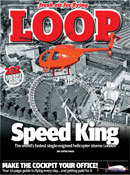
JUNE ISSUE OUT NOW


NOW ON LOOPTV:
SEE THE AMAZING
YAKOVLEVS IN ACTION


ANDY REOHORN
CHIPPY FIRST FLIGHT (PART TWO)
Andy's first lesson in a taildragger.

Last updated: 19th May 2006

A steep descending turn from the overhead soon saw us on the downwind leg. Surprisingly she was a lot harder to slow down on base leg than I thought. First stage of flaps are allowable at a generous 93 knots but the second stage needs you to be under 70 knots, so tends to be put down on final.

Apprehension began to build as we approached short final, the words from the back seat moulding together. This is just like starting to learn to fly all over again!!

As we were landing on tarmac, my first tailwheel landings were going to be wheelers, where the main wheels touch down first and then as the speed decays the tailwheel kisses the earth gently.

From 50' I followed through and of course the instructor made it look easy. He gave me control as the tailwheel met the ground and I applied full throttle and eased the stick forward. The runway went left, then right, then left as the pendulum effect gathered momentum and I was glad to get airborne again. Must make the rudder inputs more gentle!!!

The second approach was better but I cut the throttle too soon and we made an elegant trio of bounces before settling down. Again my world went to pieces as we swayed from left to right down the runway before releasing ourselves back into the air again.

Determined not to be beaten, I nailed the speed on short final, cut the throttle at the right time and had the stick at full forward before the tailwheel met the ground. Next lesson: NEVER EVER relax. As we sped forward again my brave instructor had to put in loads of rudder to keep us from exiting the runway and he managed to get us into the air before I could do us any more damage.  

After another slightly better touch and go I decided my brain had taken enough punishment for one day and elected to land off the next approach. Managed it all by my little self. Amazing how good it feels  

Even taxying back to the hangar becomes more fun in a taildragger. Weaving from side to side we managed not to hit anything.

Climbing out from the cockpit we fuelled up (just adore the brass filler caps and the fuel gauges in the wings!!) and pushed her back into the hangar. After a cuppa I found out another reason why flying a Chippy is unlike most other aeroplanes. The chipmunk loses around a litre of oil an hour and spreads itself all over the engine bay, along the bottom of the fuselage and the sides of the plane. Grabbing a rag we spent the next half hour getting intimate with my new lover and rather good it was too.

The nearest I have come to flying a Chippy is the Bulldog. The Chippy is like a graceful ballet dancer, whereas the Bulldog is more of a ....... well, bulldog!! The Bulldog feels aggressive, happy to be thrown about the sky, always straining at the leash. The Chipmunk is altogether a more graceful beast, a little easier to fly and lighter on the controls.

Landing them is a different matter.  

I am glad of the opportunity to learn exactly what the rudders are for and it gives immense satisfaction to get it right. I managed that in the air, also on the taxiways, but was not so successful on the runway.

A tailwheel is only really different on the ground, apart from the judiscious use of rudder required in the air. I am sure my nosewheel flying will benefit from a little more concentration on the rudders though.

Last updated: 5th April 2006

I couldn't believe my luck when I awoke to bright sunshine, the breeze just moving the tree tops. Perfect for my first attempt at tailwheeling.

Would it be as bad as some say, or would it prove to be something a mere mortal like myself could cope with?

I spied the little red and white Chipmunk in the corner of the hangar, nestled against the Stampe, almost as if they were both nestled together to ward off the cold. A curiously warm feeling crept through my veins as I stood contemplating the next few hours.

After a coffee, a thorough briefing and pre-flight check, we pulled the Chippy out of the hangar, threading it between some expensive looking heli's and the fuel bowser.

Hmmm, ok, a little olde worlde in here, but charming. Switches scattered randomly all over, unmarked levers to my left and right. And the smell, oily definitely, but with a pleasant muskiness.

Strapping in, I looked around. Not the windscreen I was used to in my 152. Though not claustrophobic, it is definitely cosy. The feeling of being in something from another era is strong, the view out similar to my boyhood fighter plane dreams. OK, pretty cool so far.

A snow shower passed overhead, so the starting procedure was a little hurried, but basically consisted of pulling the priming ring and using the manual fuel pump until fuel is vented onto the ground. Once that has slowed to a trickle, the propeller is pulled through half a dozen blades to prime.

My instructor arrived in the rear cockpit and the canopy slid forward. Check brakes on, Isolate Switch and mags to on, stick back, push the starter and the engine coughed into life. Set 1100 rpm and wait for the engine to warm.

Now to see if I could get this thing to move across the ground with any semblance of obedience!

Easing the throttle forward we slowly moved forwards. Craning my neck to the left and right we managed not to hit any of the spam cans, nor the Harvard, nor the expensive blue Enstrom. A good start then!

Off the grass, onto tarmac and things start to move a little quicker. I won't bore you with the details, but the brakes are hand operated and very effective.

Power checks are simple and pretty standard. Back round we rotated thanks to our tiny wheel at the back and before I knew it we were lining up.

Now to a 250 hour nosewheel pilot, the view over the nose as we lined up was....well...... disturbing!! As the power was applied I was swiftly reminded that British engines turn the opposite way to the good old Yank's!

Pushing forward on the stick just doesn't seem....... well....... right. But suddenly I can see the runway, well the left hand side of the runway..... oh no make that the right hand side....oh no the left hand side...bugger no not that way.........thank God, airborne!!

Climbing out at 60 knots, the controls are amazingly sensitive. The joy of a stick rather than a yoke!!
Ah yes...... rudders......they need some pressure from those feet don't they!?!  
As I started to relax a little, so the plane relaxed with me. It's almost like wearing the wings.

Back pressure was intuitive and a series of steep turns left and right resulted in minimal height loss. If you turn without rudder it is pretty obvious through the seat of your pants, with rudder the turns are beautifully tight and natural. Maximum rate turns, keeping on the edge of the buffet all the way round. Cool. With large control surfaces the effort required is surprisingly small, which makes flying this aeroplane on the limit far easier than your average trainer.

Climbing now, arcing round in a big clearing turn whilst carrying out the HASSELL checks. Clean stall, power off was easy. Full flap, power off required a little more concentration. Full flap, power on required committed concentration but it was great balancing her level, whilst fluttering downwards at 500' per minute, stick pulled back into my groin.  Instructor happy, he suggested we go back and try a couple of circuits.

"Go on, have a play, shame to waste such a glorious day flying straight and level!"  And therein lays the problem. You just could not fly a Chippy straight and level for very long. Some gentle wingovers followed by a demonstrated loop and straight into a roll, then over to me and we go rolling the horizon around in front of us, over our heads, making the fields smaller, making them bigger.

Swooping, turning, grinning, laughing, like kids at play, relishing in the clear cold air, left, right, up, down, who really cares as long as it's not straight and level. Nearing home we thought we had better behave a little more, but as we approached the overhead I couldn't resist one last waggle, one last flirtation with those gloriously able wings. There is simply no way you can fly this aeroplane in a straight line, too much grin factor available to do that.

We levelled off at 2500'. Immediately noticeable was the large change in pressure required on those infernal rudders as we accelerated.  The trim wheel is sensitive but once settled at 2000rpm and 85 knots she flies as if on rails. "Have a play and get used to it" says a voice over the headphones. Made me jump, very easy to forget there is somebody with you when you can't see them. Suddenly everything I have read about this aeroplane began to make sense. Slick, light controls, responsive to every input, yet not so sensitive as to destroy any hope of a smooth flight.


Previous Blogs from Andy
| Forget your troubles on a local bimble


Would you like to make a comment about Andys Blog? send an e-mail to to post your comments

News calendar
<June 2006>
SunMonTueWedThuFriSat
123
45678910
11121314151617
18192021222324
252627282930
Partners
Tested
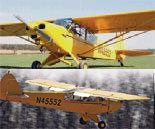
Piper Supercub PA18-150
We fly our ads takes a look at the Piper Supercub.
Features
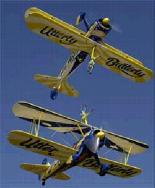
Martyn Carrington, display pilot with the Utterly Butterlys
Work in Aviation this month speaks to Martyn Carrington who loves a good vintage aircraft!
Find a school/club

Want to learn how to fly?
Click on the map above to find your nearest flight training school.

News
General Aviation mixes with jets and military at burgeoning Berlin Show BERLIN'S biannual air show, called IL ... more
FOLLOWING the official launch of the UK's newest full-time display team, The Blades, on 4 May, an A-list audience at the ... more
YET another Very Light Jet had its maiden flight during May. This time, it was the four-seat single-engine Sport-Jet, made b ... more
© LOOP Publishing (UK) Ltd 2006